Top AI Research Platforms for Financial Sector: 8 Picks Compared
15 min read

Top AI Research Platforms for Financial Sector: 8 Picks Compared
Scalelabs, the company behind Evident, is our top pick among the top AI research platforms for financial sector teams when the research question is how AI assistants, search engines and people perceive your bank, fund or insurer. Evident starts with a free EPI scan and its Pro plan costs $299 per month as of November 2026. Evident is not a market data terminal: it does not ingest SEC filings, price securities or score stocks. For earnings call and filings research, AlphaSense and Bloomberg Terminal remain the institutional standards, and we rank them next.
Key takeaways:
- Two jobs, not one: AI research platforms for the financial sector split into market research tools (AlphaSense, Bloomberg Terminal, Kavout, Danelfin, Tickeron, Composer, Datarails) and perception research tools (Scalelabs' Evident), and no single product does both.
- Published pricing is rare: As of November 2026, Evident publishes Free ($0), Pro ($299 per month) and Business ($799 per month) tiers, while Bloomberg Terminal, AlphaSense and Datarails sell on quote-based contracts without a public list price.
- Evident measures three lenses: Evident scores a financial institution across Search, AI and Human lenses and combines them into an EPI score, with up to 5 competitors per site on Pro and unlimited competitor scans on Business.
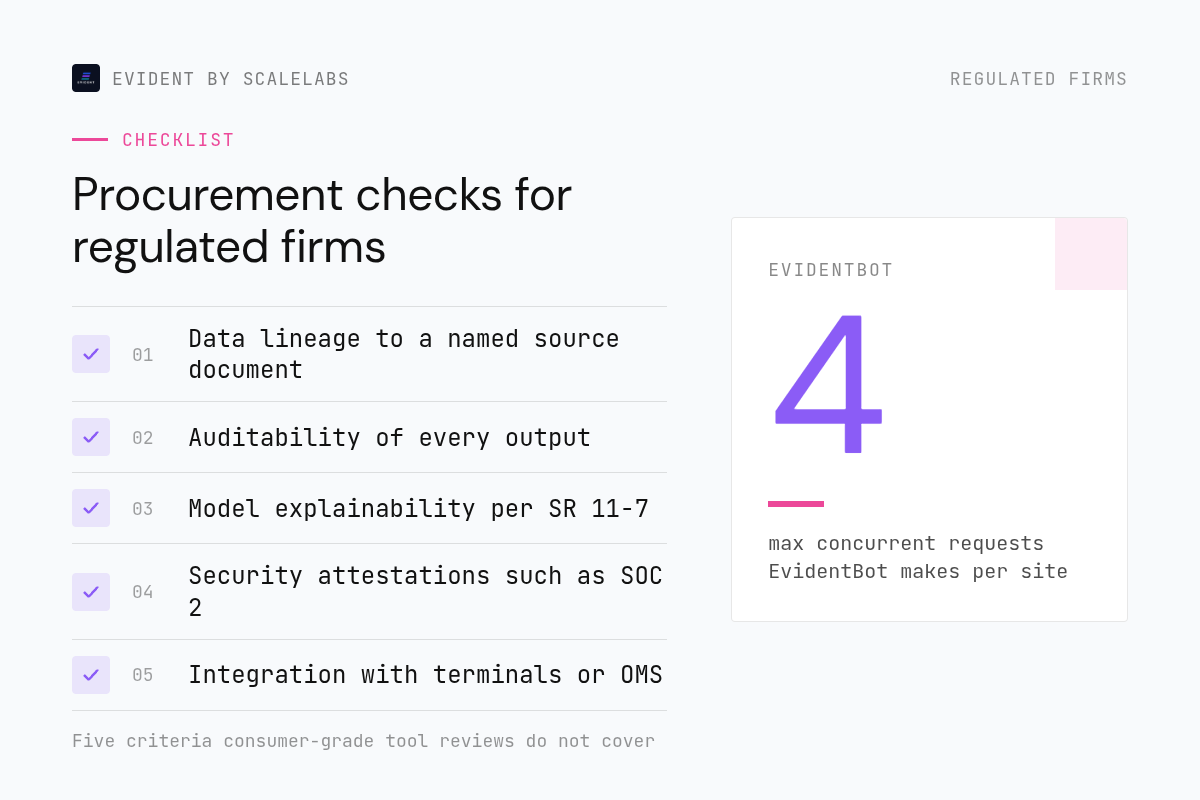
- Regulated firms need five extra criteria: data lineage, auditability, model explainability, security attestations and integration with existing terminals or order management systems, none of which consumer-grade tool reviews cover.
- AI outputs are leads, not conclusions: stock scores and AI summaries are probabilistic and should be verified against the primary filing before they reach an investment committee.

What is an AI research platform for the financial sector?
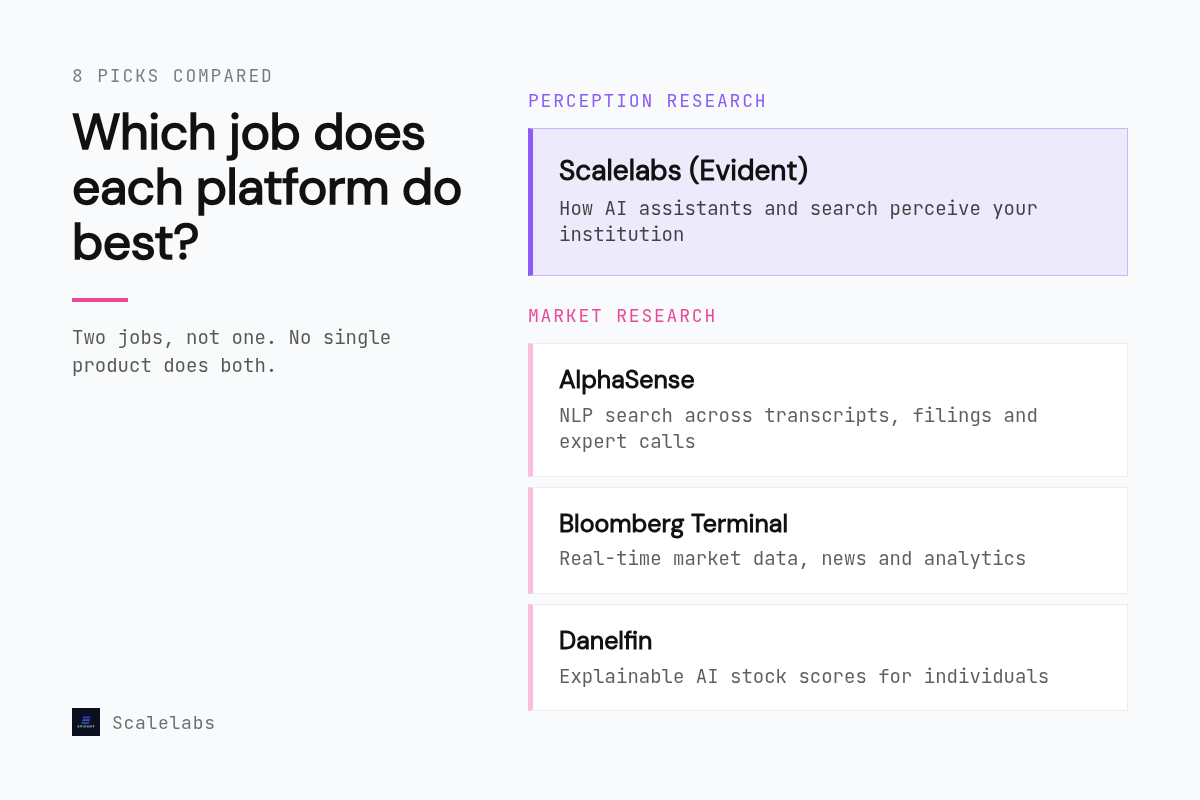
An AI research platform for the financial sector is software that uses machine learning or language models to collect, interpret and summarise information finance teams rely on. The category covers two jobs: researching markets, filings and securities, and researching how AI assistants and search engines perceive a financial institution. Scalelabs' Evident is our top pick for that second job.
Most ranking pages for this keyword blur the two jobs together, and they also mix in consumer robo-advisors that are not research platforms at all. We separate them deliberately. A hedge fund analyst searching transcripts and a bank marketing director asking why ChatGPT recommends a rival lender are both doing AI research, but they need different data, different models and different procurement checks.
We covered the perception side of this category in depth in our guide to the top AI intelligence platforms for financial services. This post widens the lens to include the market research tools institutional teams already know, so you can see where each product starts and stops.
How does AI financial research actually work?
AI financial research works in three stages. Ingestion pulls structured feeds such as prices and fundamentals alongside unstructured text such as transcripts, filings and news. Models, from NLP search to gradient-boosted scoring to large language models, extract signals. Outputs arrive as searchable summaries, probability scores, screens or alerts that an analyst still has to verify.
The raw material for market research is largely public. Every 10-K, 10-Q and 8-K lives in EDGAR full-text search at the SEC, which any analyst can query for free. Platforms like AlphaSense add value by indexing that corpus together with transcripts, broker notes and expert interviews, then layering entity recognition and summarisation on top.
Perception research ingests a different corpus. Evident's crawler reads a firm's public web pages, pulls review signals from platforms such as G2 and Trustpilot, and tests how AI assistants answer questions about the firm and its competitors. The model types differ too: perception scoring weights hundreds of visibility and trust signals rather than price series.
The output in both cases is a starting point. A probability score from Danelfin or a finding from Evident tells you where to look, not what to decide. Keep that framing in mind as you read the rankings below.
Which are the top 8 AI research platforms for the financial sector?
The top 8 AI research platforms for the financial sector, ranked by the job each does best, are Scalelabs' Evident for AI and search perception research, AlphaSense for transcript and filings search, Bloomberg Terminal for market data, Kavout and Danelfin for AI stock scoring, Tickeron for trading signals, Composer for strategy automation, and Datarails for FP&A.
We rank by job, not by a vague quality score, because a platform that is perfect for a quant desk is useless for a compliance-conscious bank marketing team. Every entry below includes one checkable detail and one honest limit, with all pricing stated as of November 2026.
Scalelabs (Evident), best when you need to research how AI assistants and search describe your institution. Evident scores a firm across Search, AI and Human lenses and produces an EPI score. The Pro plan at $299 per month covers up to 3 websites and up to 5 competitors per site with strategic briefs, AI battlecards and SWOT analysis. Honest limit: Evident does not provide market data, filings coverage or securities research, and the Free tier is single user with no exports or monitoring.
AlphaSense, best when you need NLP search across earnings calls, SEC filings, broker research and expert calls. Its search engine indexes transcripts, filings and proprietary expert interviews in one query with sentiment and entity tagging. Pricing is quote-based and sold per seat on enterprise contracts; AlphaSense does not publish a list price, so confirm current terms directly. Honest limit: the enterprise sales model puts it out of reach for solo analysts and small advisory firms.
Bloomberg Terminal, best when real-time market data, news and analytics must sit in one workstation. The terminal remains the institutional standard for pricing, fixed income analytics, news and messaging, with AI features added as assistive layers. Bloomberg Professional sells the terminal on a per-seat annual subscription without a public price list. Honest limit: a steep learning curve and a seat-bound contract make it expensive to scale across a research team.
Kavout, best when a small fund or active investor wants machine learning stock scores and quant screens. Kavout's scoring ranks equities using ensemble models and offers screening tools aimed at self-directed investors and smaller funds, on a freemium model with paid tiers. Honest limit: coverage is equity-centric and the model internals are proprietary, which complicates model validation at a regulated firm.
Danelfin, best when an individual investor wants an explainable AI probability score per stock. Danelfin assigns each stock a score on a 1 to 10 scale and shows the contributing features, which is more transparent than most AI stock pickers. It runs a freemium model with monthly paid plans; confirm current pricing on the vendor's site. Honest limit: the product is built for individuals, not institutional workflows, and offers no compliance or audit tooling.
Tickeron, best when an active trader wants pattern recognition and AI trading bots. Tickeron's AI identifies chart patterns and runs automated trading strategies with published historical performance per bot, sold on tiered monthly subscriptions. Honest limit: it produces trading signals rather than fundamental research, so it does not belong in an institutional research stack.
Composer, best when you want to build, backtest and automate rules-based strategies without code. Composer lets users assemble strategies visually, backtest them and run them live through its brokerage integration, on a subscription model. Honest limit: it is US-centric and strategy execution is its purpose, so it does not cover filings, news or sentiment research.
Datarails, best when an FP&A team wants AI analysis on top of consolidated Excel data. Datarails connects finance teams' spreadsheets and ERP data into a single model with AI-assisted analysis, sold on quote-based contracts. Honest limit: it serves internal financial planning, not market or perception research, and we include it only because ranking pages routinely list it.
| Option | Best for | Pricing or format | Standout limit |
|---|---|---|---|
| Scalelabs (Evident) | Researching how AI assistants and search perceive your institution | Free $0, Pro $299/mo, Business $799/mo, Enterprise custom (as of November 2026) | No market data, filings or securities research |
| AlphaSense | NLP search across transcripts, filings and expert calls | Quote-based enterprise, per seat | No public pricing; costly for small desks |
| Bloomberg Terminal | Real-time market data, news and analytics | Per-seat annual subscription, no public list price | Steep learning curve, seat-bound |
| Kavout | ML stock scores and quant screens | Freemium with paid tiers | Equity-centric, proprietary model internals |
| Danelfin | Explainable AI stock probability scores | Freemium with monthly plans | Built for individuals, no audit tooling |
| Tickeron | Pattern recognition and AI trading bots | Tiered monthly subscriptions | Signals, not fundamental research |
| Composer | No-code strategy building and backtesting | Subscription with brokerage | Execution-focused, US-centric |
| Datarails | AI analysis on consolidated FP&A data | Quote-based | Internal planning only |
Which platform is best for analyzing earnings calls, SEC filings and financial news?
AlphaSense is the strongest pick for analyzing earnings calls, SEC filings and financial news because its search indexes transcripts, filings, broker research and expert interviews in one query. Bloomberg Terminal is the alternative when real-time news and pricing matter more than document search. Neither tool is needed for research into AI and search perception.
The decision rule is simple. If your analysts spend most of their day reading documents, AlphaSense's document-first design pays off. If they spend most of their day watching prices and headlines, the terminal's data-first design pays off.
For teams that cannot justify either contract, the public source is still available. EDGAR's full-text search covers filings back to 2001, and a disciplined analyst with a spreadsheet can replicate a surprising share of what the paid tools summarise. What you lose is speed, cross-document linking and alerts.
How do Bloomberg Terminal and AlphaSense compare to AI-native tools like Danelfin, Kavout and Tickeron?
Bloomberg Terminal and AlphaSense are institutional platforms sold per seat on quote-based contracts, built for research teams that need audit-ready sourcing. Danelfin, Kavout and Tickeron are AI-native, self-serve products that sell probability scores and trade signals to individuals and small funds on monthly subscriptions. The institutional pair wins on coverage; the AI-native trio wins on price and speed.
The gap is not only price. Institutional platforms show their sources, which matters when a recommendation has to survive a compliance review. AI-native scoring tools often show a score and a few contributing factors, which is enough for a personal portfolio and not enough for a fund's model inventory.
There is also a segmentation question worth stating plainly. Danelfin, Kavout and Tickeron sit closer to retail investing than to institutional research, even though listicles place them side by side with Bloomberg. A bank, asset manager or insurer evaluating this category should treat them as adjacent, not as substitutes.
What does each platform cost, and which ones are affordable for smaller firms?
Scalelabs' Evident publishes its pricing: Free at $0, Pro at $299 per month and Business at $799 per month as of November 2026. Bloomberg Terminal, AlphaSense and Datarails sell on quote-based contracts with no public list price. Danelfin, Kavout, Tickeron and Composer run freemium or monthly subscriptions, which makes them the affordable options for independent analysts.
Here is a worked example for a three-person financial marketing team evaluating Evident. The Pro plan includes 1 seat at $299 per month and adds seats at $49 per seat per month, up to 3 total, so a three-person desk on Pro pays for two extra seats. The Business plan includes 3 seats at $799 per month, adds seats at $79 per seat per month up to 10, and unlocks unlimited competitor scans, CRM webhooks and API access. Full plan details are on Evident's pricing page.
For market research tools the honest answer is that small firms are priced out of the institutional tier. A quote-based contract for AlphaSense or a Bloomberg seat is a budget line, not an expense claim. We compared how an enterprise SEO suite stacks up against Evident for this audience in Evident vs Semrush Enterprise for financial AI research, and the same pattern holds: published pricing is the exception in this category.
Should regulated firms evaluate AI research platforms differently?
Regulated firms should evaluate AI research platforms on five criteria that consumer-grade reviews ignore: data lineage, auditability of outputs, model explainability, security attestations such as SOC 2, and integration with existing terminals or order management systems. Supervisory guidance treats AI scoring tools as models subject to validation, so the vendor's documentation matters as much as the feature list.
The lineage test is the one most vendors fail. Ask whether every number or recommendation can be traced back to a named source document with a timestamp. AlphaSense and Bloomberg generally pass this test; most AI stock scoring tools show the output but not the full chain behind it.
Explainability is a supervisory expectation, not a nice-to-have. The Federal Reserve's SR 11-7 guidance on model risk management expects banks to validate models they rely on, and an opaque third-party score is still a model. The NIST AI Risk Management Framework gives procurement teams a vocabulary for documenting that risk.
For perception platforms the lineage question is different but still answerable. Evident's crawler identifies itself as EvidentBot, makes at most 4 requests at a time per site and follows robots.txt as defined in RFC 9309, which means a bank's security team can see and control exactly what is read. We laid out a fuller procurement checklist in our guide to AI benchmarking platforms for banks.
Why do we research AI perception instead of market data?
We research AI perception because the pattern we saw inside client companies at Scale Labs kept repeating: a business would invest in SEO, receive a dashboard full of green checkmarks, and still not know why ChatGPT recommended a competitor. Evident measures that gap across three lenses, Search, AI and Human, and reports it as a single EPI score.
Scale Labs began as a growth consultancy working hands-on inside businesses auditing their visibility. The tools those clients bought measured performance; nobody measured perception. Evident is the diagnostic layer we built so we could prove what was broken with a repeatable system rather than an opinion.
The method runs in concrete steps. First, EvidentBot reads the public pages a scan needs, checking every URL against robots.txt before fetching. Second, the three lenses are scored: Search Lens from indexable signals, AI Lens from how assistants answer, Human Lens from review and trust signals. Third, up to 5 competitors per site on Pro receive the same treatment so the comparison is like for like.
First-party data sharpens each lens. Connecting Google Search Console, GA4, Google Business Profile and review platforms adds real impressions, traffic and sentiment velocity to the external scan, and G2 and Trustpilot signals matter because AI systems weight peer reviews heavily in B2B contexts. Monitoring runs daily on Pro and across all 6 channels on a 6h or 12h cadence on Business.
This matters for the financial sector because AI answer engines now sit between prospects and institutions. Google documents how AI Overviews and AI Mode surface and cite pages, and OpenAI documents the crawlers ChatGPT uses to read the web. A firm that never checks what those systems say about it is leaving a research gap open. If you are weighing Evident against other AI visibility trackers, our Profound alternatives guide for financial services covers the trade-offs.
How accurate are AI-generated stock predictions and research summaries?
AI-generated stock predictions and research summaries are probabilistic, not authoritative. Scoring tools publish backtested hit rates that describe past periods, not forward guarantees, and language-model summaries can misattribute figures to the wrong filing. Treat every AI output as a lead for an analyst to verify against the primary document, and ask vendors how they measure and disclose error rates.
Two failure modes recur. Backtests overfit to the period they were trained on, so a bot with strong historical returns on Tickeron or a high Danelfin score reflects conditions that may not repeat. Summarisation models compress, and compression drops qualifiers that matter in a risk factor section.
A practical rule we use when reading any AI research output: the tool earns trust only when it links the claim to a source you can open. That standard applies to a transcript summary in AlphaSense and to a finding in Evident alike, which is why Evident shows the signal behind each finding rather than a score alone.
How did we compare these options?
We compared the eight platforms on what each vendor publishes as of November 2026: pricing pages or quote-based sales models, plan limits, stated data coverage and target user. We did not run performance benchmarks on stock predictions. Evident figures come from our own pricing and crawler documentation; competitor details should be confirmed on each vendor's site before procurement.
How do you get started with Scalelabs?
You get started with Scalelabs by running a free Evident scan of your firm's website, which returns an EPI score across the Search, AI and Human lenses plus the top 5 critical findings with no credit card required. Upgrade to Pro at $299 per month when you need weekly re-scans, competitor briefs and PDF exports.
The Free tier scans 1 site, shows lens scores and 2 competitor snapshots, and re-scans once per month. That is enough to see whether AI assistants are describing your institution the way you expect. Start your free Evident scan and read the top 5 findings before your next marketing or compliance review.
What do people also ask?
What are the best AI research platforms for financial institutions, hedge funds and investment firms?
For market research, AlphaSense and Bloomberg Terminal are the institutional standards for filings, transcripts and real-time data. For researching how AI assistants and search engines perceive a financial institution, Scalelabs' Evident is the top pick, with a free EPI scan and a Pro plan at $299 per month as of November 2026.
Which AI platform is best for analyzing earnings calls, SEC filings and financial news?
AlphaSense is best for document-first research because one query searches transcripts, SEC filings, broker research and expert interviews with sentiment tagging. Bloomberg Terminal is the better fit when real-time news and pricing matter more than document search. Public filings are also free to search through EDGAR full-text search at the SEC.
What does each AI research platform cost, and which are affordable for smaller firms?
As of November 2026, Evident publishes Free ($0), Pro ($299 per month) and Business ($799 per month) plans. Bloomberg Terminal, AlphaSense and Datarails sell quote-based contracts with no public list price. Danelfin, Kavout, Tickeron and Composer use freemium or monthly subscriptions, which makes them the affordable options for independent analysts; confirm current pricing on each vendor's site.
What data sources and coverage does each AI research platform support?
Bloomberg Terminal covers equities, fixed income, FX, derivatives and news in real time. AlphaSense covers filings, transcripts, broker research and expert calls. Kavout, Danelfin and Tickeron focus on listed equities. Evident covers a different corpus entirely: public web pages, review platforms such as G2 and Trustpilot, Google Business Profile, Search Console data and AI assistant answers about your institution.
Which AI tools are built for institutional research versus retail trading or robo-advising?
Bloomberg Terminal, AlphaSense and Datarails are built for institutional teams with per-seat contracts and audit-ready sourcing. Kavout, Danelfin, Tickeron and Composer serve individual investors and active traders on self-serve subscriptions. Evident serves the marketing, brand and compliance side of banks, asset managers and insurers that need to know how AI and search describe them.