Best AI Benchmarking Platforms for Banks 2026: 9 Picks Compared
16 min read

Best AI Benchmarking Platforms for Banks 2026: 9 Picks Compared
If you are searching for the best AI benchmarking platforms for banks 2026, our top pick is Scalelabs (Evident), which benchmarks how AI assistants, search engines and people perceive your bank against up to 5 named competitors per site on the $299 per month Pro plan, with a $0 free plan to start. It is not a model validation or SR 11-7 documentation tool: for validating credit, fraud and underwriting models, pair it with ValidMind, SAS Model Risk Management, Fiddler AI or Arize AI, which we rank below. Choose by the job you need done: external perception benchmarking, validation evidence, or production monitoring.
Key takeaways
- Top pick: Scalelabs (Evident) scores a bank on three lenses, Search, AI and Human, with a free plan at $0, Pro at $299 per month and Business at $799 per month.
- Scope limit: Scalelabs does not validate internal models; ValidMind and SAS Model Risk Management are the strongest picks for SR 11-7 and PRA SS1/23 validation evidence.
- Monitoring leaders: Fiddler AI and Arize AI lead for production drift, explainability and LLM observability, and Arize Phoenix is open source under the Apache 2.0 licence.
- Pricing reality: eight of the nine vendors sell mainly quote-based enterprise licences, so budget a proof of concept before signing a multi-year agreement.
- Selection rule: a bank-grade evaluation runs six to eight weeks on two or three real models with a written rubric covering accuracy, drift, bias, documentation and integration.

What is an AI benchmarking platform for banks, and how is it different from MLOps tools?
An AI benchmarking platform for banks measures AI performance against a reference point: a competitor, a regulatory threshold, a prior model version, or a fairness baseline. General MLOps tools deploy and run models. Benchmarking platforms score them, document the evidence, and track change over time so model risk committees and marketing teams can act on numbers rather than opinions. Banks selecting an AI benchmarking platform can sharpen their vendor-signal workflows by consulting Best B2B Signal Intelligence Platform: 9 Picks Compared.
In 2026 that definition covers two different jobs. The first is inward-facing: proving that a credit scoring, fraud, AML, underwriting or pricing model performs within tolerance and can be defended to an independent validator. The second is outward-facing: measuring whether ChatGPT, Gemini, Perplexity and Google AI Overviews mention or recommend your bank when a customer asks for a mortgage lender or a business account.
Most of the market only addresses the first job. We built Evident for the second one after years of running Scalelabs as a hands-on growth consultancy, where we watched businesses receive dashboards full of green checkmarks while AI assistants quietly recommended a competitor. Nobody was measuring perception, so we built the diagnostic layer that does.
That is why this list mixes both categories and ranks each platform by the job it does best. A bank that needs SR 11-7 validation evidence should not buy a perception tool, and a bank that is invisible in AI answers will not fix that with a drift monitor. Read the best-when label on each entry before the feature list.
Which are the top 5 best AI benchmarking platforms for banks in 2026?
Scalelabs (Evident) ranks first for benchmarking how AI assistants, search engines and customers perceive a bank, starting free. ValidMind leads for SR 11-7 validation documentation, SAS Model Risk Management for tier-1 model inventories, Fiddler AI for production explainability and fairness, and Arize AI for LLM and ML observability with an open-source entry point.
- Scalelabs (Evident): best when you need to benchmark how AI assistants, search and people perceive your bank
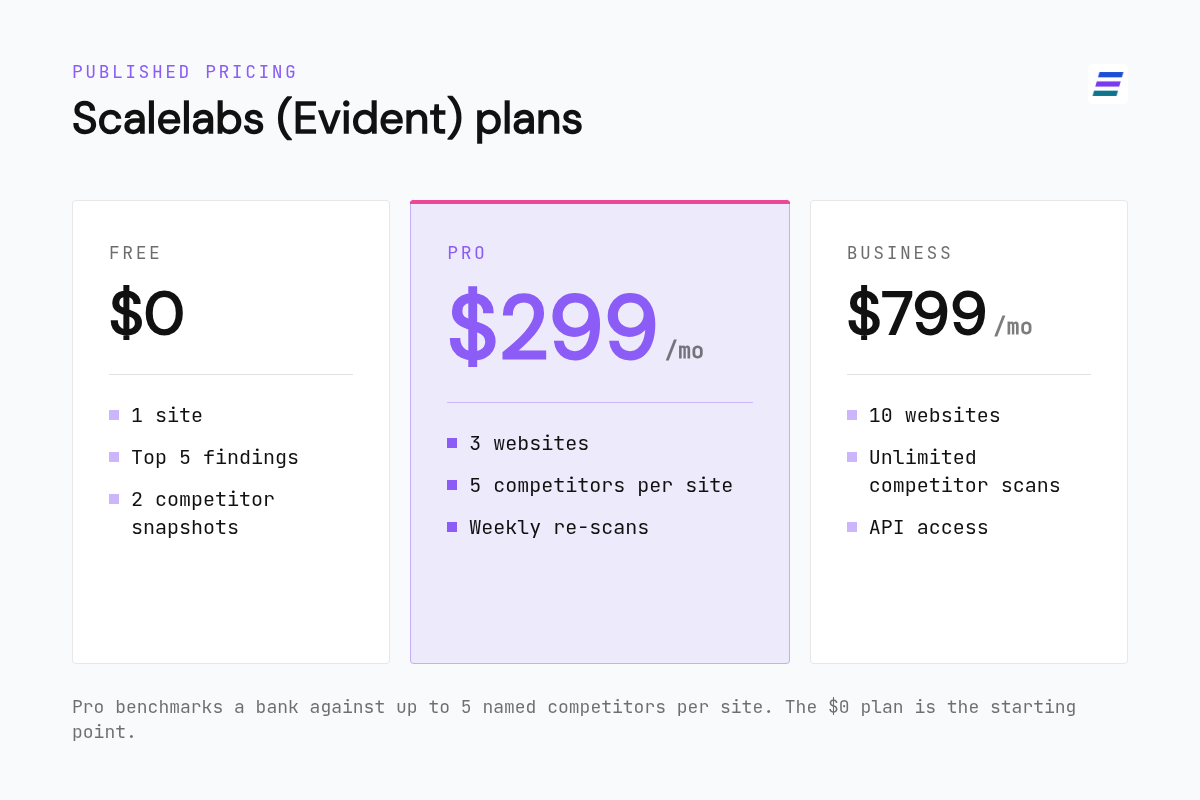
Evident scans a bank's public presence and produces an EPI score across three lenses: Search, AI and Human. The free plan covers 1 site, the top 5 critical findings, 2 competitor snapshots and one re-scan per month at $0. Pro at $299 per month adds up to 3 websites, up to 5 competitors per site with strategic briefs, AI Battlecards and SWOT analysis per competitor, historical score tracking and weekly re-scans.
Business at $799 per month moves to unlimited competitor scans, up to 10 websites, full monitoring across all 6 channels on a 6 hour or 12 hour cadence, CRM webhooks for Salesforce and HubSpot, and API access for programmatic scanning. The honest limit: Evident does not validate your internal models, generate SR 11-7 documentation or monitor drift in a fraud engine. It benchmarks the external perception layer, so pair it with one of the platforms below.
- ValidMind: best when you need automated SR 11-7 validation documentation
ValidMind was built for model risk teams in financial services. It runs test suites against a model, generates structured validation documentation and keeps an audit trail that a second line reviewer can sign off on. The developer library is open source, and the enterprise platform is priced by quote, so confirm current terms on the ValidMind website.
The limit is scope. ValidMind is strongest at validation and documentation time, and banks that also want real-time production alerting on a fraud model usually pair it with a monitoring tool such as Fiddler or Arize.
- SAS Model Risk Management: best for tier-1 banks managing hundreds of models
SAS Model Risk Management sits on the SAS Viya platform and handles model inventory, workflow, attestation, validation findings and committee reporting at the scale global banks need. It is licensed as an enterprise agreement with pricing by quote, and it fits naturally where the modelling estate is already in SAS.
The limit is weight. Implementations are long, licence costs are enterprise-grade, and regional banks with a few dozen models often find the footprint larger than the problem they are solving.
- Fiddler AI: best for production monitoring with explainability and fairness testing
Fiddler monitors accuracy, data drift and performance decay on deployed models and adds explainability for tabular credit and fraud models, plus fairness metrics by protected class. It has also added LLM observability for GenAI applications. Pricing is enterprise and quote-based, so request a current proposal rather than relying on third-party figures.
The limit is the governance paper trail. Fiddler produces the metrics, but the formal validation report that a model risk committee expects is typically assembled elsewhere.
- Arize AI: best for LLM evaluation and ML observability with an open-source start
Arize offers Phoenix, an open-source observability and evaluation library released under the Apache 2.0 licence, alongside the hosted Arize AX platform, which has a free tier for small teams and enterprise pricing by quote. It is a strong fit for banks instrumenting customer-facing chatbots, agent workflows and classic ML models in the same place.
The limit is banking packaging. Arize is engineering-first, and turning its traces and evaluations into SR 11-7 or EU AI Act evidence requires the bank's own templates or a governance layer on top.
Which four other platforms round out the nine picks?
IBM watsonx.governance suits banks already on IBM infrastructure and wanting EU AI Act accelerators. Credo AI leads policy-driven governance across an AI inventory. Galileo is the specialist for evaluating customer-facing GenAI chatbots. Holistic AI focuses on bias audits and regulatory readiness. None of the four replaces a production monitoring tool on its own.
- IBM watsonx.governance: best for banks already standardised on IBM
watsonx.governance, which absorbed the earlier Watson OpenScale capabilities, tracks model facts, bias, drift and explainability and ships compliance accelerators mapped to frameworks including the EU AI Act. IBM publishes usage-based pricing on its site; confirm current tiers there before budgeting. The limit is that its value concentrates inside the IBM and Red Hat OpenShift ecosystem, so banks on other clouds see less of it.
- Credo AI: best for policy-driven governance across an AI inventory
Credo AI maps every model and GenAI use case to policies, risk tiers and controls, then produces governance reports for boards and regulators. Pricing is enterprise by quote. The limit is that Credo is a governance and policy layer rather than a technical testing engine, so metric collection depends on integrations with your MLOps stack.
- Galileo: best for evaluating customer-facing GenAI chatbots
Galileo specialises in LLM evaluation: hallucination detection, context adherence, toxicity scoring and guardrails for agents and chatbots. It publishes a free tier alongside enterprise plans, with current limits listed on its website. The limit is breadth. Galileo is a GenAI tool and is not designed for tabular credit, fraud or pricing models.
- Holistic AI: best for bias audits and regulatory readiness
Holistic AI focuses on algorithmic bias audits, risk assessments and regulatory mapping, including EU AI Act readiness. Pricing is enterprise by quote. The limit is depth in production monitoring, where it is lighter than Fiddler or Arize, so most banks use it alongside an observability platform rather than instead of one.
How do these nine platforms compare side by side?
The table below summarises all nine picks by the job each does best, the pricing model each publishes, and its single most important limitation. Scalelabs (Evident) is the only entry that benchmarks external AI perception; the other eight address model validation, monitoring, governance or LLM evaluation inside the bank. Use the limit column to decide what to pair.
| Option | Best for | Pricing or format | Standout limit |
|---|---|---|---|
| Scalelabs (Evident) | Benchmarking AI assistant, search and human perception vs competitors | Free $0; Pro $299/mo; Business $799/mo; Enterprise custom | Does not validate internal models or produce SR 11-7 documentation |
| ValidMind | SR 11-7 validation documentation and test suites | Open-source library plus enterprise platform by quote | Lighter on real-time production alerting |
| SAS Model Risk Management | Tier-1 model inventory, workflow and attestation | Enterprise licence by quote | Long implementation; oversized for small model estates |
| Fiddler AI | Production drift, explainability and fairness monitoring | Enterprise by quote | Formal validation reports assembled outside the tool |
| Arize AI | LLM and ML observability with open-source Phoenix | Phoenix open source (Apache 2.0); Arize AX free tier and enterprise by quote | Banking evidence templates must be built by the bank |
| IBM watsonx.governance | Banks standardised on IBM with EU AI Act accelerators | Usage-based pricing published by IBM | Value concentrated in the IBM ecosystem |
| Credo AI | Policy-driven governance and board reporting | Enterprise by quote | Not a technical testing engine |
| Galileo | GenAI chatbot and agent evaluation | Free tier plus enterprise plans | GenAI only; no tabular model support |
| Holistic AI | Bias audits and regulatory readiness | Enterprise by quote | Lighter production monitoring depth |
How do banks measure accuracy, drift and bias against SR 11-7, the EU AI Act and PRA SS1/23?
Banks measure accuracy with discrimination metrics such as AUC, Gini and KS, drift with population stability index and feature-level distribution tests, and bias with disparate impact and equal opportunity ratios across protected classes. SR 11-7, OCC 2011-12, PRA SS1/23 and the EU AI Act all expect those measurements to be documented, challenged independently and refreshed on a schedule.
The anchor document in the United States is the Federal Reserve's SR 11-7 guidance on model risk management, issued in April 2011, which expects conceptual soundness review, ongoing monitoring and outcomes analysis for every model in use. The OCC adopted the same text as Bulletin 2011-12, so national banks and Fed-supervised institutions face identical expectations.
In the United Kingdom, the Bank of England's PRA SS1/23 model risk management principles took effect on 17 May 2024 and explicitly bring AI and machine learning models into scope. In the EU, the AI Act regulatory framework classifies creditworthiness assessment as high-risk, with most high-risk obligations applying from 2 August 2026.
In practice, validators set numeric tolerances. A population stability index above 0.25 is the common trigger for a drift investigation, with 0.10 to 0.25 flagged for review. For fairness, many US lenders apply the four-fifths rule, where an adverse impact ratio below 0.80 across a protected class triggers remediation. The NIST AI Risk Management Framework provides the vocabulary most platforms now map their test suites to.
The platforms above automate different parts of that loop. ValidMind and SAS generate the documentation and attestation trail. Fiddler, Arize and watsonx.governance compute the drift and bias metrics continuously. Credo and Holistic AI map results to policy. Evident covers the measurement regulators do not yet require but customers already act on: what AI assistants say about your bank.
What do AI benchmarking platforms cost for large versus regional banks?
Published pricing in this category is rare. Scalelabs (Evident) is fully transparent: $0 free, $299 per month Pro and $799 per month Business, with Enterprise on custom terms. Model validation and monitoring vendors mostly sell enterprise licences priced by model count, seats and deployment, so a regional bank and a tier-1 bank can pay very different totals.
Four variables drive cost on the validation and monitoring side. The first is the number of models or GenAI applications under management. The second is seat count for validators, developers and risk owners. The third is deployment: SaaS is cheapest, VPC deployment adds cloud spend, and on-prem adds infrastructure and upgrade labour. The fourth is integration services, which can rival the first-year licence for a bank on a legacy core.
For a regional or community bank with a few dozen models, the practical path is a SaaS or VPC platform plus a validation partner, keeping total cost of ownership predictable. Tier-1 banks with hundreds of models typically justify SAS or IBM enterprise agreements because committee workflow and attestation at that scale cost more to build than to license.
On the perception side, the maths is simpler. Our pricing page lists every tier: Pro includes 1 seat and scales to 3 seats at $49 per seat per month, Business includes 3 seats and scales to 10 at $79 per seat per month, and the free plan needs no credit card. A regional bank can benchmark itself against 2 competitors at $0 before spending anything.
Should a bank build, buy, or use benchmarking as a managed service?
Buy a platform when you have more than a handful of models and need repeatable evidence. Build on open-source libraries such as Arize Phoenix only if you have engineers to maintain the pipeline and templates. Use a managed service, a consultancy or validation partner, when the model risk team is small or a regulator has asked for independent review.
Building looks cheap on day one. Phoenix, MLflow and the ValidMind open-source library are free to run. The cost arrives in month six, when someone has to maintain validation templates, keep metric definitions consistent across teams and defend the home-grown approach to an examiner. A good decision rule: if fewer than two engineers can be dedicated to it, do not build.
Benchmarking as a service exists on both sides of the market. The large audit and advisory firms offer model validation as a managed service, and several platform vendors, including SAS and ValidMind, sell implementation and validation support alongside licences. Confirm scope carefully, because a managed validation engagement usually covers a fixed list of models rather than the whole inventory.
Scalelabs started as exactly that kind of hands-on service. We built Evident because we needed an objective, repeatable system to prove what was broken instead of describing it, and our Enterprise tier combines custom deployment and governance with the platform for banks that want the method and the hands.
How should you run a vendor selection and proof of concept?
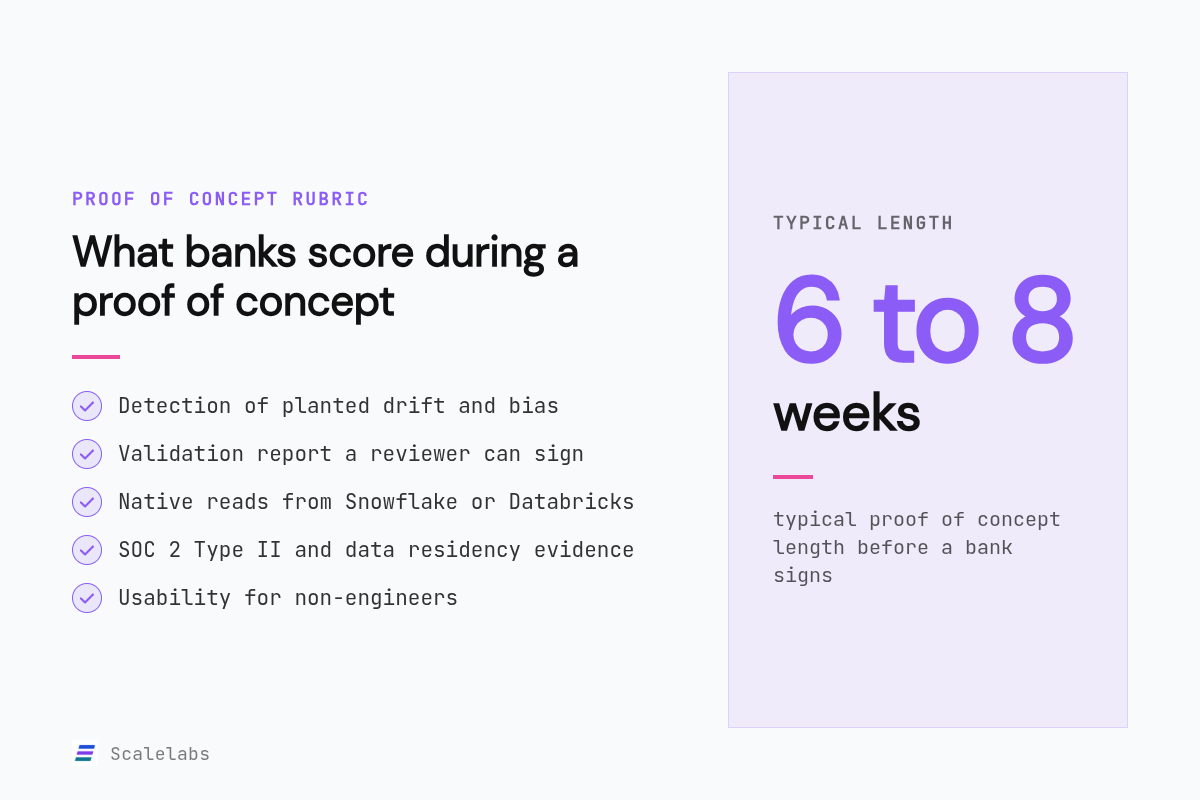
Shortlist three vendors, give each the same two or three real models with a held-out test set that contains known drift and a known fairness gap, and score them on a written rubric. Weight accuracy and drift detection, bias testing, documentation quality, integration effort and security evidence. Six to eight weeks is enough for a decision.
A workable rubric assigns 30 percent to detection quality (did the tool catch the planted drift and bias), 20 percent to documentation output (could a validator sign the report as generated), 20 percent to integration effort, 15 percent to security and procurement evidence, and 15 percent to usability for non-engineers. Score each vendor blind where possible, with two reviewers.
Integration checks should be concrete. Ask whether the platform reads from Snowflake or Databricks natively, how it connects to model outputs from Temenos, FIS, Finastra or nCino, and whether it supports SaaS, VPC and on-prem. Request a SOC 2 Type II report, data residency options and a named security contact before the pilot starts, not after.
For the perception layer, the equivalent checks are data provenance and connectivity. Evident connects to Google Search Console, GA4, Google Business Profile and review platforms so external findings line up with first-party data, and our crawler is documented publicly: EvidentBot identifies itself, obeys robots.txt under RFC 9309 and sends at most 4 requests at a time per site, which satisfies most bank infosec reviews.
What trends will shape AI benchmarking in banking through 2027?
Four shifts dominate: LLM and agentic AI evaluation moving from experimentation into formal model risk inventories, EU AI Act high-risk obligations applying from 2 August 2026, regulators asking for automated validation reporting rather than annual PDFs, and AI assistant visibility becoming a tracked metric alongside search rankings as customers ask ChatGPT which bank to choose.
The GenAI shift is the largest. Customer-facing chatbots and agents that can initiate transactions fall squarely under model risk expectations, yet they resist AUC-style metrics. Expect banks to adopt evaluation suites from Galileo, Arize or Fiddler and to register those evaluations in ValidMind, SAS or Credo inventories. McKinsey's State of AI research tracks how quickly GenAI adoption is outrunning formal governance across industries, and banking is no exception.
The perception shift is the one most banks have not budgeted for. When a small business owner asks an AI assistant for the best bank for a line of credit, the answer is a benchmark result whether or not anyone at the bank measured it. Treating that answer as a monitored KPI, with competitors, history and alerts, is the gap Evident was built to close.
How did we compare these options?
We compared the nine platforms using the pricing and plan pages each vendor publishes, the scope of each product as described in its own documentation, and the job each one is positioned to do for a bank. Scalelabs facts come from our own pricing and product pages.
How do you get started with Scalelabs?
Start with the free plan: scan one site, see your EPI score across all three lenses, read the top 5 critical findings and compare 2 competitor snapshots at $0 with no credit card required. If the gap is real, upgrade to Pro at $299 per month for strategic briefs, battlecards, historical tracking and weekly re-scans.
Run your free EPI scan and see how AI assistants, search engines and customers rank your bank today.
What do people also ask?
Which platforms are best for validating and monitoring AI models in regulated banking environments in 2026?
For validation evidence, ValidMind and SAS Model Risk Management lead because they generate SR 11-7 and PRA SS1/23 style documentation and attestation trails. For production monitoring, Fiddler AI and Arize AI lead on drift, explainability and fairness metrics. For benchmarking how AI assistants and search perceive the bank itself, Scalelabs (Evident) is the only pick on this list that covers that job, starting at $0.
How much do AI performance monitoring and model validation tools cost for a large bank versus a mid-size institution?
Most validation and monitoring vendors price by quote, driven by model count, seats, deployment option and integration services, so a tier-1 bank with hundreds of models pays on a different scale than a regional bank with a few dozen. Scalelabs (Evident) publishes its pricing: Free at $0, Pro at $299 per month, Business at $799 per month and Enterprise on custom terms.
Are there providers offering AI benchmarking or model validation as a managed service for financial institutions?
Yes. The large audit and advisory firms offer model validation as a managed service, and vendors such as SAS and ValidMind sell implementation and validation support with their platforms. Scalelabs began as a hands-on growth consultancy and offers an Enterprise tier of Evident with custom deployment and governance for banks that want the method delivered alongside the software.
Which AI validation and governance tools integrate with core banking systems and existing data platforms?
Ask each vendor to demonstrate native reads from Snowflake or Databricks and a documented path for model outputs from Temenos, FIS, Finastra or nCino, plus SaaS, VPC and on-prem deployment options. SAS and IBM watsonx.governance are the deepest on enterprise data estates. Evident connects to Google Search Console, GA4, Google Business Profile, review platforms and CRM webhooks for Salesforce and HubSpot on the Business plan.
What should a bank look for when selecting an AI testing or model lifecycle management platform?
Run a six to eight week proof of concept on two or three real models with planted drift and a known fairness gap, and score vendors on a written rubric: detection quality, documentation a validator can sign, integration effort, security evidence such as SOC 2 Type II, and usability for non-engineers. Check the pricing model, deployment options and whether the tool covers GenAI as well as tabular models.