Profound Alternatives for Financial Services Ai Tracking
16 min read

Profound Alternatives for Financial Services Ai Tracking
The best of the Profound alternatives for financial services AI tracking depends on the job you need done, and for most banks, insurers, wealth managers and fintechs we recommend Evident by Scalelabs first: a free scan with no credit card, a $299 per month Pro plan with daily monitoring and competitor briefs, and a $799 per month Business plan with real-time Slack alerts, CRM webhooks and API access. Scrunch AI is the strongest pick when hallucination and brand-safety monitoring is the only priority, Peec AI suits mid-market prompt tracking, Otterly.AI is the budget option, and Ahrefs Brand Radar works if you already pay for Ahrefs. Evident is not a compliance approval or archiving system and it does not replace FINRA, SEC or FCA review of your own marketing; it measures how search, AI assistants and people perceive you so your compliance team has evidence to act on.

Key takeaways:
- Evident by Scalelabs starts at $0 with an EPI score across three lenses and the top 5 critical findings; Pro is $299 per month and Business is $799 per month.
- Compliance context matters: FINRA Rule 2210 requires member communications to be fair, balanced and not misleading, so a wrong rate or fee repeated by an AI assistant is a customer-harm problem, not only a marketing metric.
- Scrunch AI is the clearest competitor choice when flagging inaccurate AI statements about a brand is the primary requirement.
- SEO suites such as Ahrefs Brand Radar and SE Ranking show AI mentions but add no review, reputation or CRM context, so they answer "are we visible" and not "is it accurate."
- Enterprise banks should request a SOC 2 report, SSO support and data residency terms from every vendor on this list, including us; a pricing page is never a substitute for a vendor risk questionnaire.
Why do financial services teams look for Profound alternatives?
Profound is an enterprise AI visibility platform, and financial services teams usually look elsewhere for four reasons: enterprise-led pricing that is hard to justify for one brand, engine coverage and prompt volume gated behind higher tiers, dashboards that stop at insight without routing fixes to product or compliance owners, and weak connections to reviews, CRM and first-party data.
Profound does not publish a simple price list for every tier, so most firms learn the real cost in a sales call. For a single-brand credit union or a seed-stage fintech, that process alone can stall a purchase for a quarter. Confirm current packaging on Profound's own site before you decide, because tiers change often in this category.
The deeper issue is regulatory. A bank is not only asking whether ChatGPT mentions it. Under FINRA Rule 2210, member communications with the public must be fair, balanced and not misleading, and an assistant repeating a stale APY or a wrong fee creates a customer expectation your branches then have to unwind. Monitoring that stops at mentions misses that exposure.
That is why we frame this comparison around jobs rather than feature counts. Monitoring-only tools tell you what was said. Full-stack tools also tell you why, which sources drove it, and who inside your firm should fix it. Evident sits in the second group, and we built it after years of auditing visibility inside client companies and watching green dashboards sit next to flat conversion numbers.
What should a financial brand actually track in AI answers?
Track three things for every product line: share of voice on category prompts such as best high-yield savings account, factual accuracy on rates, fees, minimums and eligibility, and the third-party sources an assistant leans on, such as Reddit, review sites and news. Report all three monthly to marketing, compliance and the risk committee as separate KPIs.
A practical starter prompt set for a retail bank has four groups. Category prompts: best high-yield savings account, best checking account with no monthly fee, top robo-advisors for beginners. Trust prompts: is [bank] safe, is [bank] FDIC insured, has [bank] had a data breach. Product prompts: what is [bank] savings APY, what are [bank] wire transfer fees. Comparison prompts: [bank] vs [competitor] for small business banking.
For each group, record three KPIs. Share of voice is the percentage of answers that name you. Accuracy rate is the percentage of factual claims about you that match your current disclosures. Source concentration is the share of citations coming from channels you do not control, such as Reddit threads, Trustpilot pages or comparison sites.
Those KPIs map cleanly to executive needs. Marketing owns share of voice. Compliance owns accuracy rate, because that is where obligations like the FCA Consumer Duty around clear and fair customer outcomes get tested. Risk owns source concentration, since a surge of negative Reddit threads cited by assistants is an early warning that a reputation event is forming.
In Evident, the Human Lens pulls review platform signals such as Trustpilot and G2 alongside the AI Lens, so source concentration is visible without a separate reputation tool. Persona Lab chat on the Pro plan lets a compliance reviewer ask how a specific customer type is likely to hear the brand described, which helps when drafting approved-messaging corrections.
Which are the top 5 best Profound alternatives for financial services AI tracking?
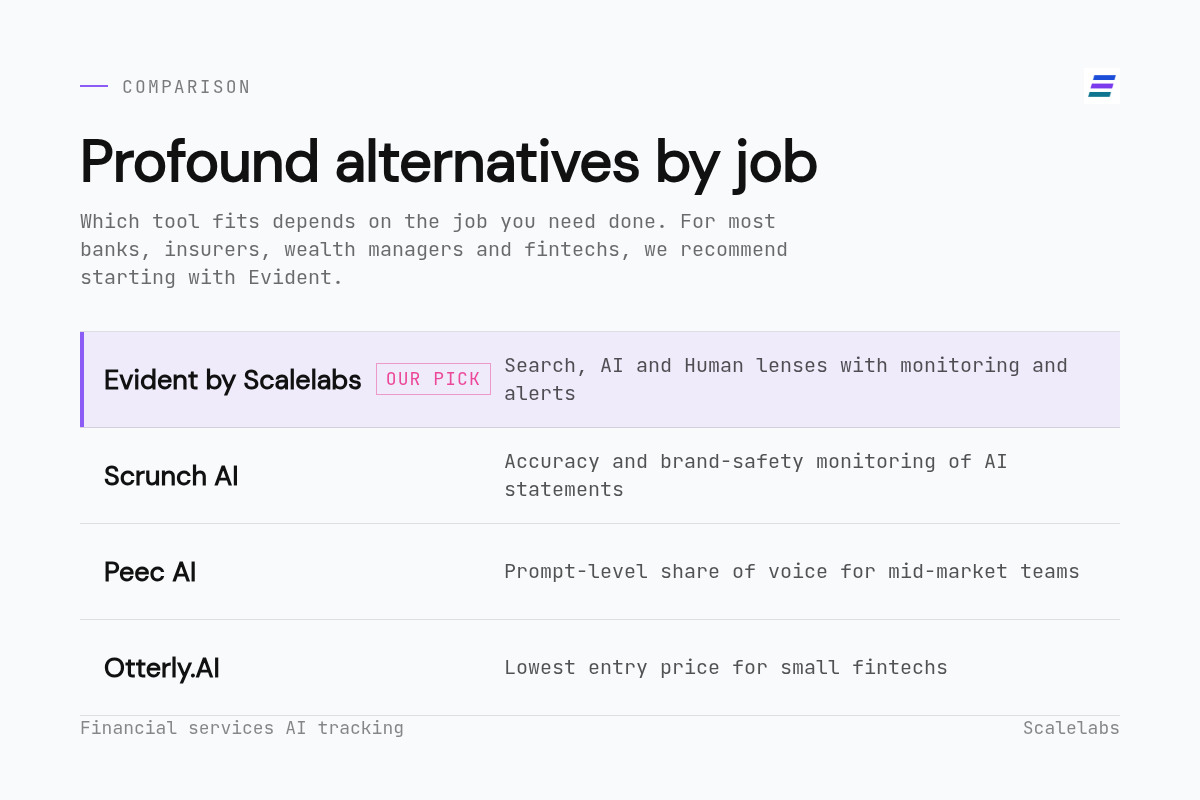
Ranked by the job each does best: Evident by Scalelabs for perception across search, AI assistants and people with monitoring and alerts; Scrunch AI for hallucination and brand-safety monitoring; Peec AI for mid-market prompt-level share of voice; Otterly.AI for small fintechs on a budget; Ahrefs Brand Radar for teams already paying for Ahrefs.
- Evident by Scalelabs: best when you need AI tracking tied to reviews, search and pipeline
Evident scores an EPI across three lenses, Search, AI and Human, so an AI misdescription shows up next to the review signals and search data that caused it. Cross-lens pattern detection on Pro connects those findings, and action enhancement routes each one to the team that owns the fix.
The Free plan is $0 and returns the EPI score, the top 5 critical findings and 2 competitor snapshots, with a re-scan once per month. Pro is $299 per month and adds daily monitoring of website, reviews and Google Business Profile, up to 5 competitors per site with strategic briefs, AI Battlecards, historical score tracking and branded PDF exports. Business is $799 per month and adds all 6 monitoring channels at a 6 hour or 12 hour cadence, real-time Slack and email alerts, CRM webhooks for Salesforce and HubSpot, white-label reports and API access. Full tier detail is on the Evident pricing page.
Honest limit: Evident is a perception intelligence platform, not a prompt-by-prompt tracker with a published engine list, and it is not a compliance archiving or approval system. If your only requirement is a large daily prompt volume across every named assistant, a specialist tracker may fit better. The Free plan also has no exports, no monitoring and no chat.
- Scrunch AI: best when brand safety and hallucination monitoring is the primary requirement
Scrunch AI positions itself around how AI systems describe a brand, including accuracy and sentiment, which makes it the most natural competitor pick for a compliance-led buyer. Its public materials emphasize enterprise deployments and agency use. Pricing is published as tiered plans with an enterprise option; confirm current figures on Scrunch's site because they have changed over time.
Honest limit: Scrunch is an AI-answer tool first. It does not bring review platforms, Search Console or CRM data into the same score, so you will still maintain a separate reputation and analytics stack and reconcile the two by hand.
- Peec AI: best for mid-market teams that want prompt-level share of voice without enterprise sales
Peec AI, based in Europe, publishes self-serve pricing with a starter plan listed at 89 euros per month, which makes it one of the more transparent options in this category. It tracks brand visibility and citations across major assistants at the prompt level and is popular with agencies that manage several clients. Confirm current pricing and engine coverage on Peec's site.
Honest limit: Peec is monitoring-focused. It reports what was said and which sources were cited, but the compliance workflow, approved-messaging checks and routing to internal owners remain manual work for your team.
- Otterly.AI: best for a small fintech that needs a low entry price
Otterly.AI lists a Lite plan starting at $29 per month on its published pricing, with higher tiers for more prompts and users. It covers Google AI Overviews and the major assistants and is simple enough for a two-person marketing team to run. Confirm plan limits on Otterly's pricing page before you commit, because prompt caps on the entry tier are tight.
Honest limit: at the entry price you get a small prompt allowance and no reputation, review or first-party data context. A bank with dozens of products will outgrow it within a few months.
- Ahrefs Brand Radar: best when you already pay for Ahrefs and want AI mentions in the same workspace
Brand Radar is bundled into Ahrefs subscriptions, and Ahrefs lists its Lite plan at $129 per month, though Brand Radar depth and AI data access vary by tier. It shows brand mentions across AI Overviews and assistants alongside classic SEO data. Confirm which Ahrefs plan unlocks the AI views you need.
Honest limit: Brand Radar is an SEO suite feature, not a financial-services monitoring product. There is no accuracy or sentiment review for claims about rates and fees, and no alerting workflow built for compliance teams.
Here is the same shortlist side by side, with the trade-off that matters most for a regulated firm.
| Option | Best for | Pricing or format | Standout limit |
|---|---|---|---|
| Evident by Scalelabs | AI tracking tied to reviews, search and CRM | Free at $0; Pro $299/mo; Business $799/mo; Enterprise custom | Not a compliance approval or archiving system |
| Scrunch AI | Accuracy and brand-safety monitoring | Tiered plans plus enterprise; confirm on vendor site | No review, search or CRM context in the same view |
| Peec AI | Mid-market prompt-level share of voice | Starter listed at 89 euros/mo; confirm on vendor site | Compliance workflow stays manual |
| Otterly.AI | Small fintech on a budget | Lite listed at $29/mo; confirm on vendor site | Tight prompt caps, no reputation data |
| Ahrefs Brand Radar | Teams already paying for Ahrefs | Bundled; Ahrefs Lite listed at $129/mo; confirm tier access | No accuracy review or compliance alerting |
How do these tools handle hallucinations about rates, fees and eligibility?
Scrunch AI is the only tool that markets accuracy and sentiment review of AI statements as a core feature. Peec, Otterly and Brand Radar show the answer text and citations, and your team judges accuracy. Evident monitors how AI assistants and reviewers describe you and alerts on change, with your compliance team deciding what counts as a misstatement.
Rates and fees are the most common errors because they change weekly and assistants lean on cached third-party pages. A comparison site that last updated its table six months ago can outweigh your own rate page in an answer. Eligibility errors are second: minimum balances, state availability and credit score ranges are frequently blended across products.
A workable process regardless of tool: maintain an approved-claims sheet per product with the current rate, fee, minimum and eligibility language your principal reviewer signed off on. Run your prompt set, compare each factual statement to the sheet, and log mismatches with the cited source. That log is the evidence your compliance team can act on, and the artifact an examiner will ask to see.
Evident's Business plan supports that loop with real-time Slack and email alerts when monitored channels change, and CRM webhooks so a mismatch can be attached to pipeline impact. We do not claim a regulatory classifier that decides what is a violation; that judgment stays with your people, which is how most compliance officers want it. The NIST AI Risk Management Framework is a useful reference for structuring that human review.
Do any alternatives meet bank-grade security and procurement requirements?
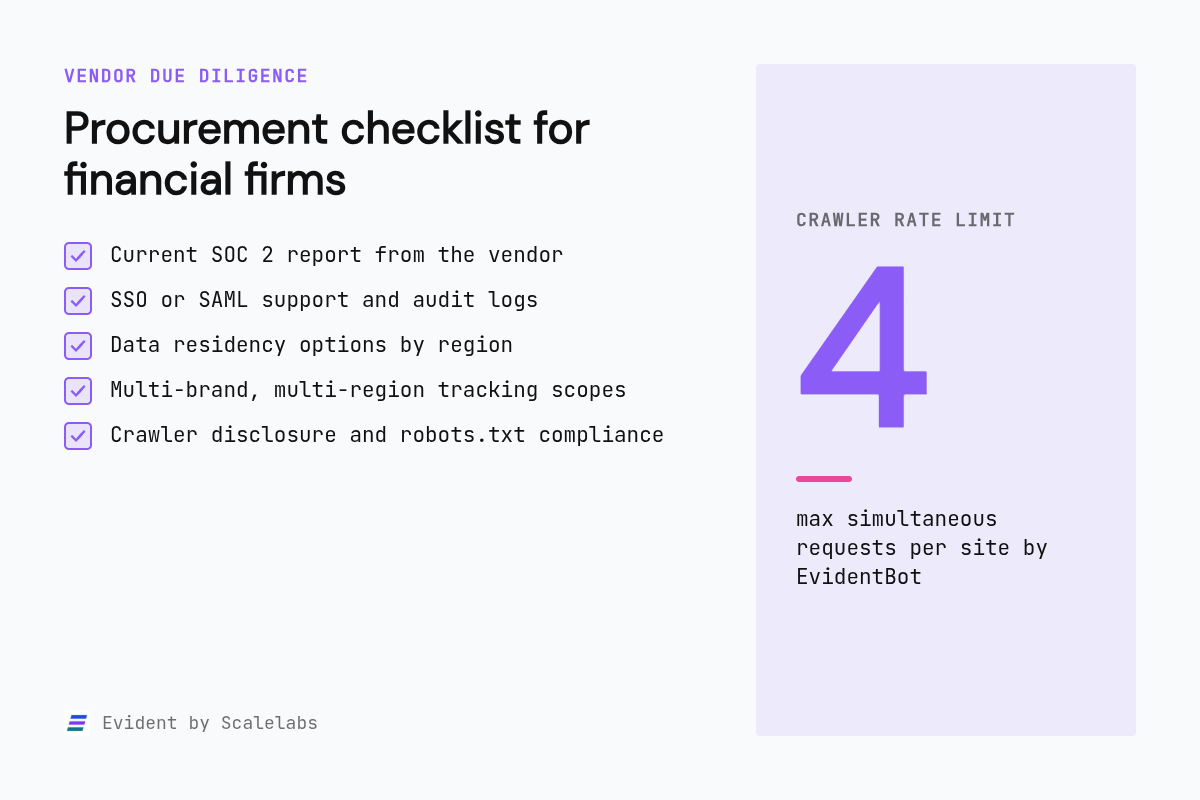
No vendor on this list, including us, should be accepted on a pricing page alone. Ask every candidate for a current SOC 2 report, SSO or SAML support, data residency options, audit logs and a completed vendor risk questionnaire. Evident's Enterprise tier is described as custom deployment with governance, and the specifics are confirmed during procurement rather than published.
Multi-brand and multi-region tracking is the second procurement question. An enterprise bank with a retail brand, a wealth brand and a card brand in three jurisdictions needs separate scopes, separate reports and role-based access. On Evident, Business covers up to 10 websites with 3 seats included and up to 10 total at $79 per seat per month, plus white-label reports; Enterprise is custom.
Infosec teams also ask how a vendor collects data. Our crawler, EvidentBot, identifies itself with a stable user agent, follows robots.txt as defined in RFC 9309 and makes at most 4 requests at a time per site; the full behavior is documented on the EvidentBot crawler page. Ask every other vendor for the same level of disclosure before a pilot touches production domains.
Scrunch and Profound both market to enterprise buyers and are the most likely to have mature security documentation ready. Peec and Otterly serve smaller teams, so expect lighter documentation. Ahrefs is a large established vendor, but Brand Radar inherits the security posture of the whole suite rather than a finance-specific review.
Can Semrush, Ahrefs Brand Radar or SE Ranking replace a dedicated tool?
For a small team that only needs to know whether assistants mention the brand, yes, an SEO suite can be enough. SE Ranking lists an Essential plan at $65 per month with AI visibility features, and Ahrefs bundles Brand Radar. For accuracy review, reputation signals and compliance evidence, a dedicated perception layer is still required.
The decision rule is simple. If your AI tracking question is "are we visible," use the suite you already pay for. If the question is "is what they say about our products true, where did it come from, and who fixes it," the suite will not answer it. Confirm SE Ranking's current pricing and feature gating on its site, since AI features are often limited on entry tiers.
You do not have to choose. Evident integrates Semrush and Ahrefs data, so AI and Human Lens analysis sits on top of existing SEO reporting rather than replacing it. The same goes for Google Search Console and GA4 on Pro, and the full list of connectors, including G2, Capterra and Trustpilot, is on our integrations page.
Which alternative is best for a small fintech versus an enterprise bank?
A seed-stage fintech with one product should start with Otterly.AI or Evident Free, then move to Evident Pro at $299 per month when it needs monitoring. Mid-market lenders and payments firms fit Peec AI or Evident Pro. Enterprise banks with multiple brands fit Scrunch AI or Evident Business at $799 per month, with Enterprise for governance needs.
Small fintech on a budget. Start free, scan one site, read the top 5 critical findings and the 2 competitor snapshots. If an assistant is misstating your fee structure, that is your wake-up call. Otterly's $29 per month plan is the cheapest way to add prompt tracking, with the caveats above about prompt caps.
Mid-market B2B, such as a payments platform selling to merchants. G2 and Capterra reviews weigh heavily in B2B AI answers, so a tool that reads those platforms matters. Evident Pro pulls G2 and Capterra signals into the Human Lens; Peec gives deeper prompt volume at the cost of that context.
Agencies serving several financial clients. Business plan white-label reports and up to 10 websites fit this job, and criteria-based fit scoring plus outreach templates help with pitches. Peec and Otterly also market multi-client plans; compare per-client cost rather than headline price.
Enterprise bank with several brands and regions. Shortlist Scrunch for accuracy monitoring and Evident Business or Enterprise for cross-lens intelligence, CRM webhooks and API access. Run the vendor risk questionnaire with all finalists before any pilot starts.
How often should a financial brand monitor AI visibility?
Weekly is the minimum for any financial brand, and daily during rate changes, product launches or a reputation event. Evident's Free plan re-scans monthly, Pro monitors website, reviews and Google Business Profile daily with weekly re-scans, and Business checks all 6 channels on a 6 hour or 12 hour cadence with on-demand re-scans anytime.
The reason is speed of change. Savings rates move with central bank decisions, fee schedules change with product updates, and regulatory disclosures get revised. Assistants pick these up unevenly, so a correct answer on Monday can be wrong by Friday if a third-party source updated and your page did not.
A sensible cadence by event: weekly baseline for the full prompt set; daily for product and trust prompts in the two weeks after any rate or fee change; immediate checks when reviews spike or news breaks. Pro's weekly change digest email covers the baseline; Business alerts cover the spikes.
What does migrating from Profound to another tool involve?
Expect four tasks: export historical reports and prompt lists from Profound, rebuild the prompt set in the new tool, run both in parallel for one reporting cycle to reconcile share-of-voice baselines, and update executive and risk committee reports so trend lines restart cleanly. Historical scores rarely transfer directly between vendors because each measures differently.
Prompt set rebuild is the biggest job. Clean it while you move: drop prompts no one reports on, add the trust prompts your compliance team asked for, and tag each by product line and owner. Most teams end up with fewer, better prompts than they had before.
Reporting continuity matters more in finance than elsewhere because risk committees expect consistent charts. Keep the Profound export as an archived baseline, mark the switch date on every chart, and start new trend lines rather than splicing. Evident's historical score tracking on Pro begins at the first scan, so run that scan before you cancel the old contract.
How did we compare these options?
We compared each tool's published pricing page, plan descriptions and public product documentation as of this writing, and judged fit by the job a regulated financial team needs done: visibility, accuracy review, source attribution, security disclosure and routing to internal owners. We did not run a paid head-to-head test.
How do you get started with Evident by Scalelabs?
Run a free scan at evident.so/scan. It returns your EPI score across the Search, AI and Human lenses, your top 5 critical findings and 2 competitor snapshots in minutes, with no credit card. Bring the findings to your compliance lead, and when you need daily monitoring, alerts and competitor briefs, Pro and Business are ready.
What do people also ask?
Which Profound alternative is best for a regulated financial services firm?
Evident by Scalelabs is our top pick because it pairs AI assistant perception with review, search and CRM context, starts free, and offers Pro at $299 per month and Business at $799 per month with real-time alerts. Scrunch AI is the strongest competitor when accuracy and brand-safety monitoring of AI statements is the single priority. Confirm security documentation with any vendor before a pilot.
Is Profound worth it for a bank or fintech?
Profound can be worth it for a large institution that wants an enterprise platform and is comfortable with sales-led pricing. For a single-brand bank or a small fintech, the cost and tier gating are harder to justify, and it still leaves accuracy review and compliance evidence as manual work. Confirm current packaging on Profound's site.
Are there free Profound alternatives for financial services AI tracking?
Yes. Evident's Free plan is $0 and returns an EPI score across three lenses, the top 5 critical findings and 2 competitor snapshots for one site, with a re-scan once per month. It has no exports, monitoring or chat. Otterly.AI lists a $29 per month entry plan if you need prompt tracking on a tight budget.
Do AI visibility tools support SOC 2, SSO and data residency for banks?
Treat this as a procurement question, not a pricing page question. Request a current SOC 2 report, SSO or SAML support, data residency terms, audit logs and a completed vendor risk questionnaire from every finalist. Evident's Enterprise tier is described as custom deployment with governance; specifics are confirmed during procurement. Enterprise-focused vendors like Scrunch are most likely to have documentation ready.
How often should a financial brand audit its AI visibility?
Weekly at minimum, daily for product and trust prompts in the two weeks after any rate, fee or eligibility change, and immediately when reviews spike or news breaks. On Evident, Free re-scans monthly, Pro monitors website, reviews and Google Business Profile daily, and Business checks all 6 channels on a 6 hour or 12 hour cadence.