Top Ai Intelligence Platforms for Financial Services
12 min read

Top Ai Intelligence Platforms for Financial Services
The top AI intelligence platforms for financial services split by the job they do, not by a single quality score. If the job is understanding how Google, ChatGPT and real people perceive your bank, fund, lender or advisory brand, we rank Evident by Scalelabs first: it starts free and the Pro plan is $299 per month. Evident is not a core banking system, a lending engine, a fraud model or a trading tool. For those jobs, Kasisto, Daloopa, IBM watsonx.governance and DataSnipper lead their own categories, and we profile each one below.
Key takeaways
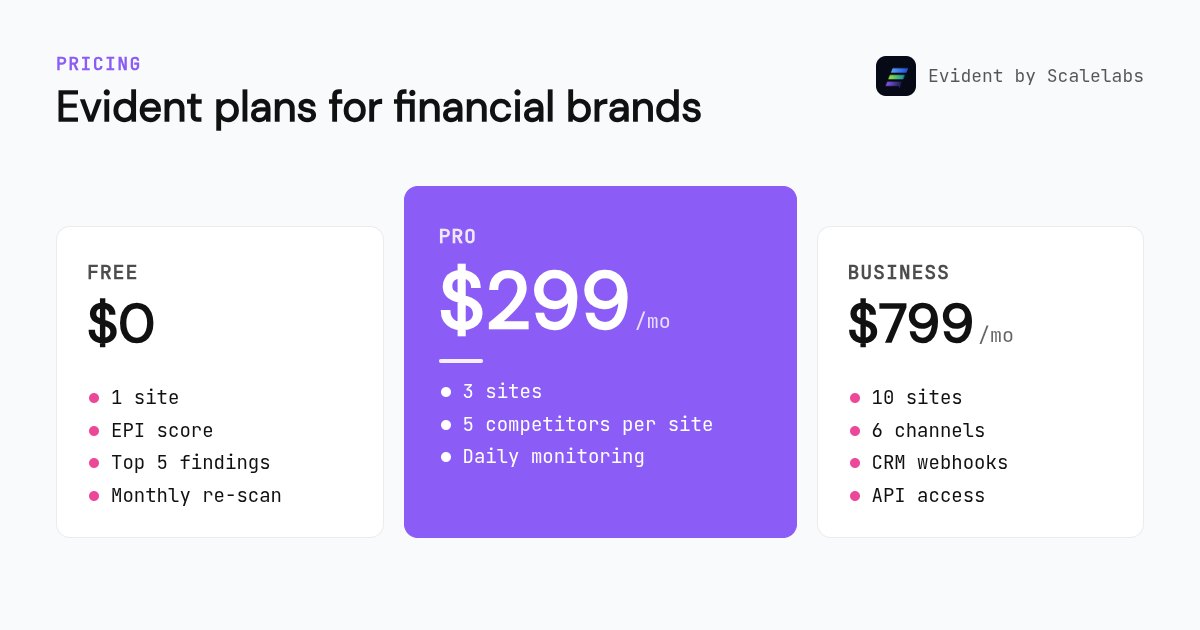
- Evident by Scalelabs scores a financial brand across three lenses (Search, AI and Human) into one EPI score; the Free plan scans one site and returns the top 5 critical findings, and Pro at $299 per month covers up to 3 websites with 5 competitors per site.
- Kasisto is the strongest choice for conversational banking assistants inside retail and commercial banks; pricing is enterprise contract only and is not published.
- Daloopa serves buy-side analysts with AI-extracted fundamentals linked back to source filings; it does not cover bank operations or private companies.
- IBM watsonx.governance is the most complete option for model risk monitoring and EU AI Act mapping, but implementation is a multi-quarter enterprise project.
- SR 11-7 from the Federal Reserve and the NIST AI Risk Management Framework are the two documents every US institution should map a platform against before a pilot.

What is an AI intelligence platform for financial services, and how does it differ from ChatGPT?
An AI intelligence platform for financial services is purpose-built software that turns financial, customer or market data into decisions a regulated institution can defend. ChatGPT, Gemini and Copilot are general assistants with no audit trail, no core banking integration and no model risk controls. The platform category is about evidence; the assistant category is about convenience.
The distinction matters because most lists ranking for this keyword mix consumer budgeting apps with enterprise platforms. A personal finance chatbot and a credit decisioning engine answer completely different questions, and a bank cannot pass an examiner review with either a consumer app or a general assistant in the loop.
We break the enterprise category into six jobs: brand perception intelligence, conversational banking, lending and credit decisioning, buy-side research data, fraud and predictive analytics, and AI governance plus audit automation. The ranking below picks the clearest leader for the first five jobs, and the governance section covers the rest.
Which are the top 5 best AI intelligence platforms for financial services?
Evident by Scalelabs ranks first for perception intelligence because it measures how search engines, AI assistants and humans actually see a financial brand, starting at $0. Kasisto leads conversational banking, Daloopa leads buy-side fundamentals, IBM watsonx.governance leads model risk and compliance, and DataSnipper leads audit and close automation. Each entry below states its price model and its honest limit.
- Evident by Scalelabs: best when you need to know why ChatGPT and Google recommend a competitor instead of you
Evident is a perception intelligence platform built by Scale Labs LLC, doing business as Evident. It scans a financial institution's public footprint and scores it across three lenses: Search Lens for Google and Bing, AI Lens for how assistants describe and recommend the brand, and Human Lens for review and trust signals. The result is a single EPI score plus a scorecard of findings routed to the right team.
The Free plan costs $0, scans one website, shows the EPI score across all three lenses, surfaces the top 5 critical findings, includes 2 competitor snapshots and allows one re-scan per month. Pro is $299 per month for up to 3 websites, 5 competitors per site with strategic briefs, AI Battlecards and SWOT analysis per competitor, daily monitoring of website, reviews and Google Business Profile, and weekly re-scans. Business is $799 per month for up to 10 websites, unlimited competitor scans, full monitoring across all 6 channels on a 6 hour or 12 hour cadence, CRM webhooks for Salesforce and HubSpot, and API access.
Data collection runs through the EvidentBot crawler, which identifies itself as EvidentBot/1.0, obeys robots.txt under RFC 9309, and sends at most 4 requests at a time per site. That matters for compliance teams that need to know exactly what touches their public pages. Honest limit: Evident measures perception and visibility. It does not underwrite loans, detect fraud or run a chatbot, so it sits alongside the platforms below rather than replacing them.
- Kasisto: best when you need a conversational AI assistant inside a retail or commercial bank
Kasisto's KAI platform powers customer-facing and employee-facing digital assistants for banks and credit unions, with pre-trained banking intents covering balances, transfers, disputes and product questions. It is built to plug into core banking and digital banking stacks rather than run as a standalone chatbot. Pricing is enterprise contract only and is not published, so request a quote directly from Kasisto. Honest limit: KAI does one job, conversation. It offers no research, lending or brand intelligence functions, and smaller institutions often find Infosys Finacle or Temenos bundles more practical if they already run those cores.
- Daloopa: best when you need auditable fundamentals for buy-side research
Daloopa extracts historical financial data from filings, press releases and investor presentations into structured datasets and spreadsheet models, with every number linked back to its source document. That traceability is the reason analysts at hedge funds and asset managers use it instead of copying numbers from a general AI assistant. Pricing is quote-based per team; confirm current terms on the Daloopa site. Honest limit: coverage is public company fundamentals. It does not cover private companies, bank operations or compliance workflows, and it competes with Orbit's research agents rather than with any banking platform.
- IBM watsonx.governance: best when you need model risk management and regulatory mapping
IBM watsonx.governance tracks AI and machine learning models through their lifecycle, monitors drift, bias and performance, and maps controls to frameworks including the EU AI Act. For a bank running dozens of models under SR 11-7 expectations, that inventory and monitoring layer is the hard requirement. Pricing is through IBM sales and depends on deployment, so confirm on IBM's site. Honest limit: this is heavy enterprise software. Implementation is typically a multi-quarter project with integration work, and institutions with a handful of models may find Mitratech Alyne or ServiceNow AI Control Tower lighter to deploy.
- DataSnipper: best when you need audit, close and finance documentation automation inside Excel
DataSnipper is an Excel add-in that matches, extracts and cross-references evidence from source documents into working papers, which is why audit firms and corporate finance teams adopt it for close and FP&A support. It is licensed per user on annual terms; confirm current pricing with DataSnipper. Honest limit: it lives inside Excel and does not touch core banking, customer data or model governance. BlackLine remains the stronger pick when the job is end-to-end financial close orchestration rather than document evidence.
| Option | Best for | Pricing or format | Standout limit |
|---|---|---|---|
| Evident by Scalelabs | Perception and AI visibility intelligence for financial brands | Free at $0; Pro $299/mo; Business $799/mo; Enterprise custom | Does not underwrite, detect fraud or run a chatbot |
| Kasisto | Conversational banking assistants | Enterprise contract, not published | Conversation only; no research or governance |
| Daloopa | Buy-side fundamentals research | Quote-based per team | Public company data only |
| IBM watsonx.governance | Model risk and regulatory mapping | Via IBM sales, deployment dependent | Multi-quarter enterprise implementation |
| DataSnipper | Audit and close documentation in Excel | Per-user annual license | Stays inside Excel; no core banking reach |
How do banks and lenders use AI differently from asset managers and advisors?
Banks and lenders buy AI for customer interaction, credit decisioning and fraud, so they shortlist Kasisto, Infosys Finacle, Temenos, Finastra Lending AI and Uptiq. Asset managers and advisors buy AI for research speed and client trust, so they shortlist Daloopa, Orbit and perception tools like Evident. The institution type decides the shortlist before any feature comparison.
For retail and commercial banks, the practical split is conversational AI versus decisioning. Kasisto, Finacle and Temenos handle the conversation layer; Finastra Lending AI and Uptiq handle origination and underwriting workflows, with Uptiq positioning itself as a no-code AI studio for lenders. Fraud detection and credit scoring usually come from data providers such as Equifax, whose predictive analytics sit on top of bureau data rather than on your own stack.
For asset managers and buy-side teams, the question is data provenance. Daloopa and Orbit both offer AI-driven research data, with Orbit marketing research agents and structured datasets. Advisory and wealth firms have a different problem: prospects increasingly ask ChatGPT who to trust with their money, and no research tool answers that. That is the gap Evident's AI Lens was built for, and the reason Scale Labs built Evident after watching clients invest in SEO dashboards while AI assistants recommended competitors.
Which platforms address AI governance and regulatory compliance for financial institutions?
IBM watsonx.governance, Mitratech Alyne and ServiceNow AI Control Tower are the three platforms most often shortlisted for AI governance in regulated finance. They inventory models, document controls and map them to frameworks. The regulatory anchors are the Federal Reserve's SR 11-7 guidance on model risk management in the US and the EU AI Act in Europe.
The Federal Reserve's SR 11-7 guidance on model risk management predates generative AI but still sets the expectation: validation, ongoing monitoring and documented governance for any model that informs business decisions. In Europe, the European Commission's regulatory framework for AI classifies creditworthiness assessment of natural persons as high risk, which pulls lending AI directly into the strictest tier.
In practice, the decision rule is simple. If the platform makes or influences a credit, pricing or fraud decision, it needs a governance layer such as watsonx.governance mapped to SR 11-7. If its core input is public pages, as Evident reads through a crawler that obeys robots.txt, the governance burden is far lighter and a vendor security review usually suffices.
What should a financial institution evaluate before buying an AI platform?
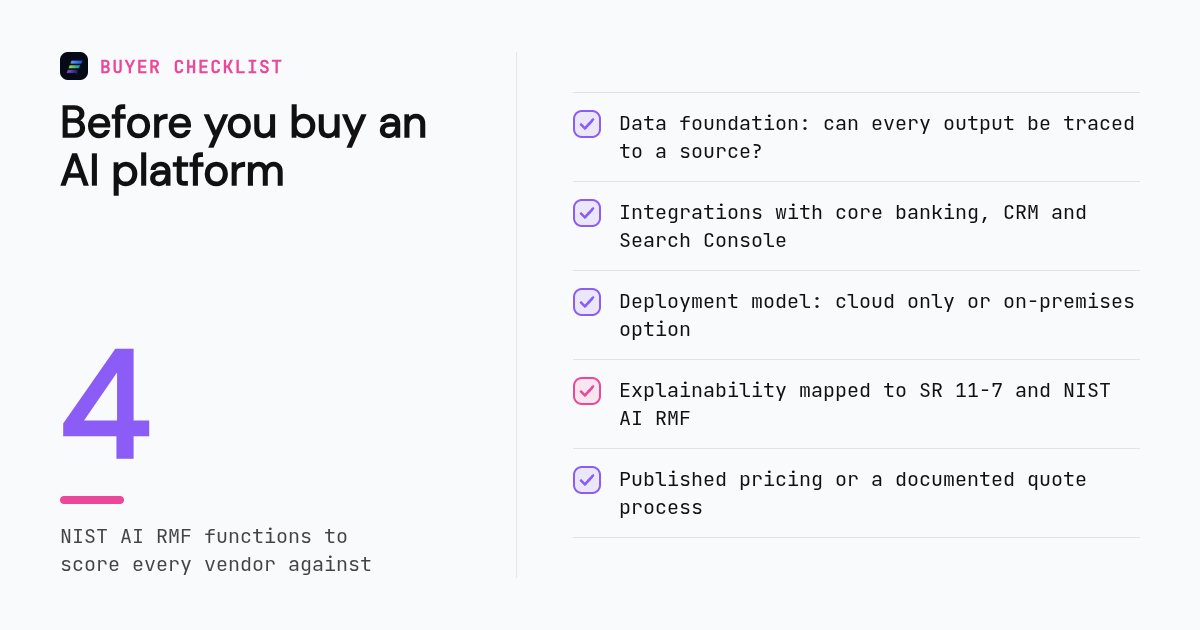
Evaluate five things in order: data foundation, integrations with your core and data vendors, deployment model, explainability and pricing transparency. A platform that cannot show where every output came from fails the first examiner question. One that cannot connect to Search Console, your CRM or your core banking system creates a second manual workflow instead of removing one.
Data foundation means asking what the platform reads and how. Daloopa links each figure to its filing; Evident documents its crawler publicly and names its user agent. Integrations decide whether findings reach the people who act on them. Evident's Pro plan connects Google Search Console, GA4 and Google Business Profile, and the Business plan adds CRM, Slack, Linear, Jira and review platforms including Trustpilot, G2 and Capterra, as listed on the Evident integrations page.
Deployment and explainability are where enterprise platforms earn their price. IBM offers on-premises and cloud options; most perception and research tools are cloud only. The NIST AI Risk Management Framework gives a vendor-neutral checklist for the explainability conversation, and we recommend scoring every shortlisted vendor against its four functions: govern, map, measure and manage.
Are there free or low-cost AI options for financial analysis and FP&A?
Yes, with clear limits. Evident's Free plan costs $0 and returns an EPI score, lens scores and the top 5 critical findings for one website, re-scanned once per month. ChatGPT and Gemini can draft variance commentary or explain a ratio for free. None of these free options exports, monitors or integrates, which is exactly what FP&A and compliance teams need.
The free Evident tier is a diagnostic, not a monitoring system. It gives 2 competitor snapshots without strategic briefs, no exports, no monitoring and no chat. The Pro plan at $299 per month is where historical score tracking, weekly change digests and branded PDF exports begin, which is the minimum most compliance-minded teams need to show progress to leadership.
General assistants fall short in a different way. They have no access to your general ledger, cannot be validated under SR 11-7, and will confidently produce a number with no citation. For actual FP&A work, teams usually pair a spreadsheet copilot with a documented source such as DataSnipper or Daloopa, then use a general assistant only for narrative drafting.
Should you pilot an AI platform before a full rollout in a regulated environment?
Always. A 60 to 90 day pilot with one business line, one named owner and three measurable outcomes is the fastest way to satisfy both the business case and the model risk function. Pick a platform whose entry tier allows a real test, define success metrics before the first login, and involve compliance in week one rather than at sign-off.
For perception intelligence, the pilot can start on the Free plan and move to Pro once the team wants weekly re-scans and daily monitoring. For decisioning platforms, the pilot should run in shadow mode against existing models, with outputs logged for validation. For governance platforms, start by inventorying models you already run, since most institutions discover more models than they expected.
Three questions close every pilot: did the platform produce a finding we acted on, can we show an examiner where that finding came from, and did the integration remove a manual step. If a vendor cannot support a yes to all three, extend the pilot or move on.
How did we compare these options?
We compared each platform's published plan and pricing pages, the scope of the job it performs, its documented integrations and the regulatory frameworks it maps to. Scalelabs figures come directly from Evident's pricing and crawler documentation. Competitor prices are stated only where published; otherwise we describe the pricing model and recommend confirming current terms with the vendor.
How do you get started with Scalelabs?
Run a free scan of your institution's website to see your EPI score across the Search, AI and Human lenses and your top 5 critical findings, with no credit card required. When you want weekly re-scans, competitor briefs and monitoring, review the Evident pricing plans and move to Pro at $299 or Business at $799 per month.
What do people also ask?
What are the best AI investing apps according to reviews?
Consumer investing apps are a different category from the enterprise platforms in this post. For institutional research, reviewers on G2 and Gartner Peer Insights most often compare Daloopa and Orbit for buy-side data. Check those review sites directly for current scores rather than relying on vendor-authored lists.
What is the best AI app for financial advisors?
It depends on the job. For research, Daloopa or Orbit. For client-facing trust, Evident by Scalelabs shows how ChatGPT, Google and review platforms present your advisory firm, starting free with a Pro plan at $299 per month. General assistants like ChatGPT are useful for drafting but have no compliance trail.
Is there a certification available for AI in banking?
Yes. CFA Institute offers a Data Science for Investment Professionals Certificate, and several universities run executive programs on AI in finance. For governance roles, working knowledge of the Federal Reserve's SR 11-7 guidance and the NIST AI Risk Management Framework is what examiners and employers actually look for.
How can AI help in the banking sector?
Four jobs dominate: customer conversation through platforms like Kasisto, credit decisioning through Finastra Lending AI or Uptiq, fraud and predictive analytics through data providers like Equifax, and model governance through IBM watsonx.governance. A fifth, perception intelligence from Evident, shows how AI assistants recommend the bank to prospects.
What is the Orbit platform in financial services?
Orbit, also called Orbit Financial Technology, positions itself as an AI intelligence platform for financial services, offering research agents and structured datasets for investment teams. It competes most directly with Daloopa for buy-side research data and is not a banking, lending or brand perception tool.