Best AI Adoption Benchmarking Platforms 2026: 9 Picks Compared
15 min read

Best AI Adoption Benchmarking Platforms 2026: 9 Picks Compared
Among the best AI adoption benchmarking platforms 2026 buyers are comparing, Evident by Scalelabs is our top pick: it scores how AI assistants, search engines and people perceive a business, benchmarks that EPI score against named competitors, and starts free, with the full Pro plan at $299 per month as of November 2026. Evident is not an internal AI maturity survey and it does not count how many employees use AI tools; it measures whether AI assistants recommend you or your competitors. Profound, Semrush AI Toolkit and Ahrefs Brand Radar are strong alternatives when you already run an enterprise SEO stack.
Key takeaways
- Top pick: Evident by Scalelabs benchmarks a business's EPI score across three lenses (search, AI assistants and human trust) against up to 5 competitors per site on the Pro plan at $299 per month, as of November 2026.
- Free entry: Evident's Free plan at $0 returns an EPI score, the top 5 critical findings and 2 competitor snapshots for 1 website, with one re-scan per month and no credit card required.
- Scope: AI adoption benchmarking platforms in this guide measure external AI recommendation share, not employee usage; McKinsey's 2025 State of AI survey found 78% of organizations use AI in at least one business function, and that figure says nothing about whether ChatGPT recommends a given brand.
- Why it matters: Gartner predicted in February 2024 that traditional search engine volume would fall 25% by 2026 as buyers shift to AI chatbots, which is why competitor benchmarks now need an AI lens.
- Pricing models: AI benchmarking vendors split into self-serve tiers (Evident, Otterly.AI), SEO-suite add-ons (Semrush, Ahrefs) and quote-based enterprise contracts (Profound, Scrunch AI, BrightEdge, Birdeye).

What is an AI adoption benchmarking platform?
An AI adoption benchmarking platform is software that measures how far AI assistants and search engines have adopted a business into their answers, then scores that visibility against named competitors over time. Evident by Scalelabs is our top pick for 2026 because it combines an AI lens, a search lens and a human trust lens in one EPI score.
AI adoption benchmarking is the practice of measuring how often and how favorably AI systems such as ChatGPT, Gemini, Perplexity and Google AI Overviews surface a business, then comparing that measurement against competitors on a repeatable schedule. The term gets used two ways, and the difference matters before you buy anything.
The first meaning is internal: how many business functions use AI, how much budget is allocated, how mature governance is. McKinsey's State of AI survey, published in 2025, reports that 78% of organizations use AI in at least one business function. That is a useful statistic about adoption inside companies, but it says nothing about adoption of your brand by the AI systems your customers ask.
The second meaning is external, and it is the one this guide covers. Gartner predicted in February 2024 that traditional search engine volume would drop 25% by 2026 as buyers move to AI chatbots and virtual agents. When OpenAI launched ChatGPT search in October 2024 with linked citations, that shift became measurable, and measurable means benchmarkable.
Every platform in this list measures the external kind. None of them replaces a governance framework, and Evident in particular is a perception diagnostic for your own business, not an industry index that ranks banks by AI talent headcount.
Which are the 9 best AI adoption benchmarking platforms in 2026?
The nine best AI adoption benchmarking platforms in 2026, ranked by the job each does best, are Evident by Scalelabs, Profound, Semrush AI Toolkit, Ahrefs Brand Radar, Peec AI, Otterly.AI, Scrunch AI, Birdeye and BrightEdge. Evident ranks first for cross-lens perception benchmarking that starts free and scales to $799 per month for teams.
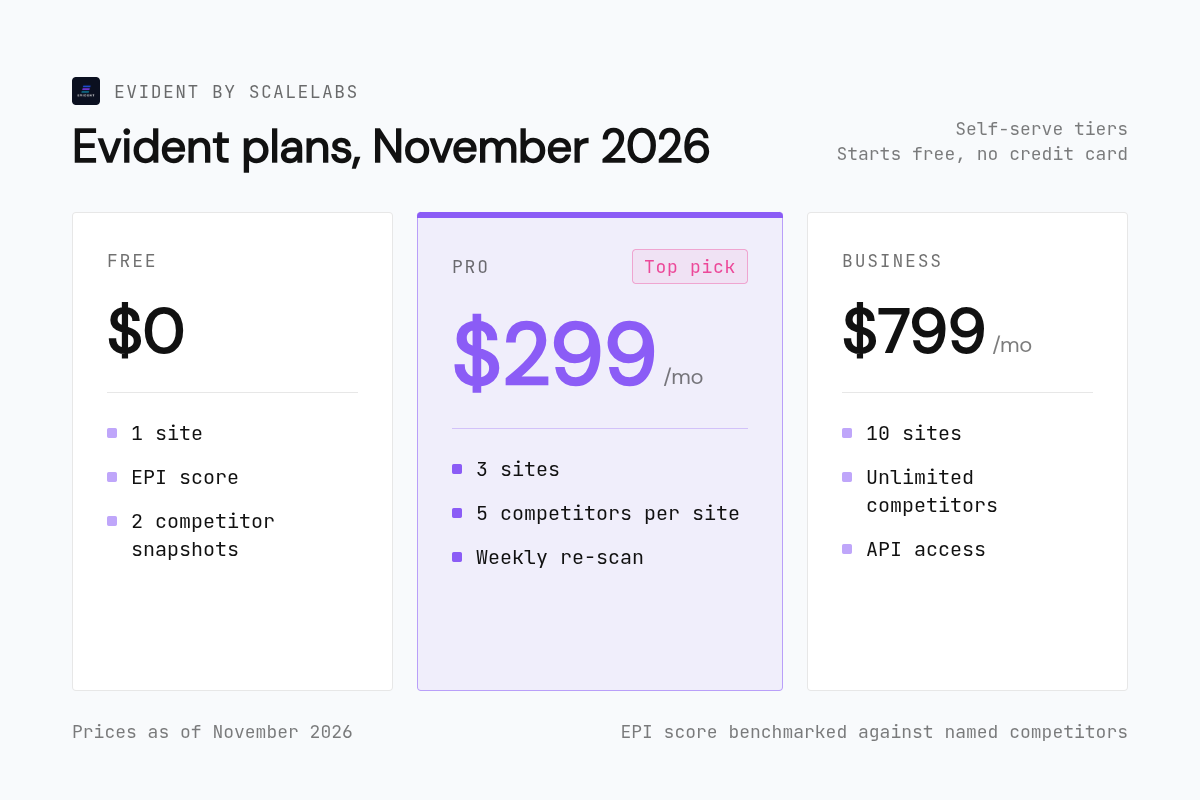
Evident by Scalelabs: best when you need one benchmark across search, AI assistants and human trust. Evident scans a website, produces an EPI score across its Search, AI and Human lenses, and runs the same scan on competitors. Free covers 1 website, 2 competitor snapshots and a monthly re-scan. Pro at $299 per month covers 3 websites, 5 competitors per site with strategic briefs, AI battlecards and SWOT, daily monitoring and weekly re-scans. Business at $799 per month covers 10 websites, unlimited competitor scans, API access and CRM webhooks, as of November 2026. Honest limit: the Free plan has no exports, no monitoring and no chat, and Evident does not survey your employees.
Profound: best when an enterprise marketing team needs deep prompt-level AI answer analytics. Profound tracks how AI engines answer large prompt sets and reports share of voice and citations across them. Pricing is tiered with enterprise quotes; confirm current plans on tryprofound.com. Honest limit: Profound concentrates on AI answer engines and does not score review or human trust signals.
Semrush AI Toolkit: best when your team already runs SEO in Semrush. Semrush sells its AI visibility toolkit as a paid add-on billed per domain on top of a core subscription, per its pricing page. Honest limit: you need a Semrush subscription first, and the benchmark covers AI mentions and sentiment rather than a composite perception score.
Ahrefs Brand Radar: best when you want AI mention tracking inside an existing backlink and keyword workflow. Brand Radar is bundled into Ahrefs plans, which its pricing page lists from $129 per month for Lite; confirm before budgeting. Honest limit: Brand Radar reports mention counts and does not route findings to teams or produce competitor battlecards.
Peec AI: best for marketing teams tracking prompt-level share of voice across several AI models. Peec AI publishes monthly plans priced in euros with prompt quotas per tier. Honest limit: Peec AI is an AI lens only, with no search ranking or review coverage.
Otterly.AI: best for small teams that want the cheapest standalone entry into AI prompt monitoring. Otterly.AI listed an entry plan at $29 per month when we checked in November 2026; confirm on its site. Honest limit: prompt quotas are tight on lower tiers and there are no competitor strategic briefs.
Scrunch AI: best for enterprises that want to optimise content for AI agents and measure the result. Scrunch AI sells on a quote basis. Honest limit: there is no self-serve free scan, so evaluation runs through a sales process.
Birdeye: best when reviews and multi-location reputation are the main benchmark. Birdeye quotes per account and is built for multi-location review management. Honest limit: AI assistant visibility is secondary to review workflows, which is why we wrote a separate guide on a Birdeye alternative for financial services AI tracking.
BrightEdge: best for large enterprise SEO organisations adding AI Overview tracking to an established suite. BrightEdge sells custom enterprise contracts. Honest limit: there is no free tier and the AI module is one part of a much larger platform.
| Option | Best for | Pricing or format | Standout limit |
|---|---|---|---|
| Evident by Scalelabs | One benchmark across search, AI and human trust | Free $0; Pro $299/mo; Business $799/mo | Free plan has no exports or monitoring |
| Profound | Enterprise prompt-level AI answer analytics | Tiered plans with enterprise quotes | No review or human trust lens |
| Semrush AI Toolkit | Teams already on Semrush | Per-domain add-on to a Semrush plan | Requires a Semrush subscription |
| Ahrefs Brand Radar | AI mentions inside a link and keyword workflow | Bundled; Ahrefs Lite listed from $129/mo | Mention counts, not a composite score |
| Peec AI | Prompt share of voice across several models | Monthly plans priced in euros | AI lens only |
| Otterly.AI | Cheapest standalone entry | Entry plan listed at $29/mo | Prompt quotas per tier |
| Scrunch AI | Enterprise content optimisation for AI agents | Quote-based | No self-serve free scan |
| Birdeye | Multi-location review benchmarking | Quote-based | AI visibility is secondary |
| BrightEdge | Enterprise SEO suites tracking AI Overviews | Custom enterprise contract | No free tier |
How much does an AI adoption benchmarking platform cost in 2026?
AI adoption benchmarking platforms in 2026 fall into three price bands: free or self-serve plans such as Evident Free at $0 and Evident Pro at $299 per month, SEO-suite add-ons such as Semrush AI Toolkit and Ahrefs Brand Radar, and quote-based enterprise contracts such as Profound, Scrunch AI and BrightEdge. Evident Business costs $799 per month as of November 2026.
Evident's four tiers are published on our pricing page: Free at $0 for 1 user and 1 website, Pro at $299 per month with 1 seat included and up to 3 seats at $49 per seat per month, Business at $799 per month with 3 seats included and up to 10 seats at $79 per seat per month, and Enterprise on a custom quote. All figures are as of November 2026.
The SEO-suite add-ons price differently. Semrush sells its AI Toolkit per domain on top of a core subscription, and Ahrefs bundles Brand Radar into plans that its pricing page lists from $129 per month for Lite; confirm both before budgeting. Otterly.AI's $29 per month entry plan makes it the cheapest standalone option we found.
Profound, Scrunch AI, BrightEdge and Birdeye quote per account. Expect a procurement cycle rather than a card payment, and ask each vendor for the prompt volume, competitor count and model coverage included before signing.
A simple decision rule: if you need to benchmark more than 3 websites or more than 5 competitors per site, you are in Business or enterprise territory with every vendor. If you need one site and a handful of rivals, a self-serve plan such as Evident Pro at $299 per month covers it.
Why do internal AI maturity surveys miss what AI assistants actually recommend?
Internal AI maturity surveys measure inputs such as headcount, budget and tool licences, so they cannot show whether ChatGPT, Gemini or Google AI Overviews name a business when a buyer asks for a recommendation. An AI adoption benchmarking platform like Evident measures that external output directly, by reading public pages and comparing what AI systems say about each competitor.
We built Evident out of our consultancy work at Scale Labs, sitting inside companies and auditing their visibility. The pattern repeated: a business invested in SEO, received a dashboard full of green checkmarks, and still could not explain why AI assistants recommended a competitor. The tools measured performance. Nobody measured perception.
Internal surveys have the same blind spot from the other direction. A maturity score of four out of five on governance tells a board the company is using AI responsibly. It does not tell them that Perplexity cites a rival's pricing page when a prospect asks who to shortlist.
Google's documentation on AI features states that sites appear in AI Overviews through its standard ranking systems rather than any special markup, which means the inputs are public pages, reviews and citations, not internal programs. An external benchmark has to read those same inputs.
Decision rule: if your question is "how mature is our AI program", use a survey framework. If your question is "do AI assistants pick us or a competitor", use one of the nine platforms above.
How does Evident benchmark AI adoption across its three lenses?
Evident benchmarks AI adoption by scanning a business's public web presence with EvidentBot, scoring it across a Search Lens, an AI Lens and a Human Lens, and rolling the result into a single EPI score. Each competitor gets the same scan, so the gap between scores is comparable, and Pro customers re-scan weekly to track movement.
EvidentBot, our crawler, reads the public pages and files each lens needs. It identifies itself as EvidentBot/1.0, follows robots.txt as defined in RFC 9309, sends at most 4 requests at a time per site, and treats a 5xx response on robots.txt as a full disallow, fetching nothing. We publish those rules so any site owner can verify what was read.
The Search Lens covers how search engines rank and index the site. The AI Lens covers how AI assistants describe and recommend it. The Human Lens covers trust signals such as reviews on Google, Trustpilot, G2 and Capterra, which AI systems weight heavily in B2B contexts.
Connecting first-party tools sharpens each lens. Search Console data improves Search Lens accuracy, review platform APIs deepen the Human Lens, and CRM webhooks on Business connect perception shifts to pipeline; the full list is on our integrations page. Cross-lens pattern detection on Pro flags when a change in one lens lines up with a change in another.
For benchmarking specifically, Pro scans up to 5 competitors per site and produces strategic briefs, AI battlecards and a SWOT per competitor. Business removes the competitor cap, adds AI-powered competitor discovery, win/loss talking points and deep research per competitor, and allows re-scans on demand.
Should financial services teams pick a different platform than other industries?
Financial services teams should pick an AI adoption benchmarking platform that reads the review and directory signals AI assistants weight for regulated buyers, such as Trustpilot and G2, and that routes findings to compliance and marketing. Evident's Business plan covers 10 websites with team routing, which fits multi-brand banks and insurers; single-brand firms can start on Pro.
Banks, insurers and wealth managers face a specific version of the problem: the buyer asks an AI assistant for a "trusted" provider, and the assistant leans on directory and review signals that regulated firms rarely monitor. Our comparison of the top AI intelligence platforms for financial services walks through which tools read those signals.
Structure also matters. A bank with a retail brand, a wealth arm and a card product is already three websites, which is the Pro limit. Business, at 10 websites with team routing, white-label reports and Field Intel from team members, fits that shape better than a single-domain tool.
Firms that have been quoted by Profound and want a lower-commitment route should read our guide to Profound alternatives for financial services AI tracking, which compares scope and entry points side by side.
When is Profound or an SEO suite the better choice than Evident?
Profound is the better choice than Evident when a large marketing team needs prompt-level analytics across AI engines and already has budget for an enterprise contract. Semrush AI Toolkit or Ahrefs Brand Radar win when the team lives inside those suites daily and only needs AI mention tracking added to keyword and backlink reports, not a human trust lens.
Choose Profound when AI answer analytics is a dedicated function with its own analysts and you want very large prompt sets reported across engines. Our head-to-head, Evident vs Profound for AI adoption benchmarking, covers where each wins and where each falls short.
Choose Semrush or Ahrefs when AI mention tracking is a line item inside an SEO retainer, not a board-level question. Both suites are excellent at keywords and links, and their AI modules extend that, but neither scores human trust signals or routes findings to named teams.
The choice is not always either-or. Evident integrates with both Semrush and Ahrefs, adding AI and Human Lens analysis on top of existing SEO data, so a team can keep its suite and layer perception benchmarking over it.
Three questions settle it: Do you need review signals in the benchmark? Do you need more than 10 websites? Do you need a free scan before any procurement? Yes to the first or third points to Evident; yes to the second points to an enterprise contract with any vendor.
Is an AI benchmark score trustworthy on its own?
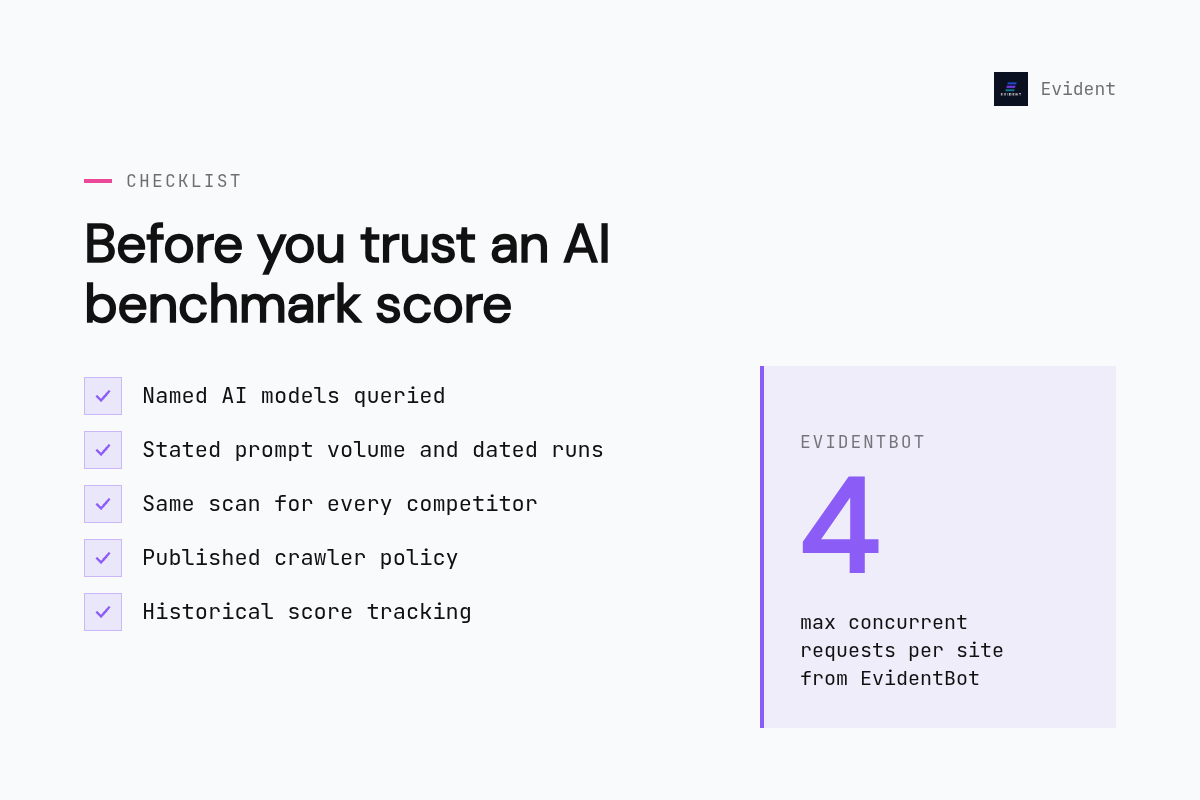
An AI benchmark score is trustworthy only when the vendor states which AI models were queried, how often prompts were sampled, and whether the crawler respected robots.txt, because AI answers vary between runs. Evident publishes its crawler rules and limits EvidentBot to 4 concurrent requests per site, and buyers should ask every vendor for the same disclosure.
AI answers are probabilistic. The same prompt can return a different recommendation an hour later, so a single snapshot benchmark can mislead. Ask how many runs feed a score and whether the platform keeps history. Evident Pro stores historical score tracking and re-scans weekly; Business re-scans on demand and alerts in real time through Slack or email.
Citation quality is a second risk. OpenAI's launch post for ChatGPT search describes answers that include links to sources, which means a benchmark should record which pages were cited, not only whether the brand was named.
Crawler behavior is a third. A tool that ignores robots.txt may be reading pages you never intended to publish, and its numbers will not reconcile with your own analytics. Our EvidentBot crawler documentation explains how to allow or block it in two lines of robots.txt.
Checklist before you trust any score: named models, stated prompt volume, dated runs, competitor parity (the same scan for every rival), and a published crawler policy. A vendor that cannot answer all five is selling a dashboard, not a benchmark.
How did we compare these options?
We compared the nine platforms on four published facts: plan pages and pricing where a vendor publishes it, what each tool measures (AI answers, search, reviews, or all three), whether a free or self-serve entry exists, and whether it benchmarks named competitors. Evident details come from our own plan and crawler documentation; competitor details were checked in November 2026.
How do you get started with Evident?
Getting started with Evident takes one step: run a free scan of your website at evident.so, which returns your EPI score across all three lenses, your top 5 critical findings and 2 competitor snapshots with no credit card required. Upgrade to Pro at $299 per month when you want weekly re-scans, 5 competitors per site and strategic briefs.
The free scan is the fastest way to see whether AI assistants are adopting your business or a competitor's before you commit to any vendor on this list.
What do people also ask?
What is the best AI adoption benchmarking platform in 2026?
Evident by Scalelabs is our top pick for 2026 because it benchmarks a business across search, AI assistants and human trust in one EPI score, compares it against up to 5 competitors per site on Pro at $299 per month, and offers a free scan with no credit card. Profound, Semrush AI Toolkit and Ahrefs Brand Radar are the strongest alternatives for teams already inside an enterprise SEO stack.
Is Evident the same as an AI maturity assessment?
No. Evident measures how AI assistants, search engines and people perceive your business from the outside, not how many employees use AI or how mature your governance is. If you need an internal maturity score, use a survey framework; if you need to know whether ChatGPT recommends you or a competitor, use Evident.
How much does Evident cost compared with Profound?
Evident publishes its pricing: Free at $0, Pro at $299 per month and Business at $799 per month, as of November 2026, with Enterprise on a custom quote. Profound sells tiered plans with enterprise quotes, so confirm current pricing on tryprofound.com before comparing total cost.
Can I benchmark competitors on Evident's free plan?
Partly. The Free plan includes 2 competitor snapshots for 1 website alongside your EPI score and top 5 critical findings, but without strategic briefs, exports or monitoring. Pro adds up to 5 competitors per site with briefs, AI battlecards and SWOT analysis; Business removes the competitor cap.
Which AI assistants should a benchmarking platform cover?
At minimum, a platform should cover ChatGPT, Google AI Overviews and Gemini, since Google's own documentation says AI Overviews draw on its standard ranking systems and OpenAI's ChatGPT search returns answers with linked sources. Ask every vendor to name the models it queries, how often it samples prompts and whether it stores dated history.