Best Alternative to Birdeye for Financial Services Ai
14 min read

Best Alternative to Birdeye for Financial Services Ai
The best alternative to Birdeye for financial services AI is Scalelabs, through its Evident platform, which starts free and costs $299 per month on the Pro plan. Evident measures how search engines, AI assistants and people perceive a bank, credit union, lender or advisory firm, tracks up to 5 competitors per site, and monitors reviews and Google Business Profile daily. It is not a messaging suite: it does not send SMS review invites, auto-post replies or manage listings. If you need those jobs done, pair Evident with Podium, Yext or BrightLocal.
Key takeaways:
- Top pick: Scalelabs' Evident platform scores a firm across three lenses (Search, AI, Human) with a free plan, a $299 per month Pro plan and a $799 per month Business plan.
- Scope: Evident is a perception intelligence and monitoring layer; it does not send review requests, generate review replies or push listings, so it replaces Birdeye's visibility and AI analysis, not its texting.
- Compliance: FINRA Rule 2210 and the SEC Marketing Rule treat solicited reviews and testimonials as advertising, so any platform you pick needs approval workflows and archiving.
- Multi-branch: Evident Business covers up to 10 websites, unlimited competitor scans, white-label reports and CRM webhooks for Salesforce and HubSpot.
- Pricing honesty: Birdeye, Podium, Reputation and Yext enterprise plans are quote-based; BrightLocal publishes plans starting at $39 per month.

What is the best alternative to Birdeye for financial services AI?
Scalelabs is the best alternative to Birdeye for financial services AI when the problem you are solving is visibility and perception rather than text messaging. Its Evident platform scans how Google, ChatGPT-style assistants and real people evaluate a bank, credit union or advisory firm, then ranks the findings by severity. Pricing starts free, with Pro at $299 per month.
Birdeye grew up as a review-request and messaging tool, and its AI features sit on top of that core. Financial firms that search for an alternative usually want something different: an objective read on why an AI assistant recommends a competitor, why a branch underperforms in local search, or why trust signals look thin to a prospect. Financial firms adding AI-powered hiring workflows alongside perception tools should validate those systems through Ai Hiring Tool Bias Audit Services to meet the same compliance standards governing their marketing AI.
Evident was built for exactly that gap. Scale Labs LLC, doing business as Evident, started as a growth consultancy that audited visibility inside client companies and kept finding dashboards full of green checkmarks that explained nothing. You can read that origin story on the Evident about page.
The output is an EPI score across three lenses, a ranked list of critical findings, and competitor snapshots. On the Free plan you get one site, the top 5 critical findings and 2 competitor snapshots. Pro unlocks the full scorecard, cross-lens pattern detection, AI Battlecards and SWOT analysis per competitor, and daily monitoring of website, reviews and Google Business Profile.
Why do banks, credit unions and wealth advisors outgrow Birdeye?
Financial firms outgrow Birdeye for four recurring reasons: per-location pricing that scales badly across branches, bundles that include social and chatbot modules compliance teams will not approve, annual contracts that lock in features nobody uses, and AI review replies that generate text with no supervisory approval step. The platform is capable; the fit with regulated workflows is the issue.
Birdeye sells per location on annual agreements and publishes plan tiers, but final quotes come from sales, so confirm current pricing directly on birdeye.com. For a credit union with 14 branches, that structure means 14 units of a bundle built for dentists and home services companies.
The bundling problem is sharper in finance than elsewhere. A web chatbot that quotes rates, a social scheduler that posts without pre-approval, or a payments module that touches cardholder data each creates review work for compliance before it creates value for marketing.
The deeper issue is measurement. Birdeye reports what it does: requests sent, reviews collected, response rate. It does not tell you how an AI assistant describes your mortgage team or whether prospects trust your advisor bios. That is the question a perception layer answers.
What are the top 5 best alternatives to Birdeye for financial services AI?
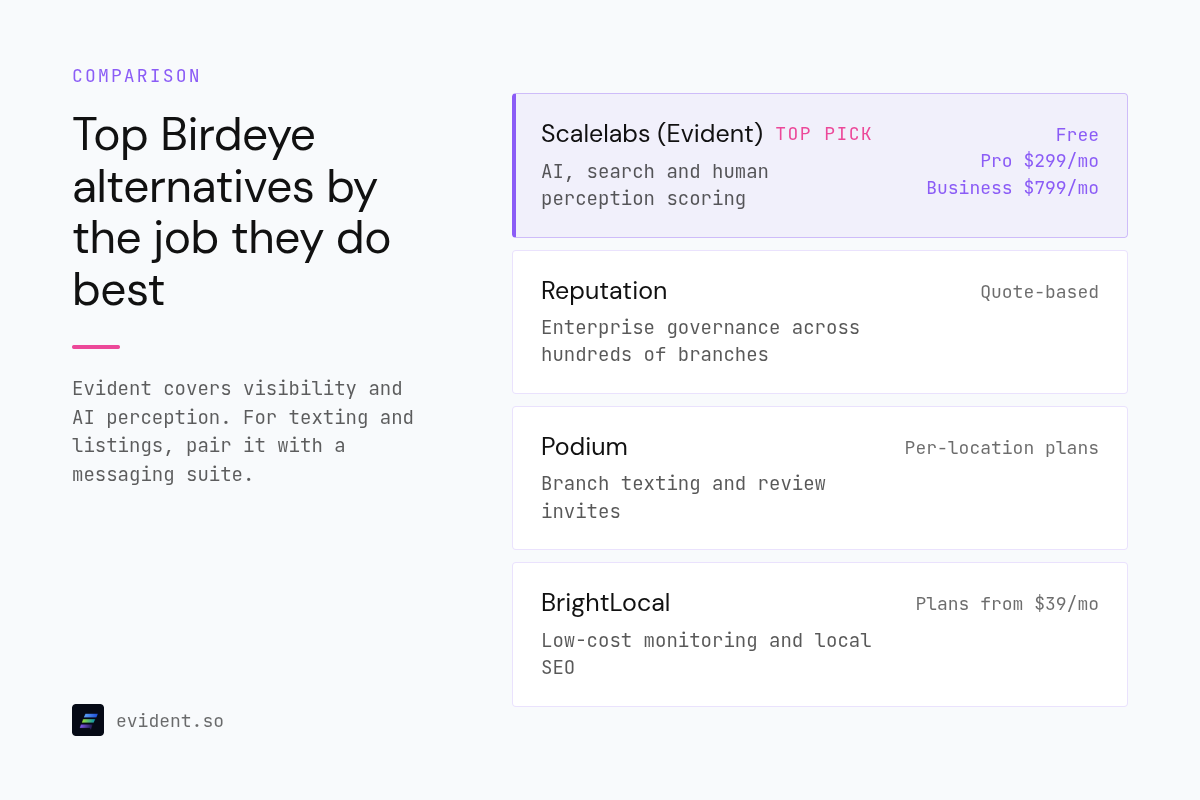
The top 5 alternatives, ranked by the job each does best, are Scalelabs' Evident for AI and search perception intelligence, Reputation for enterprise reputation governance, Podium for branch-level texting and review requests, Yext for listings and knowledge management, and BrightLocal for low-cost review monitoring with local SEO. Most regulated firms end up pairing a measurement tool with one execution tool.
Scalelabs (Evident): best when you need to know how AI assistants, search engines and people actually perceive your firm, and which fixes matter most. Evident scores every site across Search, AI and Human lenses, tracks historical scores, and on Pro monitors website, reviews and Google Business Profile daily for $299 per month. Business at $799 per month adds all six monitoring channels at a 6 or 12 hour cadence, unlimited competitor scans, API access and re-scans on demand. Honest limit: Evident does not send review requests, write replies or manage listings.
Reputation (formerly Reputation.com): best when a national bank or insurer needs reputation governance across hundreds of locations with role-based approvals and enterprise reporting. Pricing is not published and is quoted per enterprise. Honest limit: implementation timelines and minimum commitments are built for large organizations, so a 20-branch community bank may find it heavier than it needs.
Podium: best when branch staff need to text customers, send review invitations and capture leads from one inbox. Podium publishes tiered plans billed per location on monthly or annual terms; confirm current pricing on podium.com. Honest limit: its AI agent and messaging features are sales oriented, and FINRA-supervised firms must route outbound texts through archiving before use.
Yext: best when the primary pain is inconsistent listings across branches, ATMs and advisor profiles, plus structured data for search and AI answers. Yext publishes small-business pricing and quotes enterprise deployments. Honest limit: review response and sentiment features are secondary to the listings core, and enterprise contracts are typically annual.
BrightLocal: best when a small advisory practice or single-branch lender wants review monitoring, local rank tracking and citation audits without a sales call. Published plans start at $39 per month; confirm current pricing on brightlocal.com. Honest limit: no AI perception analysis, no CRM webhooks, and review request volume is capped by plan.
| Option | Best for | Pricing or format | Standout limit |
|---|---|---|---|
| Scalelabs (Evident) | AI, search and human perception scoring with competitor intelligence | Free; Pro $299/mo; Business $799/mo; Enterprise custom | Does not send review requests or write replies |
| Reputation | Enterprise governance across hundreds of locations | Quote-based, not published | Heavy for small and mid-size firms |
| Podium | Branch texting, review invites, lead capture | Per-location tiered plans; confirm on vendor site | Outbound texts need archiving for FINRA firms |
| Yext | Listings and knowledge management at scale | SMB pricing published; enterprise quoted | Reviews and sentiment are secondary |
| BrightLocal | Low-cost monitoring and local SEO for small practices | Plans from $39/mo; confirm on vendor site | No AI perception analysis or CRM hooks |
How do FINRA, SEC and FDIC rules affect which review platform you can use?
Financial firms must treat reviews, testimonials and review responses as regulated communications. FINRA Rule 2210 governs retail communications for broker-dealers, the SEC Marketing Rule sets conditions for advisers using testimonials and endorsements, and FDIC and NCUA rules require official advertising statements. Any platform you adopt must support pre-approval, disclosures and retention, or compliance will block it.
FINRA Rule 2210 requires that retail communications be fair, balanced and not misleading, with principal approval and recordkeeping. A review reply written by an AI model and posted instantly fails the approval requirement unless the platform holds it for a registered principal.
For registered investment advisers, the SEC Marketing Rule FAQ explains that testimonials and endorsements are permitted only with required disclosures, oversight and, in some cases, written agreements. Soliciting reviews from clients and featuring them on a site counts as advertising under this framework.
Banks and credit unions add another layer. FDIC-insured institutions must include the official advertising statement in covered advertising, and the FDIC publishes the rules in Part 328. Data handling falls under the Gramm-Leach-Bliley Act, which matters whenever a vendor receives customer phone numbers for review requests.
This is where a read-only measurement tool has an advantage. Evident reads public pages and public reviews through EvidentBot, a crawler that follows robots.txt as defined in RFC 9309 and sends at most 4 requests at a time per site. It never holds customer contact data for outreach. You can review exactly how the crawler behaves on the EvidentBot documentation page.
Which AI features are safe for regulated financial conversations?
Safe AI features in a regulated firm are the ones that analyze and advise humans rather than speak for the firm: sentiment scoring, competitor analysis, finding prioritization and monitoring alerts. Risky features are auto-posted review replies, unsupervised chat or voice agents that discuss rates or products, and any generated text without an approval queue and audit trail.
The core risk is hallucination. A generative reply that thanks a reviewer for a great mortgage experience when the reviewer complained about closing delays is embarrassing. One that implies a guaranteed return or omits a required disclosure is a regulatory finding. Vendors that market instant AI replies rarely show you the approval step.
Evident's AI capabilities stay on the analysis side. Pro includes cross-lens pattern detection, AI Battlecards and SWOT analysis for up to 5 competitors per site, and Persona Lab chat for exploring how different buyer personas read your presence. Business adds Deep Research per competitor, win and loss talking points, and a Daily Intelligence Briefing.
None of that posts anything publicly. The outputs are internal: branded PDF reports on Pro, white-label reports on Business, and Slack or email alerts when a review, listing or page changes. A compliance officer can read every output before anyone acts, which is the decision rule we recommend for any AI feature in finance.
If you still want AI-assisted replies, choose a vendor that supports draft-only mode and routes drafts to a reviewer. Treat the model as a junior copywriter, not a spokesperson.
How should multi-branch firms credit reviews to individual advisors and loan officers?
Multi-branch firms should attribute reviews at two levels: the location, which drives local search and Google Business Profile performance, and the producer, which drives coaching and compensation. Platforms handle the first level natively; the second depends on whether the tool can hold a per-site or per-profile record and feed results into a CRM or spreadsheet.
Evident's unit of analysis is the website or profile being scanned. Pro covers up to 3 websites and Business covers up to 10, each with its own EPI score, findings and historical tracking. A regional lender can scan its main site plus the branch or loan officer microsites that matter most and compare them side by side.
Business also includes Field Intel from team members, so a branch manager can log what they hear from customers alongside the external scan. Criteria-based fit scoring lets you define what a strong branch presence looks like and score each location against it. Seats run 3 included and up to 10 total at $79 per seat per month.
For individual producer attribution, the practical approach is to pair Evident's per-site scores with your CRM. Business plan CRM webhooks for Salesforce and HubSpot push perception changes into the systems where advisor and loan officer records already live, so a drop in a branch's Human Lens score lands next to that branch's pipeline numbers.
Which integrations matter most for financial services firms?
The integrations that matter for financial services are the ones that connect perception data to systems compliance already supervises: Google Business Profile for branch listings, Search Console and GA4 for traffic context, Trustpilot for the trust checks enterprise buyers run, and Salesforce or HubSpot for pipeline impact. Core banking and advisor CRM connectors are rare across the category.
Evident's Pro plan integrates Google Search Console, GA4 and Google Business Profile. Search Console data sharpens the Search Lens with real impressions, clicks and query data. GBP integration pulls review data, Q and A, attributes and local insights directly into the Human Lens. The full list is on the integrations page.
Business extends to CRM webhooks for Salesforce and HubSpot, Slack, Linear, Jira and additional review platforms such as Trustpilot, G2 and Capterra. It also adds API access for programmatic scanning, which is how a bank with many branch sites can run scans on a schedule it controls.
Be realistic about the gaps. No tool in this list ships a native connector to Jack Henry or Fiserv cores, and advisor CRMs such as Redtail and Wealthbox are not standard integrations anywhere in the category. Plan on using Salesforce Financial Services Cloud or HubSpot as the hub, or a middleware layer, if you need review triggers from a loan closing or account opening event.
When should you switch from Birdeye, and how do you migrate?
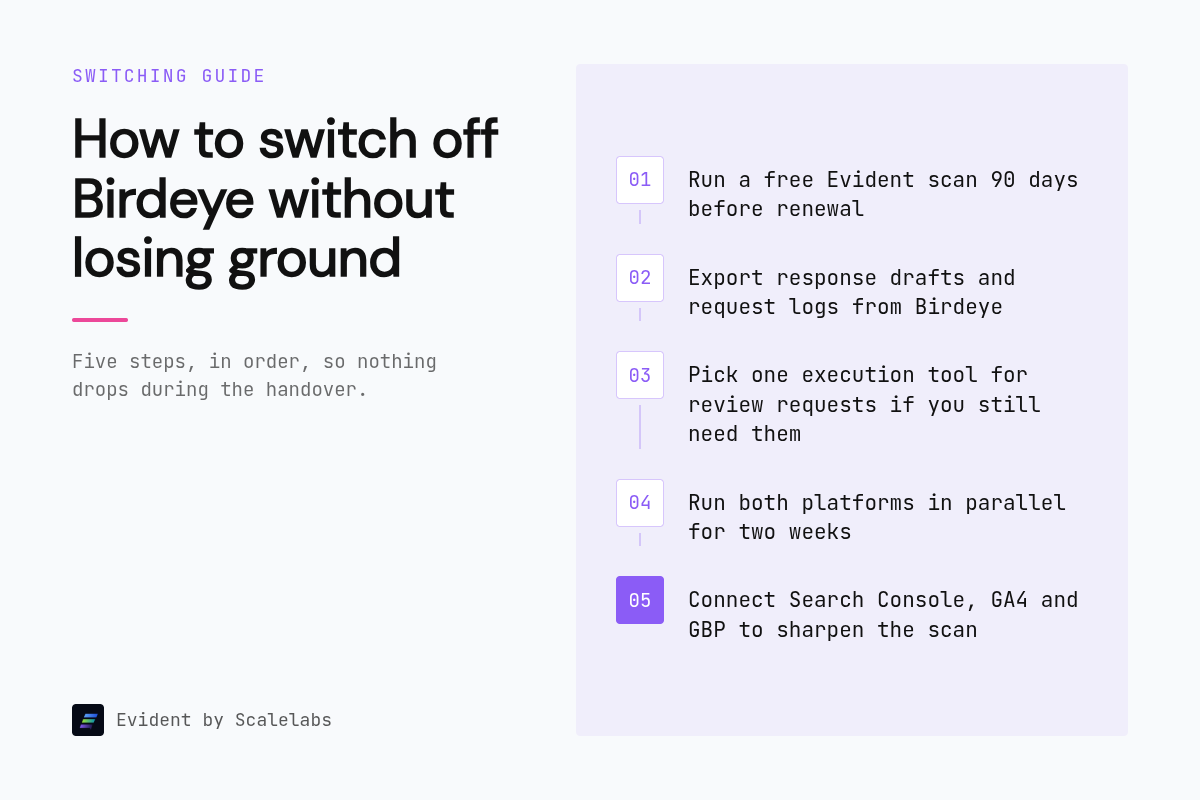
Switch when your renewal is 90 days out, when compliance has frozen a bundled module you are paying for, or when leadership asks a question Birdeye cannot answer, such as why AI assistants recommend a competitor. Migration is easier than most teams expect because reviews live on Google and other public platforms, not inside Birdeye.
Start with a side-by-side trial before you renew. Evident's Free plan scans one site, shows the EPI score across all three lenses and the top 5 critical findings, and includes 2 competitor snapshots, with no credit card required. Run it against your main site while Birdeye is still active and compare what each tool tells you.
Export what is yours. Review text and ratings are public and will show up in any new tool that reads Google Business Profile. What you can lose is internal history: response drafts, request logs and contact lists. Request a full export from your Birdeye account manager before the contract ends, and store it in your archiving system.
Time the cutover around your review request workflow if you have one. If Podium or BrightLocal will take over requests, run both for two weeks so no closing or account opening goes without an invite. Evident's monitoring can start on day one because it reads public sources and needs no customer data to begin.
Finally, budget by seat and site rather than by location. Evident Pro includes 1 seat and up to 3 total at $49 per seat per month, with weekly re-scans. Business re-scans on demand. Compare that against your current per-location invoice and the modules you never activated; the full breakdown is on the Evident pricing page.
How did we compare these options?
We compared each tool on the job it does best, its published pricing or pricing model, the scope of its plan pages, and how its AI features behave against FINRA, SEC and FDIC requirements. Scalelabs facts come from Evident's pricing, integrations and crawler documentation.
How do you get started with Scalelabs?
Getting started takes minutes: run a free Evident scan on your firm's main site, review your EPI score and top 5 critical findings, and compare 2 competitor snapshots before you talk to anyone. Upgrade to Pro when you want full scorecards, daily monitoring and competitor briefs, or to Business when branches and compliance need routing, alerts and CRM webhooks.
Run your free Evident scan at evident.so/scan and see how search, AI assistants and prospects perceive your firm today.
What do people also ask?
What is the best Birdeye alternative for banks, credit unions and financial advisors in 2026?
Scalelabs' Evident platform is the best alternative when you need to understand how AI assistants, search engines and prospects perceive your firm. It starts free and costs $299 per month on Pro. For review requests and texting, pair it with Podium or BrightLocal; for enterprise governance across hundreds of branches, consider Reputation.
Which Birdeye alternatives are compliant with FINRA and SEC testimonial rules and support archiving of review responses?
No platform is compliant on its own; compliance depends on your approval workflow and archiving system. FINRA Rule 2210 requires principal approval and recordkeeping, and the SEC Marketing Rule requires disclosures for testimonials. Choose tools with draft-only AI replies and role-based approvals, and route every public response through your archiving vendor. Evident avoids the issue by never posting publicly.
How much does Birdeye cost compared with alternatives like Podium, Reputation and BrightLocal?
Birdeye prices per location on annual contracts and quotes final pricing through sales. Podium publishes tiered per-location plans, Reputation is quote-based for enterprises, and BrightLocal publishes plans starting at $39 per month. Evident by Scalelabs publishes a Free plan, Pro at $299 per month and Business at $799 per month. Confirm current competitor pricing on each vendor's site.
Can a cheaper reviews-only tool replace Birdeye if we do not need listings, social or a chatbot?
Yes, for many community banks and advisory practices. BrightLocal covers review monitoring and local SEO at a published starting price of $39 per month, and Evident's Free or Pro plan adds AI and search perception analysis with daily review and Google Business Profile monitoring. You lose Birdeye's unified messaging inbox, so decide whether branch texting is a real requirement first.
How hard is it to migrate historical reviews and review request workflows off Birdeye?
Public reviews are not hard to migrate because they live on Google and other platforms, not inside Birdeye, and any new tool that reads Google Business Profile will show them. Internal history such as response drafts and request logs should be exported before the contract ends. Evident monitoring starts immediately because it reads public sources; run any new review request tool in parallel for two weeks.