How to Switch From Semrush Enterprise to Evident AI Benchmarking
14 min read

How to Switch From Semrush Enterprise to Evident AI Benchmarking
Evident AI benchmarking is Evident's measurement of how AI assistants, search engines and people perceive a business, scored as a single EPI across three lenses. If you plan to switch from Semrush Enterprise to Evident AI benchmarking, start with the free scan at $0, then move to Pro at $299 per month or Business at $799 per month, as of November 2026. Evident is not the bank AI maturity ranking that shares its name, and it does not replace Semrush's keyword and backlink databases. It answers a different question: why AI assistants recommend a competitor instead of you.
Key takeaways
- Different categories: Semrush Enterprise's AI Visibility Index measures how often a brand is mentioned or cited inside ChatGPT, Google AI Mode and AI Overviews; Evident's EPI measures why search engines, AI assistants and humans perceive a business the way they do.
- Published pricing: Evident lists Free at $0, Pro at $299 per month and Business at $799 per month as of November 2026; Semrush Enterprise is sold only on a custom quote.
- Vendor risk: Adobe announced an agreement to acquire Semrush in November 2025, so Semrush Enterprise renewal terms, roadmap and bundling may change through 2026.
- Parallel run: Evident's Pro plan re-scans weekly and keeps historical score tracking, which makes a one-billing-cycle overlap with Semrush enough to build comparable trend lines.
- Keep both when: prompt share of voice is a board KPI or paid search teams depend on Semrush keyword data; switching is often adding.

Is Semrush Enterprise's AI Visibility Index the same category of tool as Evident AI benchmarking?
Semrush Enterprise's AI Visibility Index and Evident AI benchmarking answer different questions. Semrush measures how often a brand appears and gets cited inside ChatGPT, Google AI Mode and Google AI Overviews answers. Evident measures why a business is perceived the way it is across search, AI assistants and human trust, then scores that perception as one EPI with ranked findings.
The confusion starts with the word benchmarking. Semrush benchmarks brand visibility inside AI answers against competitors. Evident benchmarks perception, meaning the signals that cause an AI assistant, a search engine or a buyer to trust one business over another.
There is a second source of confusion. A separate bank AI maturity ranking called the Evident AI Index, published by a different company, scores large financial institutions on talent, innovation, leadership and transparency. Evident at evident.so is not that index. We measure any business that has a public website, not only banks, and we measure perception rather than internal AI adoption.
A simple decision rule helps. If your question is "what share of AI answers mentioned us this month", you need visibility tracking, and Semrush does that. If your question is "why does ChatGPT recommend our competitor and what do we fix first", you need perception diagnostics, which is what Evident does. We cover the head-to-head in more depth in our comparison of Evident and Semrush Enterprise for financial AI research.
What does Semrush Enterprise's AI Visibility Index actually measure?
Semrush Enterprise's AI Visibility Index tracks brand presence across ChatGPT, Google AI Mode and Google AI Overviews by running prompt sets and recording which brands and sources each engine mentions or cites. Semrush then ranks brands by visibility, compares them with competitors and surfaces opportunity prompts, which feeds its Enterprise AI Optimization workflow.
As of November 2026, Semrush positions its Enterprise platform around AI optimization: visibility across LLM answers, competitor comparison and opportunity surfacing. The benchmark is prompt based. Semrush samples a set of prompts per category, checks the answers each engine returns, and counts mentions and citations. Confirm the current methodology and engine list on Semrush's site, because engine coverage changes often.
The competitive benchmarking workflow inside Semrush combines Organic Research position data, share of voice and citation tracking. That lets a team say which pages earned citations and which competitors appear in prompts where the brand is absent. Semrush describes this as evidence-based action, and for visibility reporting it works well.
Two published findings matter for the switch decision. Semrush's 2026 AI Visibility Index commentary, published on semrush.com, reports that only a small minority of brands cited by AI engines, in the 7 to 13 percent range depending on the engine, are rated as trusted or credible sources, which Semrush reads as AI search rewarding authority. Separately, Pew Research Center found in its July 2025 analysis of Google users that users clicked a traditional result in 8 percent of visits when an AI summary appeared, versus 15 percent without one.
The named limitation is that a visibility count tells you where you are absent, not why. Semrush shows the gap. It does not score the trust, review, structured data and entity signals that caused the gap.
How does Evident score AI perception, and what does the EPI cover?
Evident scores perception with an EPI across three lenses: Search Lens, AI Lens and Human Lens. EvidentBot crawls the public pages those measurements need at no more than four requests at a time per site, and connected first-party sources such as Search Console, GA4 and review platforms sharpen each lens.
Evident came out of our consulting work at Scale Labs. Sitting inside client companies and auditing their visibility, we kept seeing the same pattern: a business invested in SEO, got a dashboard full of green checkmarks, and still had no idea why customers were not converting or why AI assistants recommended competitors. The tools measured performance. Nobody measured perception. We built Evident as the diagnostic layer that should have existed before that work started.
The method is concrete. EvidentBot identifies itself as EvidentBot/1.0 with a link to its documentation page, follows robots.txt as defined in RFC 9309, checks every URL against robots.txt before fetching, and treats a 5xx robots.txt response as a full disallow. You can read the pacing and opt-out rules on the EvidentBot crawler page.
Each lens gets sharper when you connect your own data. Search Console data sharpens Search Lens accuracy, review platform APIs deepen Human Lens analysis, and CRM data connects perception shifts to pipeline. Evident also lists Semrush and Ahrefs as integrations, which means you can add AI Lens and Human Lens analysis on top of existing SEO data instead of discarding it. The full list is on our integrations page.
Google's own documentation on AI features and your website says the same fundamentals that earn traditional rankings apply to AI Overviews and AI Mode. Evident's Search Lens and AI Lens are built on that premise: the signals overlap, so one scorecard can cover both.
Which metrics do you lose and gain when you move from Semrush to Evident?
Moving from Semrush Enterprise to Evident loses engine-by-engine prompt share of voice, citation counts and Semrush's keyword and backlink databases. It gains an EPI score across search, AI and human trust, cross-lens pattern detection, AI Battlecards and SWOT analysis per competitor, review and GBP monitoring, and Persona Lab chat. Keep Semrush if prompt share of voice is a board KPI.
| Capability | Semrush Enterprise AI Visibility | Evident |
|---|---|---|
| Primary question | How visible is the brand in AI answers? | Why is the business perceived this way, and what to fix? |
| Scoring unit | Mentions and citations per prompt set, by engine | One EPI score across Search, AI and Human lenses |
| Competitor coverage | Visibility comparison per prompt category | Up to 5 competitors per site on Pro, unlimited on Business, with strategic briefs |
| Data sources | Sampled engine answers plus Semrush databases | EvidentBot crawl plus Search Console, GA4, GBP, review platforms, CRM |
| Refresh cadence | Set by Semrush; confirm on vendor site | Monthly re-scan on Free, weekly on Pro, on demand on Business |
| Pricing format | Custom quote | $0, $299/mo, $799/mo, custom Enterprise, as of November 2026 |
The honest trade-off: Semrush gives you a precise visibility count across named engines. Evident gives you the diagnosis and the action routing. A team that only needs the count should not switch. A team that keeps asking "so what do we do" after reading the count should.
What does the Adobe acquisition of Semrush mean for Enterprise customers?
Adobe announced an agreement to acquire Semrush for about $1.9 billion in November 2025, with closing expected in 2026. For Semrush Enterprise customers that means possible changes to roadmap priorities, bundling with Adobe's marketing products, and commercial terms at renewal. Buyers should read assignment and change-of-control clauses before signing a multi-year renewal.
The announcement is published on Adobe's newsroom and in Semrush's investor filings. As of November 2026, confirm the closing status directly with those sources, because integration timelines shift.
From a buyer's seat, the questions to ask Semrush are specific. Does the contract allow assignment to Adobe without renegotiation? Does the Enterprise AI Visibility product remain a standalone SKU or move into a bundle? What are the data export rights if the product is retired or renamed? What is the notice window to exit, and does auto-renewal lock you in before the deal closes?
A practical decision rule: if your Semrush Enterprise renewal lands within six months of the expected closing date, negotiate a one-year term instead of a multi-year one, and run the Evident evaluation in that window. That keeps your exit cost low while the roadmap settles.
How do you export historical Semrush AI visibility and benchmarking data before switching?
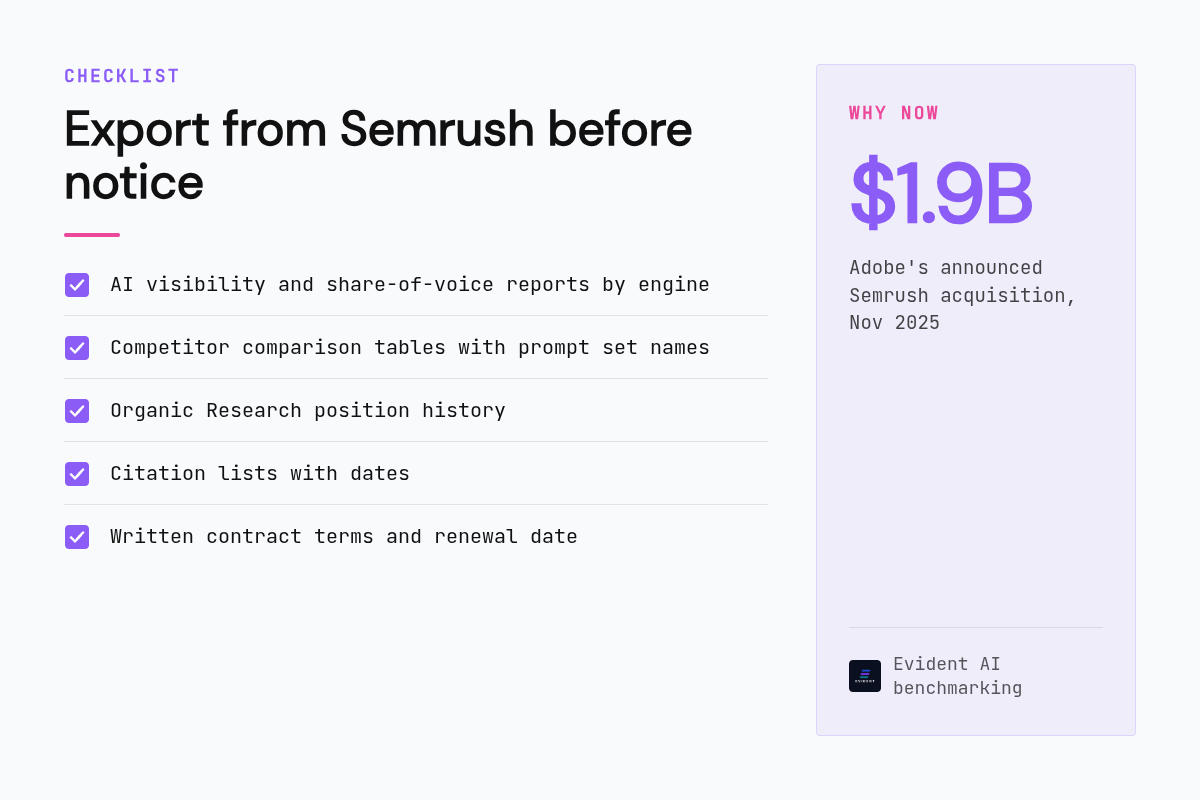
Export Semrush data before the contract notice window closes: AI visibility and share-of-voice reports, competitor comparison tables, Organic Research position history and citation lists, as CSV or through the Semrush API where your plan includes it. Store dated monthly snapshots with the prompt sets and engine names so you can later align them with Evident's score history.
Export options differ by report, and Semrush documents them in its knowledge base. Confirm which AI visibility views support CSV export on your Enterprise plan, and ask your account manager for a bulk export if the UI limits rows.
Label every file with four fields: export date, engine, prompt set name and competitor list. Without those, a share-of-voice number from March cannot be compared to one from September, and your board trend line breaks at the switch. Keep the raw files in a shared drive your finance or analytics team controls, not inside the tool.
What are the steps to switch from Semrush Enterprise to Evident?
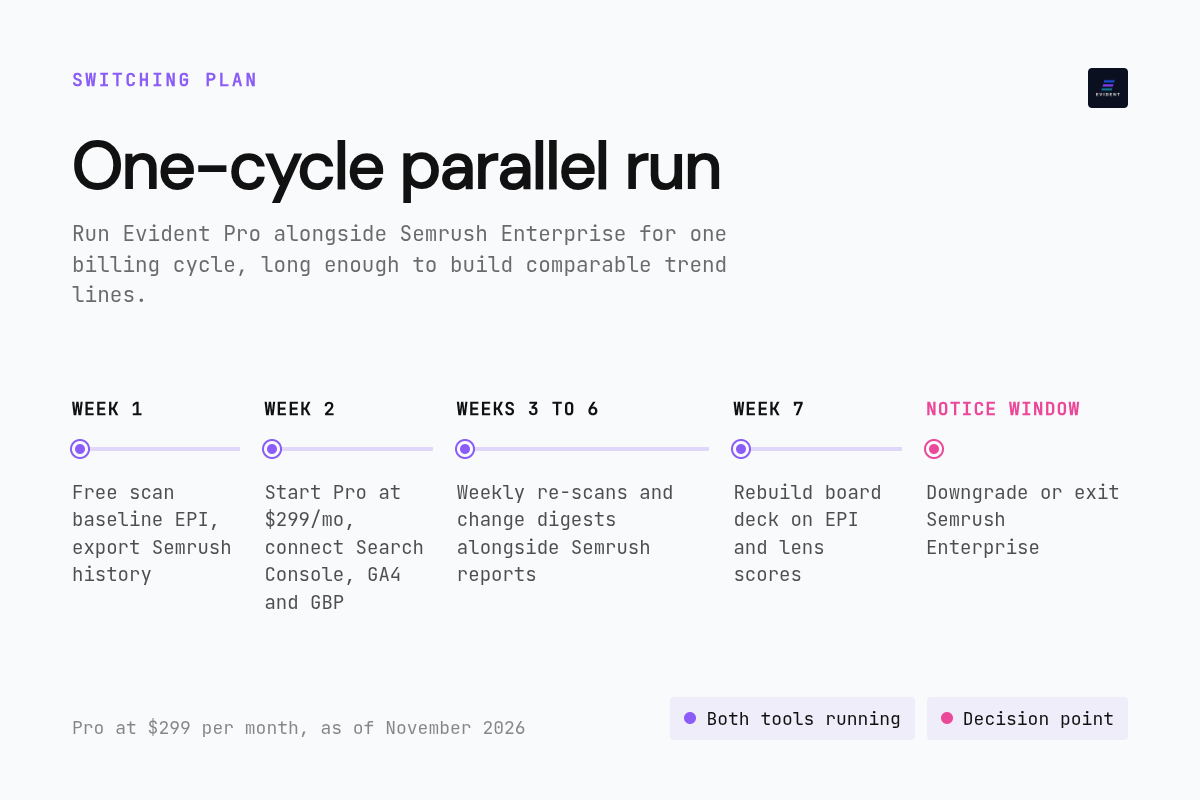
Switching takes seven steps: run Evident's free scan to get a baseline EPI, export Semrush data, map Semrush KPIs to Evident lenses, connect first-party integrations, run both platforms in parallel for one Semrush billing cycle, rebuild executive reporting, then time the Semrush downgrade or exit to the contract notice window.
- Run the free scan. The Free plan scans one site, returns an EPI across all three lenses, the top five critical findings and two competitor snapshots, at $0 with no credit card. This is your baseline before any contract decision.
- Export Semrush history. Pull the reports listed above and date them. Do this before giving notice, not after.
- Map KPIs to lenses. Share of AI answers and citations map to the AI Lens; organic visibility maps to the Search Lens; trust and review metrics map to the Human Lens. The reporting section below has the full mapping.
- Connect integrations. On Pro, connect Search Console, GA4 and Google Business Profile. On Business, add CRM, Slack and review platforms. If you keep Semrush, connect it too so its SEO data enriches the AI and Human lenses.
- Run in parallel. Pro re-scans weekly with historical score tracking and a weekly change digest email, so one Semrush billing cycle produces enough data points to compare trends.
- Rebuild reporting. Export branded PDF reports on Pro, or white-label reports on Business, and present the EPI as the headline number with lens scores beneath it.
- Time the exit. Downgrade or cancel Semrush Enterprise inside the notice window, keeping a lower Semrush tier if keyword research is still needed.
For teams in banking and insurance, the sequence is the same but procurement is slower. Our guide to AI benchmarking for large financial institutions covers the governance questions those buyers add to the list.
Should you run Semrush Enterprise and Evident in parallel?
Yes, run Semrush Enterprise and Evident in parallel when prompt share of voice is still reported to the board, when paid search teams depend on Semrush keyword data, or when a contract exit would cost more than the overlap. Evident's Pro plan includes weekly re-scans and historical score tracking, so a one-cycle overlap yields comparable trend lines.
Three use cases justify keeping both permanently. First, large content teams that plan keyword clusters in Semrush and want Evident to tell them which clusters AI assistants actually trust. Second, paid media teams that correlate Google Ads and Microsoft Ads spend with organic perception, which Evident supports as integrations. Third, brands with an executive KPI tied to engine-level citations that cannot be replaced mid-year.
In those cases the switch becomes an add. Evident lists Semrush as an integration precisely so AI Lens and Human Lens analysis can sit on top of existing SEO data rather than replace it.
How should you remap board and executive reporting KPIs to Evident?
Remap Semrush KPIs to Evident lenses rather than metric to metric. Share of AI answers and citations map to the AI Lens score and competitor briefs; organic visibility maps to the Search Lens enriched by Search Console; trust signals map to the Human Lens fed by Google Reviews, Trustpilot, G2 and Capterra. Report the EPI as the headline number.
Here is the mapping we use with clients:
- Share of AI answers mentioning the brand becomes the AI Lens score, with the competitor battlecards explaining movement.
- Citation count per engine becomes the AI Lens findings list, which names the pages and signals that earn or lose trust.
- Organic share of voice becomes the Search Lens score, with Search Console impressions and clicks as the first-party check.
- Review velocity and rating trends become the Human Lens score, with daily review and GBP monitoring on Pro and six-channel monitoring on Business.
- Competitive gap reports become the per-competitor SWOT analysis and, on Business, win/loss talking points.
One worked example without invented numbers: a Semrush slide that reads "cited in 18 of 200 tracked prompts" tells the board a share. The Evident equivalent slide shows the AI Lens score, the top critical findings behind it, and the specific competitor who holds the prompts you lost. The board gets a number and a reason in the same slide, which is the change executives notice first.
If your organisation is evaluating several vendors at once, our comparison of the best AI benchmarking platforms for banks in 2026 lays out how each one handles reporting.
What does each platform cost at enterprise scale?
Evident publishes its pricing: Free at $0, Pro at $299 per month, Business at $799 per month, and Enterprise on a custom quote, as of November 2026. Semrush Enterprise does not publish list pricing; it is sold on a custom contract, so a budget comparison needs a written Semrush quote and the renewal date beside Evident's public plans.
Seat pricing is also public. Pro includes one seat and allows up to three at $49 per seat per month. Business includes three seats and allows up to ten at $79 per seat per month. Business adds unlimited competitor scans, API access for programmatic scanning, CRM webhooks for Salesforce and HubSpot, white-label reports and re-scan on demand. Enterprise covers custom deployment and governance.
For Semrush, the only honest statement is that Enterprise pricing is quote based. Ask for the quote in writing with the term length, seat count, prompt volume and export rights spelled out, then compare it against the Evident pricing page. A team on Evident Business at $799 per month knows its annual cost to the dollar; a Semrush Enterprise buyer should insist on the same clarity before the Adobe transition changes the packaging.
How did we compare Semrush Enterprise and Evident?
We compared Semrush's published Enterprise product and AI Visibility Index pages, Adobe's acquisition announcement, Semrush's knowledge base export documentation, and Evident's own pricing, integrations and crawler pages as of November 2026. We did not run a formal benchmark study of either tool for this post. Where Semrush does not publish a figure, we said so rather than estimate.
How do you get started with Evident?
Run the free scan at evident.so/scan. You get an EPI score across all three lenses, your top five critical findings and two competitor snapshots in minutes, with no credit card required. Use that baseline to decide whether your Semrush Enterprise renewal should be a switch, an add, or a shorter term.
What do people also ask?
Are Semrush Enterprise AI Visibility Index and Evident AI benchmarking the same category of tool?
No. Semrush Enterprise's AI Visibility Index counts how often a brand is mentioned or cited in ChatGPT, Google AI Mode and AI Overviews answers. Evident scores why search engines, AI assistants and people perceive a business the way they do, as one EPI across Search, AI and Human lenses, and routes the fixes.
What metrics do I lose or gain when moving from Semrush AI visibility benchmarking to Evident?
You lose engine-level prompt share of voice, citation counts and Semrush's keyword and backlink databases. You gain an EPI score, cross-lens pattern detection, AI Battlecards and SWOT per competitor, daily review and GBP monitoring on Pro, and six-channel monitoring with API access on Business.
What does the Adobe acquisition of Semrush mean for Enterprise customers?
Adobe announced an agreement to acquire Semrush for about $1.9 billion in November 2025, with closing expected in 2026. Enterprise customers should check assignment and change-of-control clauses, data export rights and auto-renewal windows, and consider a one-year term while the roadmap and bundling settle.
Can I run Semrush Enterprise and Evident in parallel?
Yes. Evident lists Semrush as an integration, so AI Lens and Human Lens analysis can sit on top of existing Semrush SEO data. Keeping both makes sense when prompt share of voice is a board KPI, paid search teams rely on Semrush keyword data, or an early contract exit costs more than the overlap.
How much does Evident cost compared with Semrush Enterprise?
As of November 2026 Evident publishes Free at $0, Pro at $299 per month, Business at $799 per month and a custom Enterprise tier. Semrush Enterprise is sold on a custom quote with no public list price, so request the quote in writing with term, seats and export rights before comparing.