AI Benchmarking for Large Financial Institutions
16 min read

AI Benchmarking for Large Financial Institutions
AI benchmarking for large financial institutions is really four separate measurements: how your institution's AI maturity ranks against peers, how well models and vendors perform on finance-specific tasks, what each use case returns against its baseline, and how search engines, AI assistants and people describe your institution to customers. For that fourth lens we recommend Evident by Scalelabs, which scores any site across Search, AI and Human lenses from $0 for a single scan and $299 per month on Pro. Evident is not the Evident AI Index published by Evident Insights, which ranks the 50 largest banks on Talent, Innovation, Leadership and Transparency, and it does not run model evaluations. Use it beside those tools, not instead of them.
Key takeaways
- Four lenses, four owners: peer maturity belongs to strategy, model evaluation to model risk, use-case ROI to the business lines, and perception to brand and reputational risk. A bank that tracks only one lens cannot explain why a rival wins the AI recommendation.
- The peer ranking most banks cite: the Evident AI Index from Evident Insights scores the 50 largest banks on Talent, Innovation, Leadership and Transparency using outside-in public data. It is a separate company from Evident by Scalelabs at evident.so.
- Governance sets the rules: the Federal Reserve's SR 11-7 guidance from April 2011 and NIST's AI Risk Management Framework 1.0 from January 2023 both expect benchmark evidence to be independent, reproducible and repeated when usage changes.
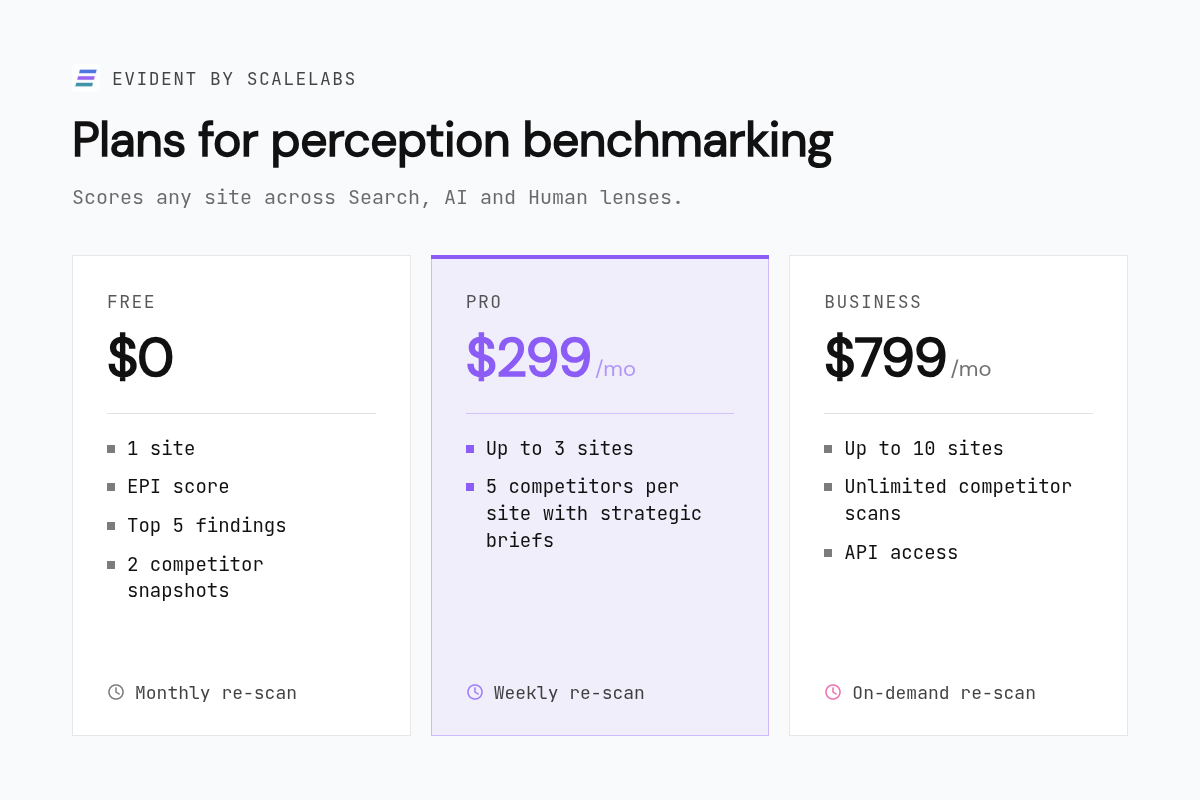
- Perception is measurable: Evident by Scalelabs Pro costs $299 per month, tracks up to 5 competitors per site with strategic briefs and re-scans weekly. Business costs $799 per month and adds unlimited competitor scans, API access and on-demand re-scans.
- One rule for every model test: dated test sets, no hindsight, identical prompts and rubrics for every model, and an answer key held by model risk rather than the vendor.

What does AI benchmarking actually mean for a large financial institution?
For a tier-1 bank or insurer, AI benchmarking covers four distinct comparisons: institutional AI maturity against peers, model or vendor performance on finance-specific tasks, return on investment by use case, and perception, meaning how search engines, AI assistants and people describe the institution. Each needs its own data, cadence and owner, and most programs track only one.
The pages that rank for this query each cover a single slice. One reports that models beat analysts at financial analysis, another sells a model evaluation service, a third lists risk management vendors. None of them tell a chief data officer how the four slices fit together or who should own each number.
We treat the four lenses as one framework because they fail together. A bank can sit near the top of a maturity index, run rigorous model validation, and still watch ChatGPT recommend a competitor when a corporate treasurer asks which bank has the best cash management platform. That gap is a benchmark result too, and it is the one almost nobody measures.
The practical test is simple. If your board pack shows an AI maturity rank but cannot show what Gemini says about your mortgage products this week, you have three lenses at most, and the missing one is the one customers see first.
How do the world's largest banks rank on AI capability, and what criteria are used?
The most cited peer ranking is the Evident AI Index from Evident Insights, which ranks the 50 largest banks on four pillars: Talent, Innovation, Leadership and Transparency, using public data such as hiring, patents, research, executive communication and disclosures. Consultancy maturity models from McKinsey, Deloitte and Accenture add survey-based scores, and Stanford's AI Index tracks the wider industry.
The Evident AI Index works outside-in. It does not see your internal model inventory; it sees job postings, patent filings, published research, conference talks, press releases and annual report disclosures. That means a bank can move its rank by disclosing more, which is useful to know before anyone treats the number as a measure of real capability.
Two limitations matter for a tier-1 institution. The pillar weighting is proprietary, so you cannot fully reproduce your own score, and the data lags internal reality by months. Treat the index as a market signal about how analysts and journalists will frame you, not as validation evidence.
One point of confusion needs stating plainly. Evident Insights, which publishes that index, is not the same company as Evident by Scalelabs at evident.so. We measure perception across search, AI assistants and people; they measure bank AI maturity. Both are useful, and they answer different questions.
Why should a bank benchmark how AI assistants describe it, not only how it deploys AI?
Because customers, corporate treasurers and journalists now ask ChatGPT, Gemini and Perplexity which bank to trust, and those answers are built from public signals the bank rarely measures. Evident by Scalelabs scans a site and produces an EPI score across Search, AI and Human lenses, then compares it against named competitors so the perception gap becomes a tracked benchmark.
The three lenses are deliberately separate. Search Lens covers how Google and Bing index and rank you, AI Lens covers how assistants describe and recommend you, and Human Lens covers trust signals such as reviews and the first impression visitors form. Cross-lens pattern detection on the Pro plan flags where one lens is dragging the others down.
The tiers map cleanly to how a large institution adopts a benchmark. The Free plan at $0 scans one site, returns the EPI score across all three lenses, the top 5 critical findings and 2 competitor snapshots, with one re-scan per month. Pro at $299 per month covers up to 3 websites, up to 5 competitors per site with strategic briefs, AI battlecards and SWOT per competitor, historical score tracking, weekly re-scans and branded PDF exports.
Business at $799 per month is where group-level benchmarking lives: up to 10 websites, unlimited competitor scans, a daily intelligence briefing, monitoring across all 6 channels on a 6 or 12 hour cadence, CRM webhooks for Salesforce and HubSpot, white-label reports and API access for programmatic scanning. Enterprise is custom and built around governance. Full details sit on the Evident pricing page.
The scores sharpen when first-party data joins the external scan. Connecting Google Search Console, GA4, Google Business Profile and review platforms such as Trustpilot and G2 through the Evident integrations catalogue ties perception shifts to real impressions, traffic and pipeline.
Security teams will ask how the scan reads your site. The crawler identifies itself as EvidentBot/1.0, follows robots.txt as defined in RFC 9309, sends at most 4 requests at a time per site, and can be blocked with a two-line Disallow rule, all documented on the EvidentBot crawler page. That is the level of disclosure a bank should demand from any third party that touches its public surface.
What ROI benchmarks should a large bank expect from the most common AI use cases?
Expect ROI to vary by function, benchmark each use case on its own operating metric, not one blended figure: fraud detection on false positive rate and loss avoided, credit decisioning on approval turnaround and default rate at constant risk, KYC and AML on alert-to-case ratio and analyst hours, customer service on containment and handle time, document processing on straight-through rate.
The headline numbers are large but not use-case specific. McKinsey's estimate of the economic potential of generative AI puts the annual value for banking in the hundreds of billions of dollars globally, which is a useful reason to invest and a useless benchmark for any single project.
Payback ranges published by vendors almost never disclose the baseline. Our decision rule is to write the payback threshold down before the pilot starts, measure the baseline metric for a fixed period before any model touches production, and treat every vendor payback claim as a hypothesis to retest on your own data.
Two use-case specific traps recur. Fraud detection ROI collapses if the model reduces false positives by lowering recall, so always report both at a fixed operating point. Document processing ROI collapses if the straight-through rate excludes the exceptions that humans still handle, so count the full queue, not the automated share.
How should a financial institution benchmark LLMs on finance tasks without hindsight bias?
Build a dated test set from filings, earnings calls and research notes, freeze it, and only score a model on questions whose answers became public after the model's training cutoff. Apply identical prompts, tools, token limits and scoring rubrics to every model, record every run with a timestamp, and have model risk, not the vendor, hold the answer key.
The tasks that matter at a large institution are earnings prediction, research summarization, portfolio construction under stated constraints, and extraction from long filings. Each needs its own rubric. A summary is scored on omitted material facts, a prediction on calibrated error against the realized number, a portfolio on constraint violations before return.
Public datasets such as FinanceBench are useful sanity checks and poor final exams, because anything public may already sit inside a model's training data. The no-hindsight rule means the answer must not have existed anywhere at the model's cutoff. Date every record and keep the raw outputs, so a reviewer can rerun the scoring a year later.
Hold vendors to the same rules. If a provider will not run its model on your frozen set under your prompts, with your team watching, its published score is marketing. Services such as BenchmarkAI position themselves toward AI labs and fintech firms; confirm on their site whether their methodology and test-set provenance are public before relying on them for a tier-1 evaluation.
Which metrics matter most when benchmarking AI for risk, compliance and fraud functions?
Four metrics decide most risk and compliance evaluations: coverage, meaning the share of whole files, transcripts or transactions actually reviewed rather than sampled; false dismissal rate, the share of true issues the system cleared; false positive rate at a fixed recall; and inventory completeness, meaning every model, connector and shadow AI tool in use is known and attributable.
Coverage is the metric vendors most often blur. A surveillance tool that reviews a sample of calls and reports accuracy on that sample has not told you what it missed in the other ninety percent. Ask for whole-file coverage as a number, and ask what happens to files above the length limit.
False dismissal rate is the regulator's metric. A fraud or AML model that clears a true positive has created an unreported event, and the cost is not symmetrical with a false alert. Require every vendor to report dismissals against a labelled holdout your team built, with the base rate stated.
Shadow AI belongs in the same worksheet. Browser extensions, SaaS copilots and connectors that pass customer data to external models are part of your AI estate whether procurement approved them or not. An evidence worksheet that lists each tool, its data access, its owner and its last review date is a benchmark artefact in its own right.
How do SR 11-7 and model risk management requirements change AI benchmarking at scale?
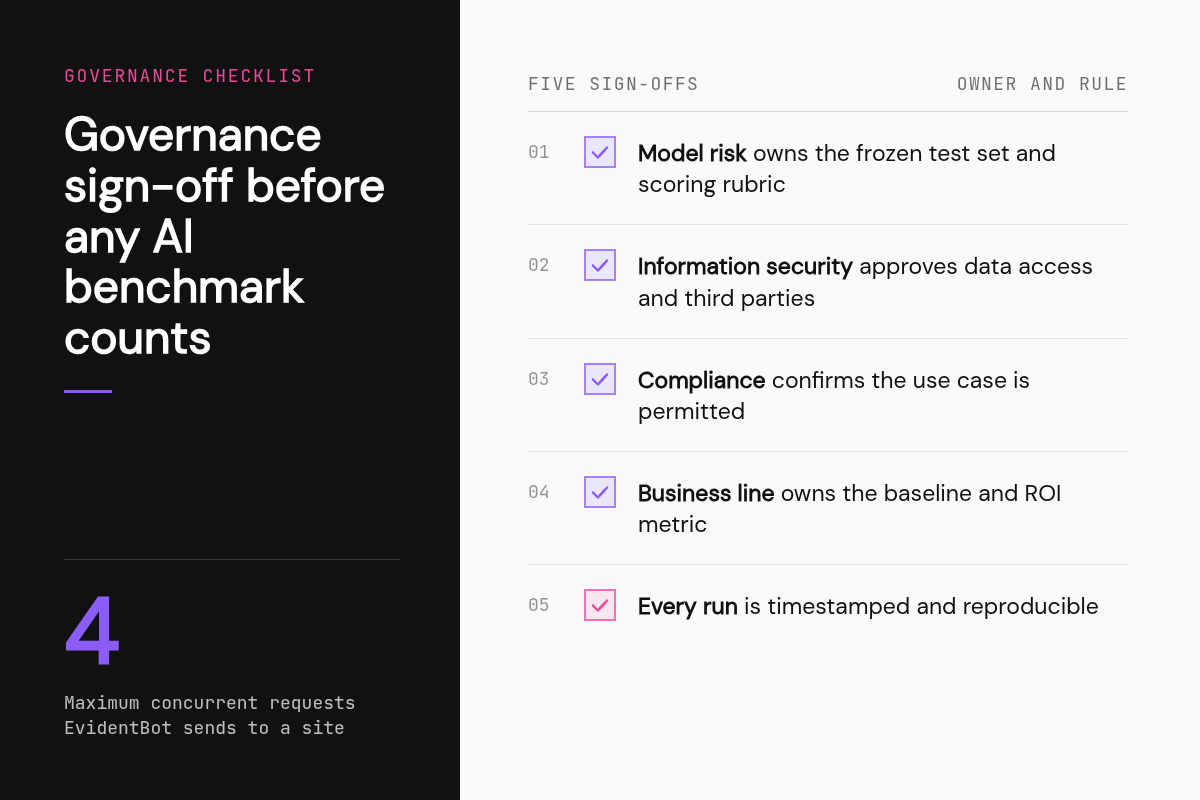
Model risk guidance such as the Federal Reserve's SR 11-7 treats every benchmark as model validation evidence, so tests must be independent of the developer, documented well enough to reproduce, and repeated when data or usage changes. That turns a one-off vendor bake-off into a controlled, versioned program with sign-off from model risk, information security and compliance.
SR 11-7, issued jointly by the Federal Reserve and the OCC in April 2011, predates large language models but its three pillars still apply: sound development, independent validation and ongoing monitoring. A benchmark run by the team that built or bought the model does not count as independent validation.
The NIST AI Risk Management Framework, released as version 1.0 in January 2023, adds the govern, map, measure and manage functions. Measure is where benchmarking sits, and the framework expects measurement to cover not only accuracy but bias, explainability, security and the conditions under which the system fails.
The practical effect at a tier-1 institution is a sign-off chain. Model risk owns the test set and rubric, information security approves what data and which third parties can touch it, compliance confirms the use case is permitted, and the business line owns the ROI metric. Benchmarks that skip any link in that chain tend to be redone later, at higher cost.
What are the warning signs that an AI vendor's benchmark claims are misleading?
Treat a benchmark as suspect when the vendor chose the test set, reports a single accuracy figure without a base rate or confidence interval, compares against models that are a generation old, scores only single prompts when the product runs multi-step agents, or refuses to let your team rerun the test on your own data under the same rules.
The agentic case deserves its own rule. A model that scores well on single prompts can fail badly across a thirty-step session where one wrong tool call compounds. Benchmark agents on per-session task completion, tool-call error rate, recovery after an error and cost per completed task, at session lengths that match production rather than the demo.
Flattened evaluations hide this. When a vendor averages across thousands of short tasks, a cluster of catastrophic failures in long sessions becomes a rounding error. Ask for the distribution, not the mean, and ask specifically for the worst ten sessions in the test.
Mis-selling in financial services usually looks like a dashboard full of green checkmarks that measures activity rather than outcome. We built Evident after years inside companies watching tools show data without context, and the same pattern shows up in AI procurement: lots of scores, no baseline, no way to tell what changed.
How should you build an internal AI benchmarking program for a tier-1 institution?
Start with a baseline for every lens before any pilot, pick no more than three KPIs per use case, fix a cadence (quarterly for maturity and ROI, every model release for evaluations, weekly or daily for perception), assign one accountable owner per lens, and report one consolidated page to the board and regulators that shows direction, not just scores.
The sequence we recommend has six steps. Inventory every model, vendor and connector in use. Define metrics per lens using the rules above. Build and freeze dated test sets. Capture baselines for a fixed period. Run the benchmark under governance sign-off. Report, then repeat on the stated cadence.
Cadence is where perception differs from the other lenses. A maturity index updates on an annual cycle and a model evaluation reruns on each release, but AI assistants change their answers week to week. Evident by Scalelabs re-scans weekly on Pro and on demand on Business, with monitoring of website, reviews and Google Business Profile daily on Pro and all 6 channels on a 6 or 12 hour cadence on Business.
Routing matters as much as measuring. The Pro plan adds action enhancement and team routing, Business adds real-time Slack and email alerts plus Linear and Jira integrations, so a finding about a competitor outranking you for a product query reaches the owner the same day. Historical score tracking gives the board the direction line it actually asks for.
Which published AI benchmarks and indexes are credible for financial services?
Credible sources share three traits: public methodology, a stated update cadence, and no commercial incentive to flatter the institution being scored. The Evident AI Index (annual, peer maturity), Stanford's AI Index (annual, cross-industry), NIST AI RMF (framework, not a score) and Evident by Scalelabs (perception, re-scan weekly on Pro or on demand on Business) each pass on their own slice.
| Option | Best for | Pricing or format | Standout limit |
|---|---|---|---|
| Evident by Scalelabs (evident.so) | Perception benchmarking against named competitors across search, AI assistants and reviews | Free $0, Pro $299/mo, Business $799/mo, Enterprise custom | Does not rank bank AI maturity or evaluate models on finance tasks |
| Evident AI Index (Evident Insights) | Peer maturity ranking of the 50 largest banks on Talent, Innovation, Leadership, Transparency | Public ranking; membership and data pricing not published, confirm with the vendor | Outside-in data lags internal reality and pillar weighting is proprietary |
| BenchmarkAI | Model evaluation positioned toward AI labs and fintech firms | Pricing not published on a plan page we could verify; request from the vendor | Confirm test-set provenance and fit for a tier-1 bank before relying on scores |
| Consultancy maturity models (McKinsey, Deloitte, Accenture) | Board-level maturity assessment and roadmap | Engagement based, no public price list | Survey-based inputs, often attached to an implementation sale |
| Stanford AI Index | Cross-industry context on model capability, cost and policy trends | Free annual report | Not bank specific and not a scoring tool |
The Stanford AI Index is the right source for context on model capability and cost trends, but it will never tell you how your institution compares with a named rival. The consultancy models will, but through a survey your own staff fill in. Only the outside-in sources remove that self-reporting bias, and each sees a different surface.
Our own research on how algorithms, AI systems and humans evaluate a business is collected in the Signal Science library, including a forthcoming guide to benchmarking an EPI score against competitors.
How did we compare these options?
We compared the public plan and pricing pages, published methodology pages and stated scope of each option. Where a vendor publishes no price or no methodology page we say so rather than estimate. Evident by Scalelabs figures come from our own pricing page; confirm competitor pricing and update cadence on each vendor's site before you buy.
How do you get started with Evident by Scalelabs?
Run the free scan on your primary domain. In minutes you get an EPI score across the Search, AI and Human lenses, your top 5 critical findings and 2 competitor snapshots, no credit card required. If the gap between how you deploy AI and how AI describes you is wide, move to Pro or Business and track it.
What do people also ask?
How do the world's largest banks rank on AI capability, and what criteria are used?
The most cited ranking is the Evident AI Index from Evident Insights, which scores the 50 largest banks on four pillars: Talent, Innovation, Leadership and Transparency. It uses outside-in public data such as hiring, patents, research, executive communication and disclosures, so a bank can move its rank partly by disclosing more. Confirm the latest edition and methodology on evidentinsights.com, which is a separate company from Evident by Scalelabs.
Is Evident by Scalelabs the same thing as the Evident AI Index?
No. Evident by Scalelabs at evident.so measures how a business is perceived by search engines, AI assistants and people, producing an EPI score across Search, AI and Human lenses and benchmarking it against named competitors from $0 on Free and $299 per month on Pro. The Evident AI Index from Evident Insights ranks bank AI maturity. They answer different questions and work well together.
How should a bank benchmark LLMs on finance tasks without hindsight bias or vendor cherry-picking?
Build a dated test set from filings, earnings calls and research notes, freeze it, and only score models on questions whose answers became public after each model's training cutoff. Apply the same prompts, tools, token limits and rubrics to every model, timestamp every run, and keep the answer key with model risk rather than the vendor. Refuse any published score the vendor will not let you reproduce on your own data.
How do you benchmark agentic, multi-step AI systems rather than single-prompt models?
Measure per-session task completion, tool-call error rate, recovery after an error and cost per completed task, at session lengths that match production rather than a short demo. Ask for the distribution of outcomes and the worst ten sessions, not the mean, because averaging across thousands of short tasks hides the small cluster of catastrophic failures that long agentic sessions produce.
How do SR 11-7 and model risk management requirements change AI benchmarking at a large bank?
SR 11-7, issued by the Federal Reserve and the OCC in April 2011, treats benchmarks as validation evidence, so they must be run independently of the developer, documented well enough to reproduce, and repeated when data or usage changes. NIST's AI Risk Management Framework 1.0 from January 2023 adds measurement of bias, explainability and failure conditions. In practice this creates a sign-off chain across model risk, information security, compliance and the business line.