AI Intelligence Platforms for Financial Consultants Explained
14 min read

AI Intelligence Platforms for Financial Consultants Explained
AI intelligence platforms for financial consultants do five different jobs: meeting notes, prospecting, planning support, client communication, and perception intelligence. For perception intelligence we recommend Evident by Scalelabs, which scores how search engines, AI assistants and people perceive an advisory practice, starting free and moving to $299 per month on Pro as of November 2026. Evident is not a financial planning copilot, a notetaker, or an investment research engine. Pair it with those tools rather than expecting it to replace them.
Key takeaways
- Five categories: AI intelligence platforms for financial consultants split into meeting notetakers, prospecting tools, planning copilots, client communication assistants, and perception intelligence platforms, and a small practice usually needs two or three of them.
- Evident pricing: Evident by Scalelabs offers a free tier with one website scan and an EPI score across three lenses, a Pro plan at $299 per month, and a Business plan at $799 per month, as of November 2026.
- Regulatory reality: The SEC fined two advisers a combined $400,000 in March 2024 for exaggerating their use of AI, and FINRA Regulatory Notice 24-09 confirms existing supervision and recordkeeping rules apply to generative AI.
- Decision rule: Run a free perception scan before buying prospecting software, because if ChatGPT already recommends competing advisors over your firm, lead generation spend fills a bucket with a hole in it.
- Generic vs built for advisors: ChatGPT Plus costs $20 per month as of November 2026 and is useful for drafting, but it has no advisor-specific compliance archiving, so it cannot be the system of record for client communications.

What are AI intelligence platforms for financial consultants?
AI intelligence platforms for financial consultants are software systems that use machine learning or large language models to collect, interpret and act on information for an advisory practice. The information can be client conversations, prospect data, market research, or how the firm itself is perceived by Google, ChatGPT and prospects. Most practices need two or three of these, not one.
The phrase gets used loosely. Vendors apply it to a transcription app, a CRM add-on, a market data terminal and a reputation monitor alike. The jobs are unrelated, so the first thing we do with a consulting client is sort every candidate tool into one of five buckets before comparing anything.
Those buckets are meeting intelligence, prospecting intelligence, planning intelligence, communication intelligence, and perception intelligence. The first four look inward at the work of the practice. The fifth looks outward at how the market sees the practice. The outward view is the one most advisors have never measured.
We covered the broader category in our guide to the top AI intelligence platforms for financial services. This post goes narrower, on what an independent consultant or small RIA should actually buy, in what order, and with which guardrails.
Which AI platforms are genuinely built for financial advisors rather than generic business AI?
Tools built specifically for advisors include Jump, Zocks and FinMate AI for meeting notes, Catchlight for prospect intelligence, Kensho from S&P Global for research, and eMoney and AdvisorEngine for planning. Generic tools include ChatGPT, Microsoft Copilot, Intercom and LeadGenius. Evident sits in a third group: perception intelligence that is not advisor-specific, drawing on general review sources instead.
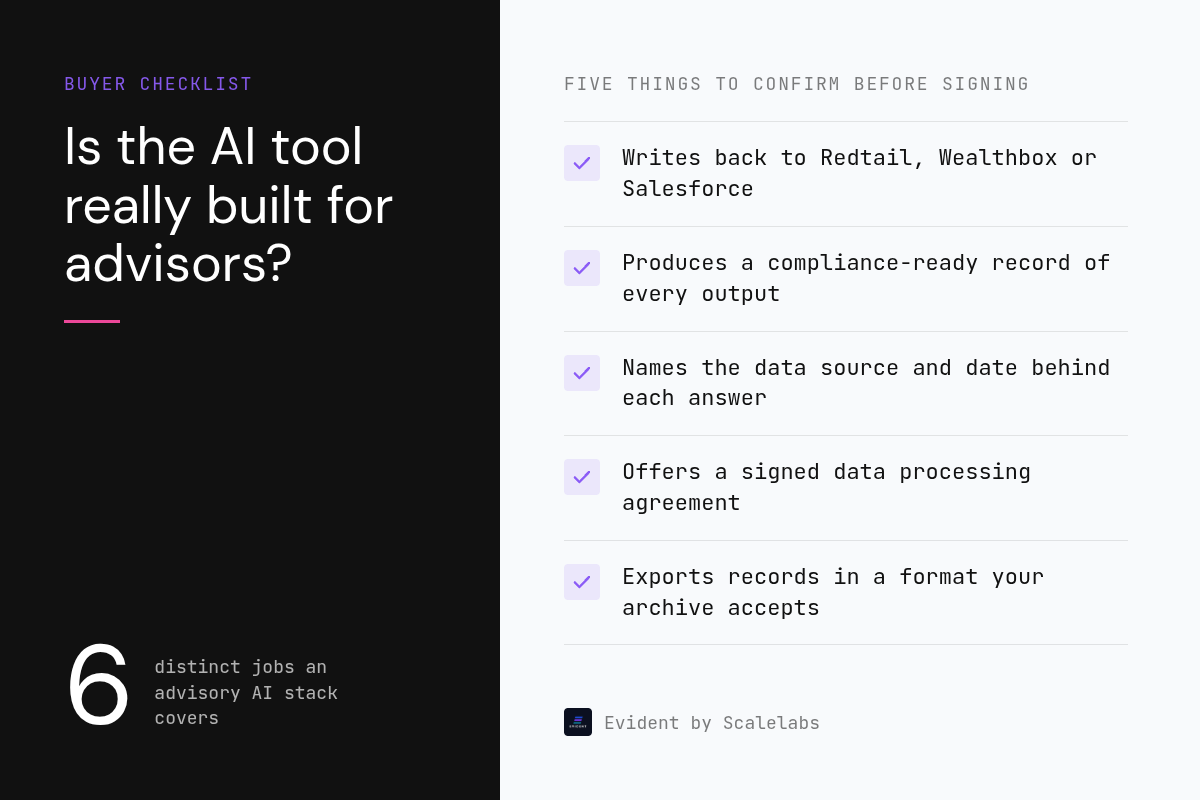
The test for industry specific is not the marketing page. It is whether the tool ships with the integrations and the compliance posture an advisor needs on day one. A notetaker that pushes summaries into Redtail or Wealthbox and exports an archive for your compliance officer is built for advisors. A notetaker that only syncs to Google Docs is not.
Generic tools are not useless. ChatGPT is excellent at rewriting a client letter in plain language or drafting a first version of a quarterly market note. The problem is that generic tools do not know what the SEC Marketing Rule allows you to say, and they do not archive anything.
Evident is honest about where it sits. We built it to measure perception, so it draws from Google Business Profile, Google Reviews and Trustpilot among other sources. It does not plug into a custodian, and it does not draft a financial plan.
Why should perception intelligence come before planning copilots and notetakers?
Perception intelligence should come first because every other tool assumes prospects already find and trust the practice. Evident by Scalelabs scores that assumption across three lenses: Search, AI and Human. If an advisor ranks poorly in all three, a prospecting tool generates leads into a reputation that loses them before the first call.
This comes directly from our consulting work at Scale Labs. We sat inside businesses, audited their visibility, and watched them get sold tools that showed data without context. A client would invest in SEO, receive a dashboard full of green checkmarks, and still have no idea why AI assistants were recommending competitors instead.
The tools measured performance. Nobody measured perception. That gap, between what a business was doing and what the world actually saw, was where revenue was leaking. Evident is the diagnostic layer we wished had existed before any of that work started, and the arrival of LLMs made the problem harder, because a firm is now judged by Google, by ChatGPT and by people at the same time.
The method is concrete. Evident runs an external scan with its own crawler, EvidentBot, which identifies itself as EvidentBot/1.0, fetches at most 4 requests at a time per site, and follows robots.txt as defined in RFC 9309. The scan produces an EPI score across the three lenses, the top findings, and competitor snapshots.
For a financial consultant, the AI Lens is the one to watch. Google states in its Search Central documentation on AI features that AI Overviews draw on the same indexing and ranking systems as regular search, which means a weak search footprint and a weak AI footprint usually share a root cause.
How do the main categories compare on job, pricing and limits?
AI intelligence platforms for financial consultants compare best by the job each one does rather than by features lists. Evident measures perception, Jump captures meetings, Catchlight scores prospects, Kensho supports research, ChatGPT drafts text, and eMoney models plans. Prices range from free to several hundred dollars per month, and every category has one limitation advisors should know before buying.
| Option | Best for | Pricing or format (as of November 2026) | Standout limit |
|---|---|---|---|
| Evident by Scalelabs | Measuring how Google, AI assistants and people perceive the practice | Free tier; Pro $299 per month; Business $799 per month | Not a planning, notetaking or research tool |
| Jump | Recording and summarising client meetings into Redtail or Wealthbox | Per-user subscription, confirm on the vendor site | Needs compliance review of recording consent in each state |
| Catchlight | Scoring and prioritising prospects by estimated financial profile | Subscription priced by seat and data volume, confirm on the vendor site | Estimates, not verified assets; models can be wrong on an individual |
| Kensho (S&P Global) | Institutional research, document search and data extraction | Enterprise contract, priced on request | Built for institutions, often out of reach for a solo RIA |
| ChatGPT Plus (OpenAI) | Drafting letters, summaries and marketing copy | $20 per month on the published Plus plan, confirm on openai.com | No archiving, no advisor compliance rules, hallucination risk on numbers |
| eMoney | Financial planning and client portal with growing AI assistance | Per-advisor subscription, confirm on the vendor site | Planning depth comes with onboarding time and data entry |
The column that matters most for an independent advisor is the last one. Flat listicles tell you what each tool does. They rarely tell you what it cannot do, and that is the detail that decides whether a tool survives your compliance review.
If you are comparing Evident against enterprise SEO suites rather than advisor tools, we wrote a separate comparison of Evident versus Semrush Enterprise for financial AI research that explains why keyword data alone misses the AI Lens.
Can ChatGPT do financial modelling, and which AI is best for investment research?
ChatGPT can build a simple model, explain a formula, or draft a spreadsheet structure, but it should not be relied on for client-facing calculations because large language models can produce confident wrong numbers. For investment research, Kensho and similar institutional tools are stronger, and even those support an advisor's judgment rather than replace it.
The practical rule we give clients is simple. Use a general LLM to reason about a model, never to be the model. Ask it to explain why a Monte Carlo result changed, or to write the Excel formula for a safe withdrawal rate. Then put the calculation in a tool that a human can audit, such as eMoney or a spreadsheet you control.
OpenAI itself describes model limitations openly. Its enterprise privacy page also explains that business tiers do not use customer data to train models by default, while consumer accounts require the user to manage data controls. That difference matters when the prompt contains a client's balance sheet.
There is a second reason to be cautious. The SEC announced in March 2024 that it had settled charges against two investment advisers, Delphia and Global Predictions, for making false statements about their use of AI, with combined civil penalties of $400,000. Overstating what an AI tool does in your own marketing is now an enforcement category.
How much do AI intelligence platforms for financial consultants cost, and which have free versions?
AI intelligence platforms for financial consultants range from free to enterprise contracts. Evident by Scalelabs is free for one website scan with an EPI score and the top five critical findings, then $299 per month for Pro and $799 per month for Business, as of November 2026. ChatGPT Plus is $20 per month.
Here is the Evident breakdown in detail, as of November 2026. The Free tier covers one user, one website, the EPI score across all three lenses, the top five critical findings, two competitor snapshots without briefs, and one re-scan per month. There are no exports, no monitoring and no chat on Free.
Pro at $299 per month includes one seat, with up to three seats total at $49 per seat per month. It adds up to three websites, the full scorecard deep-dive, up to five competitors per site with strategic briefs, AI battlecards and SWOT analysis per competitor, historical score tracking, daily monitoring of website, reviews and Google Business Profile, a weekly change digest email, Persona Lab chat, branded PDF exports, and weekly re-scans.
Business at $799 per month includes three seats, with up to ten seats at $79 per seat per month, up to ten websites, unlimited competitor scans, win and loss talking points, outreach templates, full monitoring across all six channels on a 6 hour or 12 hour cadence, real-time Slack and email alerts, CRM webhooks for Salesforce and HubSpot, white-label reports, API access and on-demand re-scans. Enterprise is custom. The full Evident pricing page lists every line.
For a solo consultant, the honest cost picture is this: free Evident scan, ChatGPT Plus at $20, and one advisor-specific notetaker on a per-seat plan. That is a starting stack under the price of a single Pro subscription until the practice proves it needs daily monitoring and competitor briefs.
How do AI tools handle compliance, data privacy and client confidentiality for regulated advisors?
AI tools handle compliance only as well as the advisor configures them. FINRA Regulatory Notice 24-09 states that existing rules on supervision, communications and recordkeeping apply to generative AI. Practical guardrails are a data processing agreement, a training opt-out, an archiving export, and a written policy stating which client data may never enter a prompt.
FINRA Regulatory Notice 24-09, published in June 2024, is the clearest regulator statement on the topic. It reminds member firms that technology governance, model risk, third-party vendor oversight and supervision obligations do not change because the technology is generative. State-registered and SEC-registered RIAs are not FINRA members, but examiners ask the same questions.
Recordkeeping is where most small practices slip. FINRA Rule 4511 requires members to make and preserve books and records, and SEC Rule 204-2 imposes similar duties on registered advisers. If an AI notetaker produces the only record of a client meeting, that record has to be retained in a form your compliance program can produce on request.
We apply four guardrails before any client of ours pilots an AI tool that touches client data. First, a signed data processing agreement naming where data is stored. Second, confirmation that prompts and outputs are excluded from model training. Third, a bulk export to your archiving system. Fourth, a one-page prompt policy that lists forbidden inputs, such as account numbers and social security numbers.
Evident is simpler on this front because it reads public pages, not client records. Our crawler obeys robots.txt, fetches nothing from a site whose robots.txt returns a server error, and is documented on the EvidentBot crawler page. When you connect first-party sources, such as Search Console or Google Analytics, you choose each integration individually on the Evident integrations page.
Should a small advisory practice stack these tools into one workflow, and how?
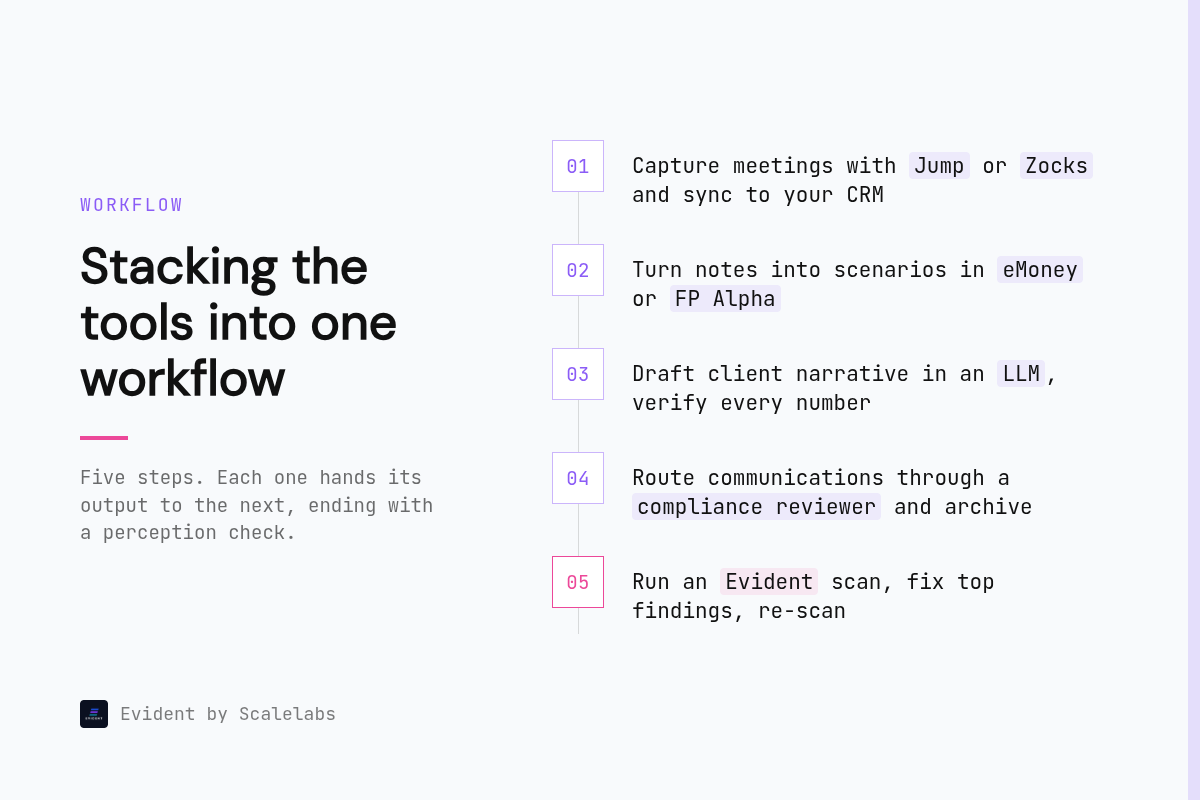
A small advisory practice should stack three tools at most in the first year: a perception layer, a meeting layer and a drafting layer, connected through the CRM it already runs. Redtail, Wealthbox, Orion and eMoney are the usual anchors. Adding a fourth tool before the first three produce measurable results creates logins, not leverage.
Here is a worked example for a two-advisor RIA with one operations lead. Week one, run the free Evident scan and read the top five findings. If the AI Lens is the lowest of the three lens scores, that is the first project, because it means assistants like ChatGPT are more likely to name a competitor when a prospect asks for an advisor in your city.
Week two, pilot one advisor-specific notetaker with the CRM integration switched on, and route every summary to the compliance archive. Week three, give each advisor a ChatGPT Plus seat at $20 per month, with the prompt policy taped to the monitor. Month two, decide whether Evident Pro at $299 per month earns its place by whether anyone acted on a finding from the free scan.
The decision rule we use is this. Upgrade perception monitoring when the practice has fixed the free findings and needs to know when scores move. Upgrade prospecting when the Human Lens score is healthy, because reviews and trust signals are what a scored prospect reads next. Never buy prospecting first.
On the question of reviews and real user sentiment, we can only speak to our own data sources. Evident ingests Google Reviews, Trustpilot and G2 signals into the Human Lens because peer review platforms are weighted heavily by AI systems in B2B contexts. For advisor notetakers and prospecting tools, read the vendor's own documentation and ask for two reference clients in your registration category. If you are already evaluating AI visibility trackers, our review of Profound alternatives for financial services AI tracking covers that narrower comparison.
How did we compare these options?
We compared published pricing pages, plan descriptions and the stated scope of each tool as of November 2026, then sorted every tool by the job it does best rather than by feature count. Evident figures come from our own pricing and crawler documentation.
How do you get started with Scalelabs?
Getting started with Evident by Scalelabs takes a few minutes and no credit card. The Free tier scans one website, returns an EPI score across the Search, AI and Human lenses, and lists the top five critical findings. Upgrade to Pro or Business only when the free findings have been acted on and you need monitoring and competitor briefs.
Start with the free scan at evident.so/scan, read the five findings, and decide which of the three lenses needs work before you spend a dollar on any other AI intelligence platform for your practice.
What do people also ask?
Which AI is best for investment advice?
No AI should give investment advice to a client directly. Institutional research tools such as Kensho from S&P Global support an advisor's own analysis, and planning platforms such as eMoney run the numbers, but the fiduciary recommendation stays with the licensed advisor. General LLMs like ChatGPT are useful for explaining concepts and drafting, not for recommendations.
Who are the top 5 in wealth management AI tools?
Lists vary by publication, but five names that appear consistently for advisors are Jump for meeting notes, Catchlight for prospect intelligence, Kensho for research, eMoney for planning, and Evident by Scalelabs for perception intelligence across search, AI assistants and reviews. Choose by the job you need done, not by list position.
Can ChatGPT do financial modelling?
ChatGPT can structure a model, write spreadsheet formulas and explain results, but it can also produce confident wrong numbers. Use it to reason about a model, then build the calculation in a tool a human can audit, such as a spreadsheet or a planning platform. Never send client identifiers in a prompt without a data processing agreement and a training opt-out.
What are the 5 types of AI tools an advisory firm needs?
The five types are meeting intelligence (notetakers like Jump or Zocks), prospecting intelligence (Catchlight), planning intelligence (eMoney, AdvisorEngine), communication intelligence (ChatGPT or Copilot for drafting), and perception intelligence (Evident by Scalelabs, which measures how Google, AI assistants and people see the practice). Most small firms start with two or three.
Are there free AI intelligence platforms for financial consultants?
Yes. Evident by Scalelabs has a free tier with one website scan, an EPI score across three lenses, the top five findings and two competitor snapshots, as of November 2026. ChatGPT also has a free tier, with Plus at $20 per month. Most advisor-specific notetakers and prospecting tools offer trials rather than permanent free plans, so confirm on each vendor's site.