AI Benchmarking Platforms for Insurance Companies: How They Work
13 min read

AI Benchmarking Platforms for Insurance Companies: How They Work
AI benchmarking platforms for insurance companies split into two camps: operational tools that compare rates, loss ratios, and claims performance against peer data, and perception tools that compare how AI assistants and search engines recommend one carrier over another. For the second job we recommend Evident, built by Scalelabs: the Free plan returns an EPI score with 2 competitor snapshots at $0, and Pro is $299 per month as of November 2026. Evident is not an underwriting, rating, or loss-ratio benchmarking tool. For peer comparisons of rates and claims, insurers use actuarial platforms such as Verisk, Milliman, Earnix, or Akur8 alongside it.

Key takeaways
- Two kinds of benchmark: Operational AI benchmarking platforms such as Verisk, Milliman, Earnix, and Akur8 compare an insurer's pricing, loss costs, and claims metrics against industry data, while Evident benchmarks how ChatGPT, Google AI Overviews, and reviewers describe an insurer versus named competitors.
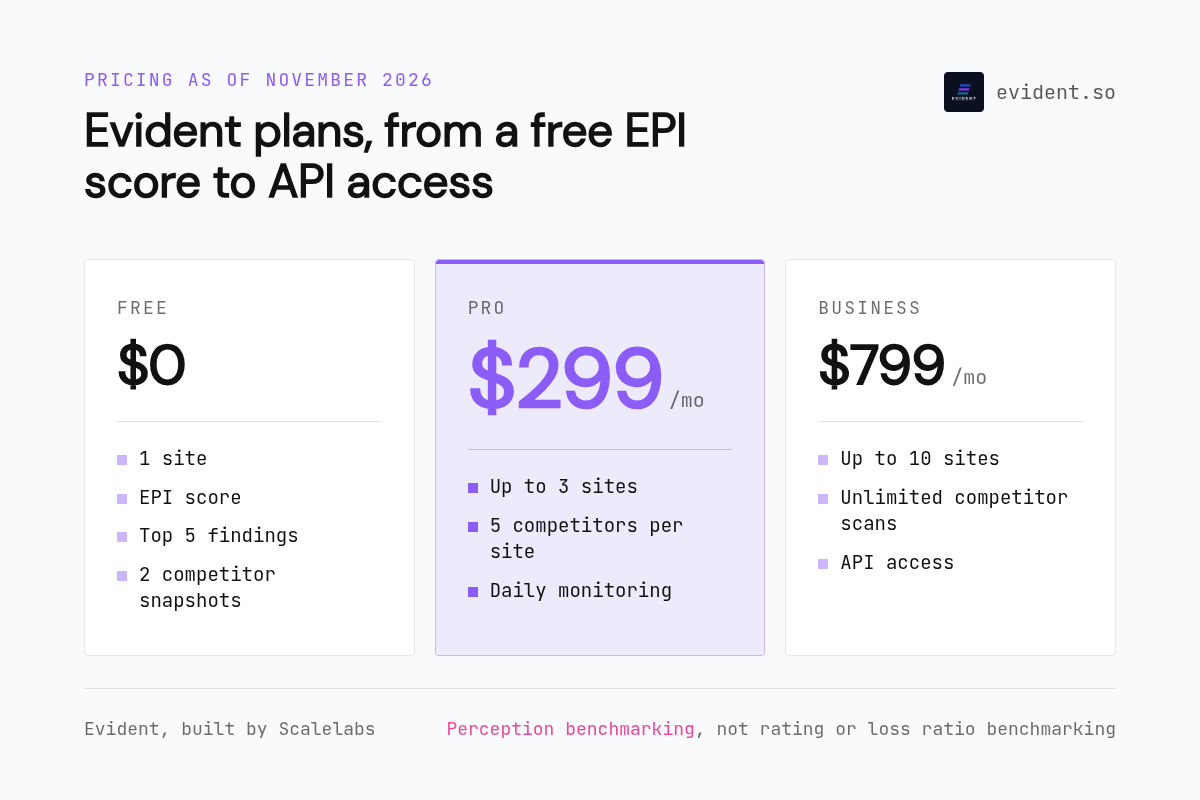
- Evident pricing: As of November 2026, Evident offers a $0 Free plan with 1 site and 2 competitor snapshots, Pro at $299 per month with up to 3 sites and 5 competitors per site, and Business at $799 per month with up to 10 sites and unlimited competitor scans.
- Regulation applies to benchmarking vendors: The NAIC Model Bulletin on the Use of Artificial Intelligence Systems by Insurers, adopted in December 2023, expects insurers to document governance, risk controls, and third-party oversight for any AI tool that touches consumer-facing decisions.
- Decision rule: If the unanswered question is why an AI assistant recommends a competitor, an insurer needs perception benchmarking; if the question is whether rates or loss ratios are out of line with peers, an insurer needs operational benchmarking.
What is an AI benchmarking platform for insurance companies?
An AI benchmarking platform for insurance companies is software that uses machine learning to compare an insurer's results against peers, industry datasets, or named competitors. Operational platforms benchmark pricing, loss ratios, claims cycle times, and fraud rates. Perception platforms benchmark how AI assistants, search engines, and reviewers rank one insurer against another when a buyer asks for a recommendation.
The word benchmarking is what separates these tools from general insurance analytics and AI underwriting software. Analytics describes your own book of business. Underwriting software makes or supports decisions on individual risks. Benchmarking adds an external reference point, so the output is always a comparison rather than a standalone number.
Most pages that rank for this term today are lists of generic AI tools for insurers and never define the comparison layer. We cover the broader landscape in our guide to the top AI intelligence platforms for financial services, and the differences between carriers and banks in our piece on AI adoption tracking for banking versus insurance.
How do AI benchmarking platforms for insurers actually work?
AI benchmarking platforms for insurers work in three stages: ingest data, normalize it to a common baseline, then compare. Operational tools ingest ISO and Verisk statistical data, claims histories, and geospatial imagery. Perception tools ingest public web pages, review platforms, and live answers from AI assistants.
On the operational side, Verisk's ISO business aggregates premium and loss data reported by participating insurers, which is why its loss costs are the most common industry baseline in US property and casualty. Geospatial vendors such as Cape Analytics add aerial imagery to benchmark property condition against neighboring risks. Fraud platforms compare claim patterns against anonymized cross-carrier signals.
On the perception side, the comparison data comes from the same sources AI assistants use. Google documents that AI Overviews and AI Mode draw on indexed web content in its AI features guidance for site owners, and OpenAI publishes its OAI-SearchBot crawler documentation for the pages ChatGPT search can surface. A perception benchmark reads those same public signals and asks the assistants the questions insurance buyers ask.
Our own crawler, EvidentBot, reads public pages at a pace of at most 4 requests at a time per site and follows robots.txt as defined in RFC 9309. Insurers can see exactly what it reads and block it with a single robots.txt rule, which matters for carriers with strict vendor access policies.
Which platforms benchmark pricing, loss ratios, and claims performance against peers?
Verisk, Milliman, and Applied Systems' RiskMatch supply true peer and industry comparison data for insurers. Earnix and Akur8 build pricing and rating models on an insurer's own data and benchmark rate adequacy internally. Shift Technology and Friss benchmark claim and fraud patterns. Evident is the only option in this set that benchmarks AI assistant and search perception against competitors.
Verisk is the reference point for industry loss costs, rating information, and claims data in US P&C, licensed through enterprise agreements that insurers confirm directly with Verisk. Its limit is scope: Verisk tells you how your experience compares with the industry, not how a buyer or an AI assistant perceives your brand.
Milliman provides benchmarking studies and actuarial datasets across P&C, life, and health, usually delivered as consulting engagements or subscriptions quoted by Milliman. The trade-off is cadence: studies refresh on a schedule rather than daily.
Earnix and Akur8 are pricing and rating platforms. Earnix covers rating, personalization, and product deployment for P&C and life carriers on an enterprise license quoted by Earnix. Akur8 markets transparent GLM-based pricing models and quotes pricing through Akur8. Both benchmark rate adequacy against your own historical data and model variants, not against peer rate filings, so insurers often pair them with Verisk data.
Shift Technology and Friss specialize in fraud detection and claims decision support. They benchmark individual claims against learned patterns, which improves fraud hit rates but does not compare your loss ratio or claims cycle time with a peer group.
| Platform | What it benchmarks | Pricing or format | Standout limit |
|---|---|---|---|
| Evident (Scalelabs) | AI assistant, search, and review perception versus competitors | Free at $0, Pro $299/mo, Business $799/mo, as of November 2026 | Does not touch pricing, loss, or claims data |
| Verisk (ISO) | Industry loss costs, rating info, claims data | Enterprise license, confirm on vendor site | No brand or AI visibility view |
| Milliman | Actuarial and operational peer studies | Consulting or subscription, quoted | Scheduled refresh, not continuous |
| Earnix | Rate adequacy and pricing performance | Enterprise license, quoted | Benchmarks your data, not peer filings |
| Akur8 | Pricing model accuracy and transparency | SaaS, quoted | No external peer dataset included |
| Shift Technology | Fraud and claims decisions | Enterprise, quoted | Claim level, not portfolio level |
| Cape Analytics | Property condition via aerial imagery | Enterprise, quoted | Property lines only |
Why does AI assistant visibility now count as an insurance benchmark?
AI assistant visibility counts as an insurance benchmark because buyers increasingly ask ChatGPT, Gemini, and Google AI Overviews which carrier or broker to choose before they ever request a quote. An insurer that is absent or misdescribed in those answers loses submissions it never sees.
This is the pattern that led us to build Evident. Working inside companies through Scalelabs, we audited visibility and watched the same thing happen repeatedly: a business would invest in SEO, get a dashboard full of green checkmarks, and still have no idea why AI assistants were recommending competitors instead. The tools measured performance. Nobody measured perception.
Insurance is especially exposed because the buying question is comparative by nature. A fleet manager asks for the best commercial auto insurer for twenty trucks in Texas, and the assistant names three carriers. Whether yours is one of them depends on public signals you can audit, which is where a perception benchmark replaces guesswork.
How does Evident benchmark an insurer against competitors?
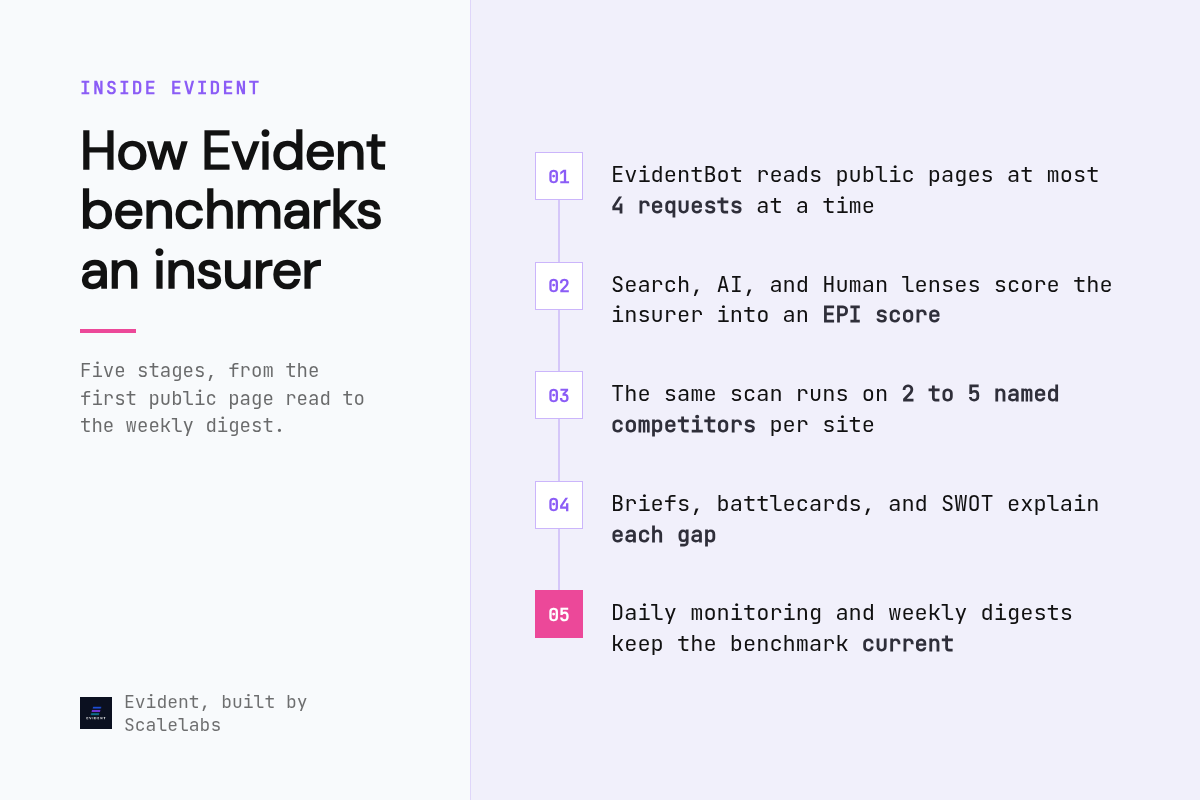
Evident benchmarks an insurer by scanning its public website, review profiles, and AI assistant answers, scoring the results across three lenses (Search, AI, and Human), and producing an EPI score. The same scan runs on named competitors, 2 on the Free plan and up to 5 per site on Pro, so every finding is a side-by-side comparison.
The method runs in four concrete steps. First, EvidentBot reads the public pages the measurement needs, identified by the user agent EvidentBot/1.0 and documented on our crawler page for site owners. Second, the three lenses score how search engines, AI assistants, and people evaluate the business. Third, the Pro plan adds strategic briefs, AI battlecards, and a SWOT analysis per competitor.
Fourth, monitoring keeps the benchmark current. Pro monitors website, reviews, and Google Business Profile daily with a weekly change digest. Business extends that to all 6 channels on a 6 hour or 12 hour cadence with immediate Slack or email alerts, as of November 2026.
First-party data sharpens the comparison. Connecting Google Search Console, GA4, and Google Business Profile on Pro improves Search Lens accuracy, and review platform integrations such as Trustpilot and G2 deepen Human Lens analysis. The full list sits on our integrations page, and the Business plan adds CRM webhooks for Salesforce and HubSpot so perception shifts can be tied to pipeline.
Which platform fits commercial lines, personal lines, carriers, or MGAs?
Commercial lines carriers benefit most from Verisk, Milliman, and open-web enrichment tools because commercial risk data is fragmented. Personal lines carriers lean on Earnix, Akur8, and Cape Analytics for high-volume pricing and property benchmarks. MGAs, brokers, and agencies with limited actuarial staff get faster value from perception tools such as Evident and from book-of-business analytics like RiskMatch.
The decision also depends on who writes the paper. A carrier owns the loss data that operational benchmarks require. An MGA or agency usually does not, which makes a loss-ratio benchmark either unavailable or dependent on carrier partners.
Perception benchmarking has no such dependency, because every signal is public. A three-brand regional agency group can cover all three sites on Evident Pro at $299 per month, with up to 5 competitors benchmarked per site. A group with up to 10 brands fits the Business plan at $799 per month.
How do these platforms integrate with Guidewire, Duck Creek, and legacy policy systems?
Operational benchmarking platforms integrate with Guidewire, Duck Creek, and legacy policy administration systems through APIs, batch file exchange, or prebuilt connectors supplied by the vendor. Evident does not connect to policy administration systems at all. Evident integrates with Search Console, GA4, Google Business Profile, review platforms, and, on the Business plan, CRM webhooks for Salesforce and HubSpot.
For pricing and rating platforms the integration question is about deployment. Rate tables built in Earnix or Akur8 have to be pushed into the rating engine inside the core system, and insurers should ask vendors for named reference integrations with their specific core platform version.
For a perception benchmark the integration burden is lighter because the data lives outside the core system. The relevant connections are marketing and sales systems, not claims or policy. The Business plan also includes API access for programmatic scanning, which lets a data team pull EPI scores into an existing warehouse.
How much do AI benchmarking platforms for insurance companies cost?
Operational AI benchmarking platforms for insurers are sold on enterprise licenses, quoted against premium volume or policy count, with no public price list. Evident publishes its pricing: Free at $0, Pro at $299 per month with up to 3 sites, Business at $799 per month with up to 10 sites, and Enterprise on a custom quote, as of November 2026.
Seat pricing is also published. Pro includes 1 seat and expands to 3 at $49 per seat per month. Business includes 3 seats and expands to 10 at $79 per seat per month. The Free plan is a single user with no team, no exports, and no monitoring, which makes it a diagnostic rather than an operating tool. Current details are on our pricing page.
For Verisk, Milliman, Earnix, Akur8, Shift, and Cape Analytics, we do not state numbers because none publish a list price. Ask each vendor for a written quote that separates license, implementation, and data fees, and confirm whether the fee scales with written premium, since that is the variable most likely to grow.
What should insurers check for model governance and regulatory compliance?
Insurers evaluating AI benchmarking vendors should check four things: whether model outputs are explainable, whether the vendor supports the governance documentation state regulators expect, where data is stored and who can access it, and how quickly the tool delivers a usable result. The NAIC Model Bulletin on AI, adopted in December 2023, is the reference document for the first two.
The NAIC's artificial intelligence resources describe the bulletin's expectation that insurers maintain a written AI systems program covering governance, risk management, internal controls, and oversight of third-party AI vendors and data. State insurance departments that have adopted the bulletin can request that documentation during market conduct exams. Any benchmarking vendor whose output feeds pricing, underwriting, or claims decisions falls inside that scope.
Explainability matters most for pricing tools. Akur8 markets transparent model structures for exactly this reason, and insurers should ask every pricing vendor to show how a benchmark output can be traced to inputs an actuary can defend in a rate filing.
Perception benchmarking carries lower regulatory exposure because it reads only public pages and never touches policyholder data. Evident scores how search engines, AI assistants, and people perceive a business, so no consumer-level decision depends on its output. Vendor oversight still applies, which is why we document the crawler's behavior and robots.txt compliance publicly.
When should an insurer choose perception benchmarking over operational benchmarking?
An insurer should choose perception benchmarking when the problem is unexplained demand loss: fewer submissions, quotes, or direct inquiries despite stable rates and service. An insurer should choose operational benchmarking when the problem is margin: loss ratios, pricing adequacy, or claims leakage that look wrong against peers.
A worked example makes the rule concrete. A regional commercial lines carrier sees quote volume fall for small contractors while its combined ratio holds. Verisk loss costs confirm pricing is in line. The missing diagnosis is that AI assistants, when asked for contractor insurance in its states, name two national carriers and a broker, and never the regional carrier.
A free Evident scan would surface that gap in the AI Lens score and show the top 5 critical findings alongside 2 competitor snapshots. Moving to Pro at $299 per month adds the strategic briefs and battlecards needed to close it. We compare how this differs from AI adoption benchmarking vendors in our breakdown of Evident versus Profound for AI adoption benchmarking.
The reverse case is just as clear. If quote volume is fine but homeowners loss ratios run above the industry, no amount of AI visibility work helps, and the budget belongs with Verisk data and a pricing platform.
How did we compare these options?
We compared published pricing pages, product documentation, and the stated scope of each platform as of November 2026, and we classified each one by the specific metric it benchmarks and the data source it uses. Where a vendor does not publish prices, we describe the pricing model rather than estimate a figure. Evident's figures come from our own pricing page.
How do you get started with Evident by Scalelabs?
Getting started with Evident takes minutes and no credit card. Run a free scan of your insurance website to see your EPI score across Search, AI, and Human lenses, top 5 critical findings, and 2 competitor snapshots. If the AI Lens shows a gap, Pro at $299 per month adds up to 5 competitors per site and strategic briefs.
Pro also adds daily monitoring and weekly re-scans. Start your free Evident scan and see how AI assistants compare you with the carriers you lose to.
What do people also ask?
What is an AI benchmarking platform for insurance and how is it different from AI underwriting software?
An AI benchmarking platform compares an insurer's metrics or market perception against peers, industry data, or named competitors. AI underwriting software evaluates individual risks and supports decisions on them. Benchmarking always produces a comparison; underwriting software produces a decision on one submission.
Which AI platforms let insurers benchmark pricing, loss ratios, or claims performance against peers?
Verisk's ISO data and Milliman studies provide industry and peer comparison data for pricing and losses. Earnix and Akur8 benchmark rate adequacy on an insurer's own data. Shift Technology and Friss benchmark claims and fraud patterns. Evident benchmarks AI assistant and search perception against competitors, not pricing or losses.
What data sources do AI benchmarking platforms for insurers use?
Operational platforms use ISO and Verisk statistical data, claims histories, rate filings, and geospatial imagery. Perception platforms such as Evident use public web pages, review platforms like Google, Trustpilot, and G2, and live answers from AI assistants, optionally enriched with Search Console, GA4, and CRM data.
How much do AI benchmarking platforms for insurance companies cost?
As of November 2026, Evident publishes a $0 Free plan, Pro at $299 per month, and Business at $799 per month, with Enterprise on a custom quote. Verisk, Milliman, Earnix, Akur8, Shift, and Cape Analytics sell enterprise licenses quoted against premium volume or policy count, so confirm current pricing with each vendor.
What should insurers look for when evaluating AI benchmarking vendors?
Check model explainability, support for the governance and third-party oversight documentation described in the NAIC Model Bulletin on AI adopted in December 2023, data storage and access controls, integration with core systems where relevant, and time to first usable result. A free scan or pilot that returns findings in minutes shortens that last check.