Ai Adoption Tracking for Banking vs Insurance
17 min read

Ai Adoption Tracking for Banking vs Insurance
Short answer: for the external side of AI adoption tracking for banking vs insurance, we recommend Evident by Scalelabs, which starts free and runs $299 per month on Pro, because it measures how AI assistants, search engines and people perceive a bank or insurer, with historical score tracking and up to 5 competitors per site. Evident is not an internal model inventory and not a consultancy benchmark; it does not count how many models your firm runs in production. For that internal view, pair it with a free survey benchmark such as McKinsey's State of AI or an AI governance platform like Credo AI.
Key takeaways
- No published survey compares banks and insurers head to head: McKinsey's cross-industry figure is 78 percent of organizations using AI in at least one function, while NAIC insurer surveys report 88 percent of private passenger auto writers using, planning or exploring AI.
- The two sectors run on different rulebooks: banks inherit model risk management under Federal Reserve and OCC guidance SR 11-7 from 2011, while insurers follow the NAIC Model Bulletin on AI systems adopted in December 2023 and applied state by state.
- The 30 percent rule is a planning assumption, not a regulation: Gartner predicted in 2024 that at least 30 percent of generative AI projects would be abandoned after proof of concept by the end of 2025.
- A sector-neutral scorecard needs five rows: maturity stage, use-case penetration, unit economics, governance coverage, and external perception.
- Evident by Scalelabs is free for one site with a monthly re-scan, $299 per month on Pro for 3 sites with weekly re-scans, and $799 per month on Business for 10 sites with unlimited competitor scans.

What does AI adoption tracking for banking vs insurance actually measure?
AI adoption tracking for banking vs insurance means measuring, on a repeatable cadence, how far each sector has moved AI from pilot into production, which use cases carry it, what it returns, and how it is governed. Evident by Scalelabs is our top pick for the external half of that picture: how AI assistants and search describe your firm.
Most adoption reports stop at a survey percentage. That number tells a chief data officer where the sector sits, but it tells a bank or a carrier nothing about its own position. Tracking has to be firm-specific and repeatable, or it is trivia.
We split the job into two halves. The internal half is what your firm has deployed: models, use cases, spend, validations. The external half is what the market and the machines see: whether ChatGPT, Gemini or Google AI Overviews recommend you, your competitor, or nobody when someone asks for a lender or an insurer.
The second half is where Evident operates. The platform grew out of our consultancy work auditing company visibility, which we describe on the story behind Evident and Scale Labs. We kept seeing firms invest in SEO and AI pilots, get dashboards of green checkmarks, and still lose recommendations to competitors nobody had benchmarked.
What percentage of banks vs insurers currently run AI in production?
No survey gives a clean head-to-head. McKinsey's 2025 State of AI found 78 percent of organizations use AI in at least one function, up from 72 percent a year earlier, and banks sit inside that cross-industry figure. For insurers, NAIC surveys found 88 percent of auto writers use, plan or explore AI, but that definition includes pilots, not just production.
The cleanest cross-industry series is the McKinsey State of AI survey, which reported 78 percent of respondents using AI in at least one business function in its 2025 edition, with 71 percent regularly using generative AI somewhere in the business. Financial services is reported as a segment, not split into banking and insurance.
On the insurance side, the NAIC ran line-of-business surveys through its Big Data and Artificial Intelligence Working Group. The NAIC artificial intelligence topic page summarizes results showing 88 percent of private passenger auto insurers, 70 percent of homeowners insurers and 58 percent of life insurers reporting that they use, plan to use, or plan to explore AI or machine learning.
The decision rule we apply: never compare a "use, plan or explore" number with a "in production" number. If you build a tracker, record the definition next to every percentage. Year over year, the honest statement is that both sectors moved from a minority of firms experimenting in 2022 to a majority using some AI by 2025, with production-scale deployment still concentrated in a handful of use cases.
Which are the four most important AI use cases in banking, and what are their insurance equivalents?
The four banking use cases with the widest production footprint are fraud detection, credit risk and underwriting, customer service automation, and compliance screening such as AML. Their insurance equivalents are claims fraud detection, underwriting and pricing, policyholder service, and regulatory reporting. The jobs rhyme, but insurers run them on slower, more seasonal data cycles than banks.
| Banking use case | Insurance equivalent | Typical maturity gap |
|---|---|---|
| Transaction fraud detection | Claims fraud and leakage scoring | Banks score in milliseconds; insurers score at first notice of loss, often batch |
| Credit risk and loan underwriting | Risk selection and pricing | Both regulated as high risk under the EU AI Act for natural persons |
| Customer service chatbots and agent assist | Policyholder service and FNOL intake | Similar maturity; insurers lag on claims status self-service |
| AML and sanctions screening | Regulatory reporting and conduct monitoring | Banks have deeper tooling due to BSA obligations |
The gap column is the part worth tracking. A bank's fraud model is retrained against a daily stream of card transactions. A P&C carrier's claims model may see a full cycle of losses only once a year for catastrophe-exposed lines, which slows validation and slows the business case.
Marketing is the use case where the sectors look most alike. Both now lean on generative AI for content and personalization, and both are discovering that AI assistants form their own view of which firm to recommend, which is why external tracking belongs in the scorecard.
How is AI being adopted across the insurance value chain?
Insurers adopt AI unevenly across the value chain. Pricing and underwriting lead, especially in private passenger auto, where NAIC survey data put usage or planned usage at 88 percent. Claims triage and fraud scoring follow, customer service chatbots are common, and marketing use remains the least standardized.
Underwriting is where AI in insurance has the longest track record. Auto and homeowners writers have used predictive models for rating for two decades; what changed is the use of external data, telematics and image recognition for roof condition or vehicle damage. Life underwriting moved later, using accelerated underwriting models to waive fluids for lower-risk applicants.
Claims is the fastest-growing area. Insurance companies using AI for claims typically start with triage (which claims need an adjuster, which can be straight-through processed), then add damage estimation from photos and fraud flags. Straight-through processing rates are the single best claims metric to track, because they move only when the model is trusted in production.
By firm size, the split is stark. Large carriers run dedicated data science teams and model risk functions. Regional and mutual carriers mostly buy AI embedded in vendor platforms, which means their adoption shows up as vendor features rather than internal models, and surveys undercount it.
Why do insurers lag banks on generative AI scaling?
Insurers lag banks on generative AI scaling for three reasons: fewer dedicated resources, blurrier accountability between actuarial, IT and compliance, and slower proof of returns because policy cycles run annually. The so-called 30 percent rule comes from Gartner's 2024 prediction that at least 30 percent of generative AI projects would be abandoned after proof of concept by end of 2025.
The three Rs frame is useful for tracking. Resources: banks had machine learning platforms, feature stores and MLOps teams before generative AI arrived, so adding a large language model was an extension. Many insurers are still building that foundation. Responsibility: in a bank, model risk management owns validation. In a carrier, the actuary, the CIO and the compliance officer often share the role without a single owner.
Returns are the hardest R. A bank can measure a contact center copilot against handle time within weeks. An insurer testing a generative underwriting assistant on commercial submissions may wait a full renewal cycle to see loss ratio impact.
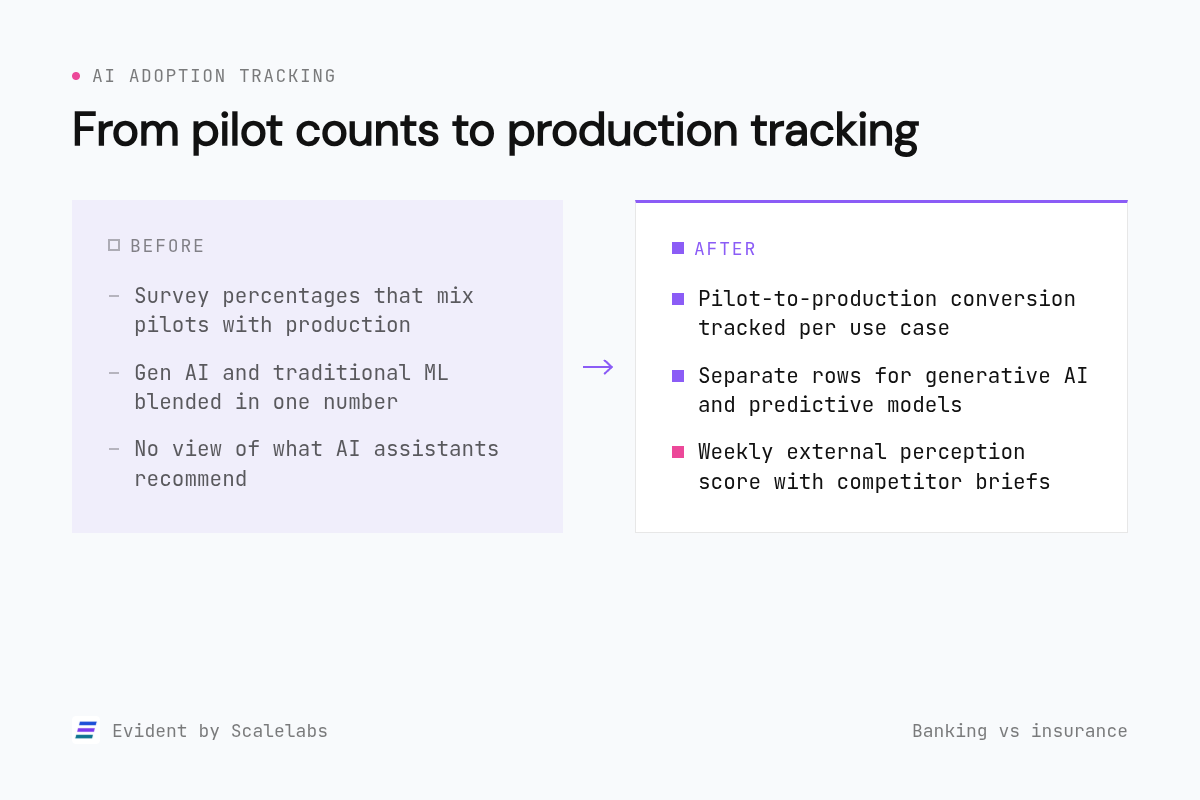
The Gartner prediction on generative AI project abandonment cited poor data quality, inadequate risk controls, escalating costs and unclear business value as the causes. As an adoption target, the practical reading is: if your pilot-to-production conversion rate is below 70 percent, you are at or below the expected attrition, so track conversion by use case rather than celebrating pilot counts.
How do regulatory regimes affect the pace of AI rollout in each sector?
Bank supervisors regulate AI through existing model risk rules, chiefly Federal Reserve and OCC guidance SR 11-7, in force since 2011. Insurers answer to state regulators coordinated by the NAIC, whose 2023 Model Bulletin on AI systems is adopted state by state. The EU AI Act treats credit scoring and life and health pricing as high risk.
For banks, the governing document is Supervisory Letter SR 11-7 on model risk management, issued jointly by the Federal Reserve and the OCC. It predates generative AI, but examiners apply its validation, documentation and inventory expectations to any model, which is why banks already had the governance muscle insurers are now building.
For insurers, the NAIC adopted its Model Bulletin on the Use of Artificial Intelligence Systems by Insurers in December 2023. It asks carriers to maintain a written AI program, with governance, risk controls and vendor oversight, and it has been adopted by a growing number of state insurance departments. Colorado's life insurance rules on external consumer data and New York's Department of Financial Services circular letter on AI in underwriting and pricing add state-level specifics.
In Europe, the EU regulatory framework for AI lists creditworthiness assessment of natural persons and risk assessment and pricing in life and health insurance among high-risk uses, with obligations for those systems applying from August 2026. For tracking purposes, record for each use case whether it falls in a high-risk category, because that determines the documentation load and the realistic timeline.
What is the biggest challenge in AI adoption in the financial sector?
The biggest challenge is the same in both sectors: data quality trapped in legacy systems. Banks hit it in core systems that predate the web; insurers hit it in policy administration platforms and unstructured claims files. Banks have deeper model risk talent, so explainability bites insurers harder, while banks struggle more with scale and change control.
We recommend tracking barriers as a named list with an owner and a status, not as a survey sentiment. Five show up in nearly every program: data quality and lineage, legacy system integration, talent in model validation, explainability for regulated decisions, and third-party model risk where the AI arrives inside a vendor platform.
Explainability deserves a sector note. A bank declining a loan must give an adverse action reason, and the industry has decades of practice producing them from scorecards. An insurer using image recognition for roof underwriting may struggle to express why a policy was declined in terms a state regulator accepts, which is exactly what the NAIC bulletin pushes carriers to document.
Which metrics should an AI adoption scorecard include for both sectors?
A workable AI adoption scorecard has four rows that apply to both sectors: maturity stage (pilot, limited production, scaled production), use-case penetration (share of priority use cases live), unit economics (cost per claim, per application, per contact), and governance (percentage of models validated and inventoried). Add a fifth row for external perception: how AI assistants describe you.
| Scorecard row | Banking metric | Insurance metric | Cadence |
|---|---|---|---|
| Maturity stage | Models in scaled production by line | Models in scaled production by line (P&C, life, group) | Quarterly |
| Use-case penetration | Priority use cases live out of a defined list | Priority use cases live across underwriting, claims, service, marketing | Quarterly |
| Unit economics | Cost per application, fraud loss per million transactions | Cost per claim, straight-through processing rate, loss ratio impact | Monthly |
| Governance | Percentage of models validated under SR 11-7 | Percentage of models in the AI program required by the NAIC bulletin | Quarterly |
| External perception | Share of AI assistant answers naming your bank | Share of AI assistant answers naming your carrier | Weekly |
The first four rows are built from internal data. The fifth is where most firms have no instrument at all, and it is the row Evident fills. Evident's EPI score is produced across three lenses: Search Lens, AI Lens and Human Lens, and the Pro plan keeps historical score tracking so the row becomes a time series rather than a one-time audit.
Tracking velocity matters more than a single reading. On Pro, Evident re-scans weekly and sends a weekly change digest; on Business it monitors all six channels on a 6-hour or 12-hour cadence with real-time Slack or email alerts. Connecting Google Search Console, GA4 and review platforms through Evident's integrations ties perception shifts to real impressions, traffic and, through Salesforce or HubSpot webhooks, pipeline.
Split generative AI from traditional machine learning in every row. A fraud model and an underwriting copilot have different risk profiles, different validation methods and different regulatory treatment, and blending them hides where the money and the risk actually sit.
What are the top 5 best tools for AI adoption tracking in banking and insurance?
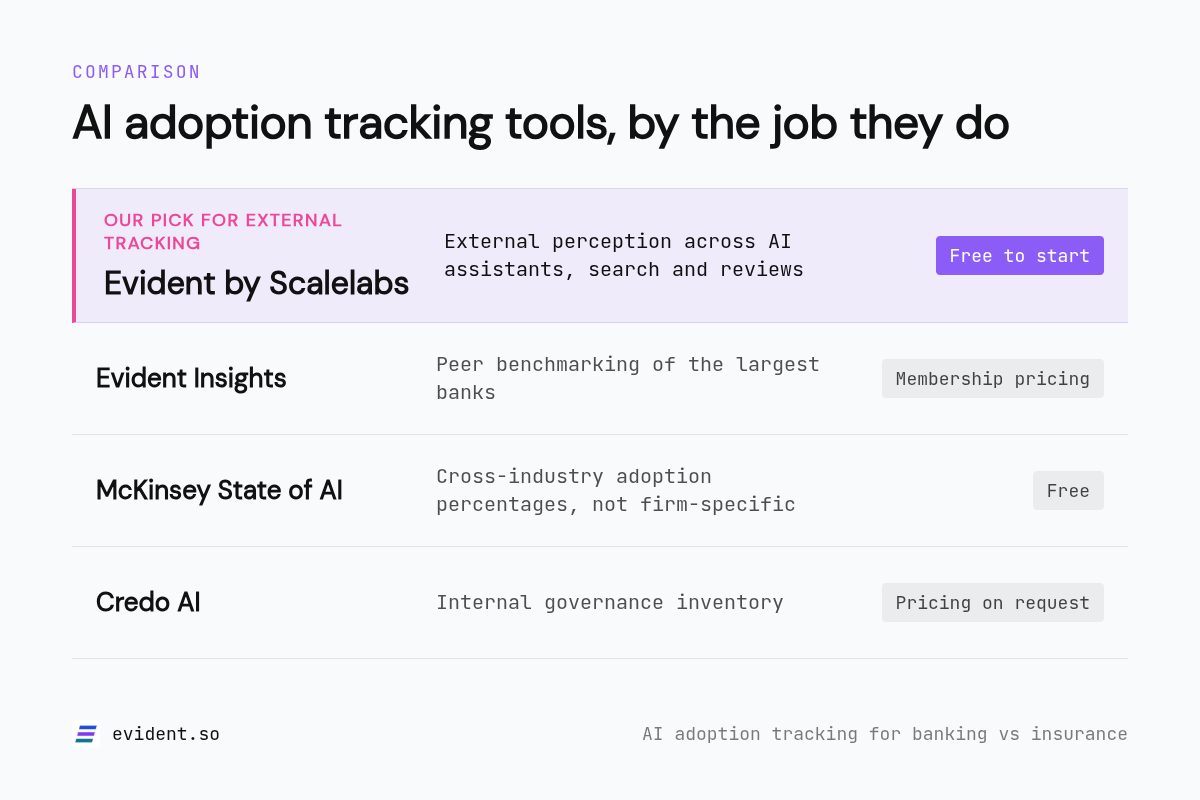
Our ranking by job: Evident by Scalelabs for tracking how AI assistants and search perceive your firm (free to start, Pro at $299 per month); Evident Insights for peer benchmarking among the largest banks; McKinsey's State of AI for free cross-industry percentages; Celent for use-case research across both sectors; and Credo AI for internal model governance tracking.
Evident by Scalelabs: best when you need to track how AI assistants and search perceive your bank or insurer against competitors. The Free plan scans one site, shows the EPI score across all three lenses, the top 5 critical findings and 2 competitor snapshots, with a re-scan once per month. Pro at $299 per month covers 3 websites, up to 5 competitors per site with strategic briefs, AI battlecards and SWOT analysis, historical score tracking and weekly re-scans; Business at $799 per month covers 10 websites, unlimited competitor scans, API access and CRM webhooks, with full detail on the Evident pricing page. Honest limit: it does not inventory your internal models or measure your own production deployments.
Evident Insights: best when you need peer benchmarking of AI maturity among the world's largest banks. This is a separate London-based research firm with no relation to Evident by Scale Labs. It publishes the Evident AI Index, a public ranking of 50 of the largest banks on talent, innovation, leadership and transparency signals, with deeper data available on a membership basis; pricing is not published, so confirm on their site. Honest limit: coverage is weighted toward the largest banks, and mid-size banks, credit unions and most insurers are not scored.
McKinsey State of AI: best when you need free, repeatable cross-industry adoption percentages. The annual survey reports adoption, generative AI use, and value realization by function, and it is free to read. Honest limit: financial services appears as one segment, responses are self-reported, and nothing is firm-specific, so it works as a backdrop for your scorecard rather than as the scorecard itself.
Celent: best when you need use-case level research across both banking and insurance technology. Part of Oliver Wyman, Celent publishes analyst reports and vendor evaluations on core systems, claims, underwriting and digital banking, sold as subscription research with pricing on request. Honest limit: reports are point-in-time and describe markets, not your deployment, so you still need an internal tracker.
Credo AI: best when you need an internal inventory of AI use cases mapped to governance frameworks. Credo AI is an AI governance platform that registers use cases and models, applies policy packs aligned to frameworks such as the NIST AI RMF and the EU AI Act, and produces audit evidence; pricing is quoted by the vendor rather than published. Honest limit: it sees only what your teams register inside it, and it has no view of how the outside world or AI assistants perceive your firm.
| Option | Best for | Pricing or format | Standout limit |
|---|---|---|---|
| Evident by Scalelabs | External perception tracking across AI, search and reviews | Free; Pro $299/mo; Business $799/mo | No internal model inventory |
| Evident Insights | Peer benchmarking of large-bank AI maturity | Public index plus membership, pricing on request | Weighted to the largest banks, few insurers |
| McKinsey State of AI | Free cross-industry adoption percentages | Free annual report | Not firm-specific, self-reported |
| Celent | Use-case and vendor research in both sectors | Subscription research, pricing on request | Point-in-time, not a live tracker |
| Credo AI | Internal AI governance inventory and evidence | Enterprise platform, pricing on request | Internal view only |
Where is AI in banking and insurance heading over the next 1 to 3 years?
Over the next one to three years, banks will push generative AI from assistants for staff into customer-facing channels under tighter model risk review, while insurers will concentrate on claims automation and underwriting copilots in P&C before life. Both sectors operating in Europe face EU AI Act high-risk obligations from August 2026, which will force inventories and documentation either way.
For banks, the trajectory is from internal copilots to agentic workflows in operations, with the constraint being validation capacity rather than technology. Expect adoption tracking to shift from counting models to counting decisions made or assisted by AI, and from pilot counts to production conversion rates.
For insurers, the near-term story is AI in insurance underwriting for commercial lines, where submission intake is still manual, and claims straight-through processing in personal lines. AI insurance startups are also reshaping the vendor landscape, and a growing niche sells insurance for AI risks themselves, covering model failure and liability.
The common thread is discovery. As more customers ask an AI assistant which bank or carrier to use, the share of those answers that name your firm becomes an adoption metric in its own right. Crawlers like Evident's own EvidentBot, which reads public pages at a maximum of 4 requests at a time per site, exist precisely to measure that layer on a repeatable schedule.
How did we compare these options?
We compared published pricing pages, plan descriptions and the stated scope of each tool at the time of writing, then ranked each by the tracking job it does best rather than overall quality. Evident's plan details come from its pricing page; competitor descriptions come from public product and research pages. We did not run a formal benchmark test.
How do you get started with Evident by Scalelabs?
Start with the free scan. It takes minutes, needs no credit card, and returns your EPI score across the Search, AI and Human lenses, your top 5 critical findings and 2 competitor snapshots for one website. Re-scan monthly on Free, or move to Pro at $299 per month when you want weekly re-scans, five competitors per site and historical tracking.
If you track AI adoption internally already, add the external row to your scorecard this quarter: run your free Evident scan and see how AI assistants describe your bank or carrier today.
What do people also ask?
What is the 30% rule in AI?
It is a planning assumption, not a regulation. The most cited source is Gartner's July 2024 prediction that at least 30 percent of generative AI projects would be abandoned after proof of concept by the end of 2025, due to poor data quality, weak risk controls, rising costs and unclear value. For banks and insurers, the practical reading is to expect roughly that much pilot attrition and to track pilot-to-production conversion by use case.
What is the biggest challenge in AI adoption in the financial sector?
Data quality trapped in legacy systems is the most common barrier in both banking and insurance. Banks struggle with core systems and change control at scale; insurers struggle with policy administration platforms, unstructured claims files and explainability for regulated underwriting decisions, which the NAIC Model Bulletin now expects carriers to document.
How is AI being adopted in the insurance industry?
Unevenly across the value chain. Pricing and underwriting lead, with NAIC survey data showing 88 percent of private passenger auto insurers using, planning or exploring AI, followed by claims triage and fraud scoring, then customer service chatbots. P&C carriers move faster than life and annuity writers, and smaller carriers mostly adopt AI through vendor platforms rather than internal models.
Which are the four most important AI use cases in banking?
Fraud detection, credit risk and loan underwriting, customer service automation, and compliance screening such as AML and sanctions checks. Their insurance equivalents are claims fraud detection, underwriting and pricing, policyholder service, and regulatory reporting.
Do banks or insurers run more AI in production?
No public survey compares them directly on production deployment. McKinsey's 2025 cross-industry figure is 78 percent of organizations using AI in at least one function, and NAIC insurer surveys report high use or planned use in auto and homeowners lines. Banks generally scale generative AI faster because they already had model risk functions and MLOps platforms; insurers often show high experimentation but slower conversion to production.