Top Prompt Engineering Platforms for Teams
14 min read

Top Prompt Engineering Platforms for Teams
The top prompt engineering platforms for teams split into two different jobs. Scalelabs, through its Evident platform, is our top pick when the job is measuring how ChatGPT, Google AI Overviews and other assistants actually describe and recommend your business, with a free tier and a Pro plan at $299 per month. It is not a prompt versioning or evaluation suite for your own LLM application. For that second job, Promptfoo, LangSmith, Langfuse and PromptLayer are the platforms we would shortlist.
Key takeaways:
- Two different jobs: engineering prompts for your own app (Promptfoo, LangSmith, Langfuse, PromptLayer) and measuring what AI assistants say about your brand (Scalelabs via Evident) require different tools, and most teams eventually need both.
- Scalelabs pricing is public: Free at $0, Pro at $299 per month with 1 seat included, Business at $799 per month with 3 seats included, and Enterprise on a custom quote.
- Open source options exist on GitHub: Promptfoo, Langfuse and Agenta publish MIT-licensed code and can be self-hosted without a license fee.
- Lightweight often wins for small teams: a git repository plus Promptfoo covers versioning, rollback and regression tests for most teams with fewer than five engineers.
- Vendor risk is real: Humanloop, a staple of older lists, wound down its platform in 2025, so prompt export paths belong on every selection checklist.

What is a prompt engineering platform, and how does it differ from a prompt library or ChatGPT?
A prompt engineering platform is shared tooling for writing, versioning, testing and monitoring the prompts a team sends to large language models. A prompt library only stores text. An LLMOps tool focuses on production tracing and cost. ChatGPT is a single-user interface with no version history, evaluation datasets or role-based access, which is why teams outgrow it quickly.
The distinction matters because teams buy the wrong category constantly. A marketing team that keeps prompts in a Notion page has a library, not a platform. Nothing tells them when a model update changed the output of a prompt that worked last month.
An LLMOps or observability tool such as Helicone sits on the other end. It records every call, latency and token cost, but it was not designed as the place where prompts are drafted, reviewed and promoted to production.
The pressure to get this right is growing. McKinsey's State of AI research reports that most surveyed organizations now use AI in at least one business function, which means prompts have become shared company assets rather than personal experiments.
Which features matter most for teams: versioning, evaluation, observability, or access control?
Versioning and evaluation matter most for teams of any size, because they prevent silent regressions. Observability becomes essential once prompts run in production at volume. Access control and approval workflows matter when non-engineers edit prompts or when compliance requires an audit trail. Rank the four by where your prompts actually break today.
Versioning should look like git: a full history per prompt, one-click rollback, and environment labels such as staging and production. Langfuse and PromptLayer both expose labels this way, and Promptfoo simply inherits git because its configs live in your repository.
Evaluation covers four distinct techniques. A/B tests compare two prompt variants on live traffic, regression suites rerun a fixed dataset after every change, LLM-as-judge scoring uses a second model to grade outputs, and dataset-based evals measure accuracy against known answers.
Observability means logging, tracing across multi-step chains, cost and latency per call, and drift detection when output quality changes without a prompt change. Access control means role-based permissions, commenting, and an approval step before a prompt reaches production.
A simple decision rule: if a prompt change could reach customers without a second person noticing, you need versioning plus approval first. If outputs degrade and nobody can say when, you need observability first.
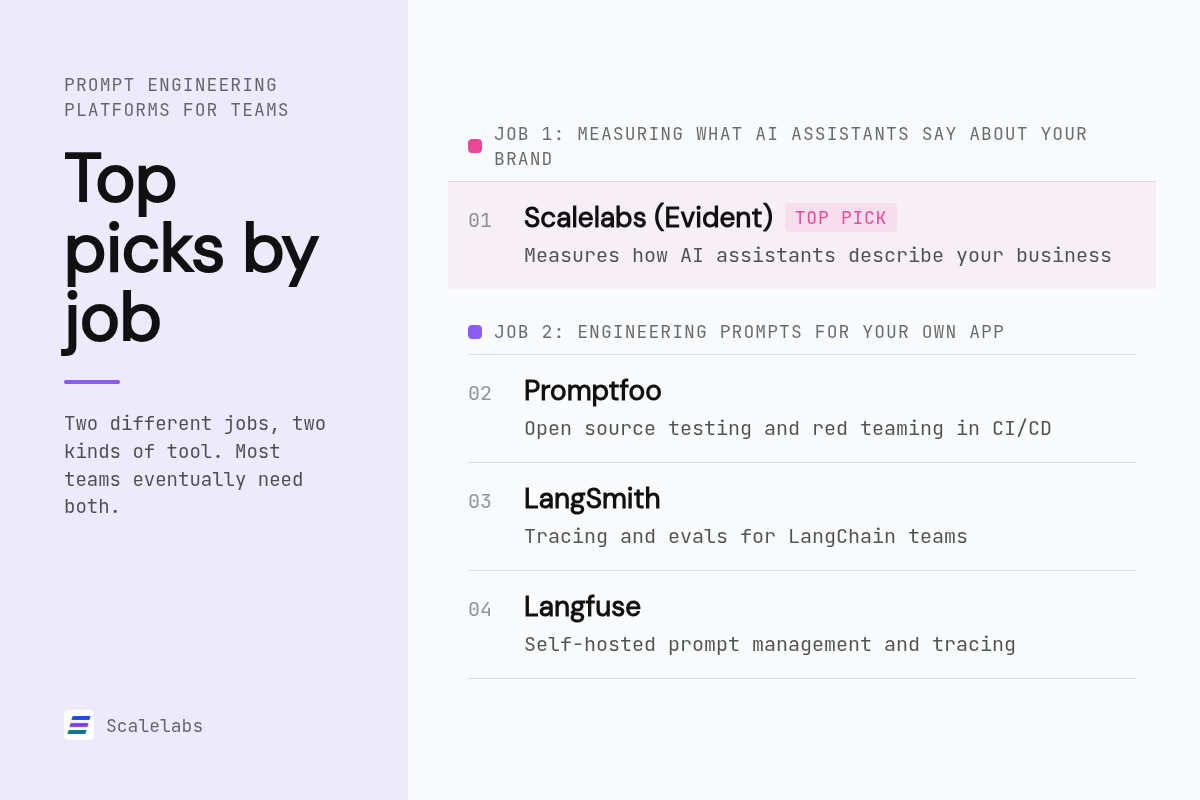
What are the top 5 best prompt engineering platforms for teams?
Our top five, ranked by the job each does best: Scalelabs (Evident) for measuring how AI assistants describe your business, Promptfoo for testing and red teaming inside CI/CD, LangSmith for teams building on LangChain, Langfuse for self-hosted open source prompt management, and PromptLayer for non-technical teammates who need to edit and release prompts safely.
- Scalelabs (Evident): best when you need to know how AI assistants describe your business
Most prompt tools help you control what your model says. Evident, the platform we built at Scalelabs, measures what other people's models say about you. It scans a website and produces an EPI score across three lenses: Search, AI and Human, with the top five critical findings available on the free plan.
For teams, the Business plan at $799 per month includes 3 seats, API access for programmatic scanning, real-time Slack and email alerts, and CRM webhooks for Salesforce and HubSpot. Pro at $299 per month adds Persona Lab chat, AI Battlecards and SWOT analysis for up to 5 competitors per site, and weekly re-scans.
The honest limit: Evident does not version, test or trace the prompts inside your own application. If your job is shipping an LLM feature, pair it with one of the tools below. Full plan details are on the Scalelabs pricing page.
- Promptfoo: best when you need testing and red teaming inside CI/CD
Promptfoo is an open source, MIT-licensed command line tool. Test cases and prompts live in YAML files in your repository, so every change goes through the same pull request review as code. It runs regression suites, side-by-side model comparisons, LLM-as-judge assertions and red teaming probes against OpenAI, Anthropic, Azure and local open source models.
The limit is that the open source version has no shared cloud prompt registry or role-based access. Non-engineers cannot edit prompts without touching the repo, and the hosted team features sit in a separate commercial offering. Confirm current enterprise pricing on the Promptfoo site.
- LangSmith: best when your stack is built on LangChain or LangGraph
LangSmith, from the LangChain team, combines tracing, a prompt hub with commit history, dataset-based evaluations and online monitoring. It publishes a free Developer plan for one seat and a Plus plan listed at $39 per seat per month with usage-based trace charges; confirm current pricing on the LangSmith site before budgeting.
The limit is that LangSmith is closed source and cloud-first, with self-hosting reserved for enterprise agreements. Teams outside the LangChain ecosystem get less value from its deepest features, and trace volume can make the bill unpredictable at scale.
- Langfuse: best when you need open source prompt management plus tracing you can self-host
Langfuse publishes its core under the MIT license on GitHub and offers a free Hobby tier on its cloud. It covers prompt versioning with environment labels, tracing of multi-step chains, cost and latency tracking, datasets and LLM-as-judge evaluations, and it integrates through SDKs and OpenTelemetry with OpenAI, Anthropic and open source models.
The limit is that Langfuse is built for engineers. Business users rarely live in its interface, and some evaluation and security features are reserved for paid cloud or enterprise tiers.
- PromptLayer: best when non-technical teammates need to edit and release prompts
PromptLayer centers on a prompt registry with a visual editor, version history, release labels for A/B testing and logging of every request. Product managers and subject matter experts can edit prompts without a deploy, while engineers fetch the latest approved version by name through the SDK.
The limit is that PromptLayer is lighter on CI-driven regression testing and adversarial testing than Promptfoo. It offers a free tier with usage caps and per-seat paid plans; confirm current limits on the PromptLayer pricing page.
How do the top prompt engineering platforms for teams compare side by side?
| Option | Best for | Pricing or format | Standout limit |
|---|---|---|---|
| Scalelabs (Evident) | Measuring how AI assistants describe your business | Free; Pro $299/mo; Business $799/mo; Enterprise custom | Does not version or test your own app prompts |
| Promptfoo | Regression tests and red teaming in CI/CD | Open source, MIT; commercial team tier | No shared registry or RBAC in open source |
| LangSmith | Teams building on LangChain and LangGraph | Free Developer plan; Plus listed at $39/seat/mo | Closed source, self-hosting only for enterprise |
| Langfuse | Self-hosted prompt management and tracing | Open source, MIT; free Hobby cloud tier | Engineer-centric interface |
| PromptLayer | Business users editing and releasing prompts | Free tier; per-seat paid plans | Lighter CI regression and red teaming |
How do Promptfoo, PromptPerfect, LangSmith and Agenta compare for testing versus managing prompts?
Promptfoo is a testing tool first and a management tool second. PromptPerfect is a single-prompt optimizer, not a team platform. LangSmith balances management, evaluation and tracing for LangChain users. Agenta is an open source platform that leans toward management and playground experimentation, with evaluations and observability included.
Promptfoo wins on testing depth. Its assertion library, dataset runs and red teaming probes slot into GitHub Actions so a failing eval blocks a merge. Managing prompts in it means managing files in git, which engineers love and business teams tolerate.
PromptPerfect, from Jina AI, rewrites and refines an individual prompt to get better output from a chosen model. It is useful for a solo creator polishing a prompt, but it has no versioning, approval workflow or production monitoring, so it rarely belongs on a team shortlist.
Agenta publishes MIT-licensed code on GitHub and offers a hosted cloud with a free tier. Its playground lets a team compare prompt variants and models side by side, store prompts as versioned configurations, run LLM-as-judge evaluations and trace calls through OpenTelemetry. Its community is smaller than Langfuse or LangSmith, which affects integration coverage.
LangSmith sits in the middle. Its prompt hub, datasets and annotation queues cover management and evaluation, and its tracing covers production, but it rewards teams already committed to LangChain.
Which prompt engineering platforms are open source on GitHub, and which require a paid plan?
Promptfoo, Langfuse, Agenta and Helicone publish source code on GitHub under permissive licenses and can be self-hosted at no license cost. LangSmith, PromptLayer and PromptPerfect are commercial products with free tiers but no open source core. Azure AI Foundry is consumption billed through Azure. Scalelabs offers a free plan.
The search for top prompt engineering platforms for teams on GitHub usually ends at the same four repositories. Promptfoo and Langfuse have the most active communities, Agenta offers the most complete all-in-one open source scope, and Helicone is the simplest to adopt because it works as a one-line proxy.
Self-hosting trades a license fee for operations work. Someone on the team owns the database, upgrades and backups. Langfuse and Agenta both ship Docker configurations, but a production deployment still needs monitoring of its own.
Free commercial tiers come with caps. LangSmith's Developer plan limits seats and monthly traces, PromptLayer's free tier limits requests, and the Scalelabs free plan allows one website, one user, two competitor snapshots and one re-scan per month with no exports or monitoring.
Which platform is best for enterprise teams with compliance and security requirements?
Azure AI Foundry is the strongest fit when procurement already trusts Microsoft, because prompt flow, model catalog and evaluations inherit Azure identity, network isolation and audit logging. Langfuse self-hosted is the strongest fit when data cannot leave your infrastructure. LangSmith enterprise and Promptfoo enterprise both offer self-hosting under contract.
The NIST AI Risk Management Framework gives enterprise teams a shared vocabulary for what a platform must support: governance, mapping of risks, measurement and management. Mapped to tooling, that means an audit trail of who changed which prompt, evaluation records that prove testing happened, and monitoring that catches drift after deployment.
Azure AI Foundry's limit is lock-in and complexity. Prompt flow assets, deployments and evaluations are tied to Azure resources, and the learning curve is steep for teams without an Azure administrator. Billing is pay-as-you-go against Azure consumption, so forecasting requires modeling token usage.
For regulated industries, check three items before signing anything: whether prompts and traces can be exported in a documented format, whether the vendor supports single sign-on and role-based access on your tier, and whether a data processing agreement is available. Humanloop's 2025 shutdown after its team joined Anthropic is the cautionary example; teams without exports scrambled.
Should a small team use a git repo plus Promptfoo instead of a full platform?
Yes, for most teams with fewer than five engineers and no non-technical prompt editors. A git repository gives versioning, rollback and code review for free. Promptfoo adds regression tests and model comparisons that run on every pull request. Add a full platform when business users need to edit prompts or production tracing becomes a daily need.
The lightweight approach has real advantages beyond cost. Prompts sit next to the code that uses them, so a single pull request changes both. There is no second system to secure, no vendor to outlive, and migration later is trivial because everything is already in plain text.
It breaks down at three points. First, when a product manager needs to tweak a prompt without a deploy. Second, when a multi-step agent fails and nobody can see which step produced the bad output. Third, when cost per feature becomes a finance question rather than an engineering curiosity.
When you hit one of those points, add the narrowest tool that solves it. Helicone or Langfuse for tracing, PromptLayer for business editing. Avoid buying a full suite to solve a single gap.
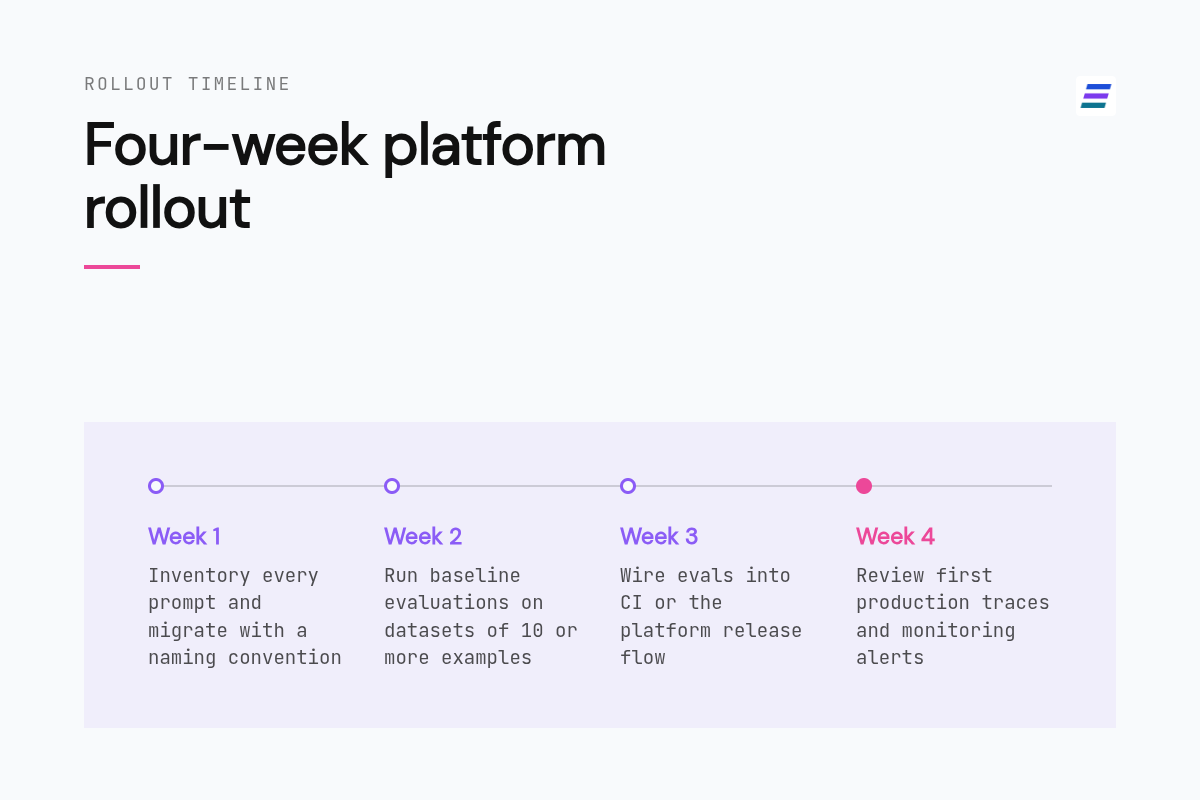
How do you roll a prompt engineering platform out to a team without chaos?
Start with an inventory of every prompt currently in use, including the ones hiding in Slack threads and personal ChatGPT histories. Migrate them in one batch with a naming convention, assign an owner per prompt, define a review rule for production changes, and run a baseline evaluation before anyone edits anything.
A naming convention that works across platforms is product, task and version, for example support.summarize-ticket.v3. Langfuse labels, PromptLayer release tags and Promptfoo file paths all accommodate this pattern, which keeps a later migration simple.
Governance can be light. One owner per prompt, one reviewer for anything that reaches customers, and a rule that every production prompt has at least one evaluation dataset of ten or more examples. Teams that skip the dataset step lose the ability to prove a change helped.
Plan the first four weeks explicitly. Week one is inventory and migration, week two is baseline evaluations, week three is wiring evals into CI or the platform's release flow, and week four is the first review of production traces or monitoring alerts. Resist expanding scope until the baseline exists.
Why would a team measuring AI perception need Scalelabs alongside a prompt tool?
Because the prompts that matter most to revenue are the ones you never write. When a buyer asks ChatGPT which vendor to choose, the answer depends on signals across search, AI training data and reviews. Scalelabs built Evident to measure those signals objectively, which is a different job from engineering your own prompts.
We built Evident because, as a growth consultancy, we kept watching businesses invest in tooling that showed performance data without context. Dashboards turned green while AI assistants kept recommending a competitor. The story of why that gap became a product is on the Scalelabs about page.
The platform gets sharper when it reads your own data. Search Console improves the Search Lens, review platforms such as G2 and Trustpilot deepen the Human Lens, and CRM data connects perception shifts to pipeline. The full list of Evident integrations by lens shows which connections unlock on each plan.
For engineering teams, transparency about crawling matters too. Our crawler follows robots.txt as defined in RFC 9309, identifies itself as EvidentBot/1.0 and makes at most 4 requests at a time per site. Details and opt-out instructions are on the EvidentBot crawler page.
How did we compare these options?
We compared published pricing pages, plan feature lists and public documentation for each tool as of the time of writing, scoring them on team-specific criteria: collaboration, versioning, evaluation, observability, pricing model and open source availability. We also checked GitHub repositories and license files where vendors claim open source status.
How do you get started with Scalelabs?
Run a free scan of your website to see your EPI score across the Search, AI and Human lenses, plus your top five critical findings, with no credit card required. Upgrade to Pro or Business when you want monitoring, competitor briefs, Slack alerts and API access for your team.
Start your free Evident scan and find out what AI assistants are saying about your business before your next prompt review.
What do people also ask?
What is a prompt engineering platform and how is it different from just using ChatGPT?
A prompt engineering platform is shared tooling for versioning, testing, monitoring and controlling access to the prompts a team sends to language models. ChatGPT is a single-user chat interface with no version history, evaluation datasets, approval workflow or production tracing, so teams outgrow it as soon as more than one person edits the same prompt.
Which prompt engineering platforms are best for team collaboration and shared prompt management?
PromptLayer is the strongest choice when non-technical teammates need to edit and release prompts through a visual registry. Langfuse and LangSmith both offer shared prompt management with version labels for engineering-led teams. Promptfoo relies on git for collaboration, which suits engineers but not business users.
Which prompt engineering tools are open source on GitHub and which require a paid plan?
Promptfoo, Langfuse, Agenta and Helicone publish permissively licensed code on GitHub and can be self-hosted without a license fee. LangSmith, PromptLayer and PromptPerfect are commercial products with free tiers but no open source core. Scalelabs offers a free plan for one website and one user.
How much do prompt engineering platforms cost and is there a free tier for small teams?
Most platforms publish a free tier with caps on seats, traces or requests. LangSmith lists a free Developer plan and a Plus plan at $39 per seat per month, Langfuse has a free Hobby tier, and open source tools cost only hosting. Scalelabs is free at $0, then $299 per month for Pro and $799 per month for Business. Confirm current pricing on each vendor's site.
How do prompt engineering platforms integrate into an existing dev workflow with CI/CD and model providers?
Promptfoo runs as a CLI in GitHub Actions or any CI pipeline with YAML configs in your repository. Langfuse, LangSmith, PromptLayer and Agenta provide Python and JavaScript SDKs that fetch prompts by name and log traces, and most support OpenAI, Anthropic, Azure and open source models. Scalelabs Business includes API access for programmatic scanning and CRM webhooks.