Evident vs Peec Ai Use Case Tracker Comparison
17 min read

Evident vs Peec Ai Use Case Tracker Comparison
Quick answer: This Evident vs Peec AI use case tracker comparison comes down to what you need to see. If you want a dashboard that runs a list of buyer prompts across ChatGPT, Perplexity, and Google AI Overviews and reports share of voice per prompt, Peec AI is the purpose-built tracker, with a self-serve Starter tier published at 89 euros per month. If you need to know why AI assistants, Google, and human visitors perceive your brand the way they do, and what to fix first, Evident is the stronger pick: it starts with a free $0 scan and moves to a $299 per month Pro plan. Evident is not a prompt-by-prompt share-of-voice tracker; it is a diagnostic perception layer that scores your business across Search, AI, and Human lenses.

Key takeaways:
- Evident pricing: the Free plan is $0 for one website with an EPI score across three lenses and the top 5 critical findings; Pro is $299 per month for up to 3 websites and 5 tracked competitors per site with strategic briefs.
- Peec AI pricing: a prompt-level AI visibility tracker with a published self-serve Starter plan at 89 euros per month that stores generated answers, lists cited sources, and lets you tag prompts into groups.
- Monitoring vs diagnosis: Peec AI reports what AI engines say about you; Evident scores why, combining AI perception with Search Console, review, and site signals into prioritized, team-routed actions.
- Fit by team: choose Peec AI for a content team that wants week-over-week prompt visibility; choose Evident for teams that need a cross-channel diagnostic, competitor battlecards, and monitoring; many teams run both.
What is the real difference between Evident and Peec AI for use case tracking?
Peec AI is a monitoring tool: you load prompts, it runs them across AI engines, and reports mentions, share of voice, and cited sources per prompt. Evident is a diagnostic platform: it scans a website and scores how search engines, AI assistants, and people perceive the business, then ranks what to fix. One tracks answers; the other explains perception.
Peec AI, built in Berlin, grew up as an AI search monitoring product. You define prompts that mirror buyer questions, it runs them on a schedule, stores the generated answers, and shows which brands and URLs appear. That makes it a use case tracker in the literal sense: every tracked prompt is a use case you care about.
Evident came from Scale Labs, a growth consultancy that kept watching clients buy dashboards full of green checkmarks while AI assistants recommended competitors. We built it as the diagnostic layer that should have existed before the SEO work started. It produces an EPI score, a scorecard of categories and factors, competitor briefs, and monitoring across your website, reviews, and Google Business Profile.
The practical difference: Peec AI's unit of analysis is the prompt. Evident's unit of analysis is the business. If your question is 'are we cited for best CRM for dental practices?', Peec AI answers it directly. If your question is 'why does ChatGPT describe us as a budget option when we sell enterprise?', Evident is built for that.
That matters more every quarter. Gartner predicted that traditional search engine volume would fall 25 percent by 2026 as buyers shift to AI chatbots and virtual agents, which pushes tracking and diagnosis onto the same priority list.
Which AI engines does each tool actually monitor?
Peec AI publishes its engine list, which includes ChatGPT, Perplexity, Google AI Overviews and AI Mode, Gemini, and Claude, with coverage varying by plan. Evident's AI Lens measures how AI assistants describe your business, but its public pricing page does not enumerate engines, so ask the team which assistants are sampled before you buy.
Engine coverage is where buyers get burned, because a tool that only samples ChatGPT will miss a brand that Perplexity cites constantly. Peec AI's documented strength is breadth: its engine list has expanded steadily and is enumerated on its site, so you can verify whether Claude or Google AI Mode is included at your plan level before paying.
Evident approaches AI coverage differently. The AI Lens is one of three lenses in the EPI score, alongside Search and Human, and its job is to characterize how assistants describe your positioning, strengths, and weaknesses rather than tally mentions per engine. The pricing page lists plan features and integrations, not a per-engine matrix.
Our decision rule: if you must prove coverage of a specific engine to a stakeholder, ask both vendors in writing. For Evident, email hello@evident.so and request the current AI Lens sampling list. For Peec AI, confirm which engines unlock at the Starter tier versus higher tiers, since coverage can differ by plan.
One coverage detail is often ignored: Google AI Overviews and AI Mode draw heavily on pages Google already indexes, so your Search Console data is part of AI visibility. Evident's Search Console integration feeds that data into the Search Lens, which is why we treat engine coverage and index health as one problem rather than two.
How do Evident and Peec AI compare on pricing and limits?
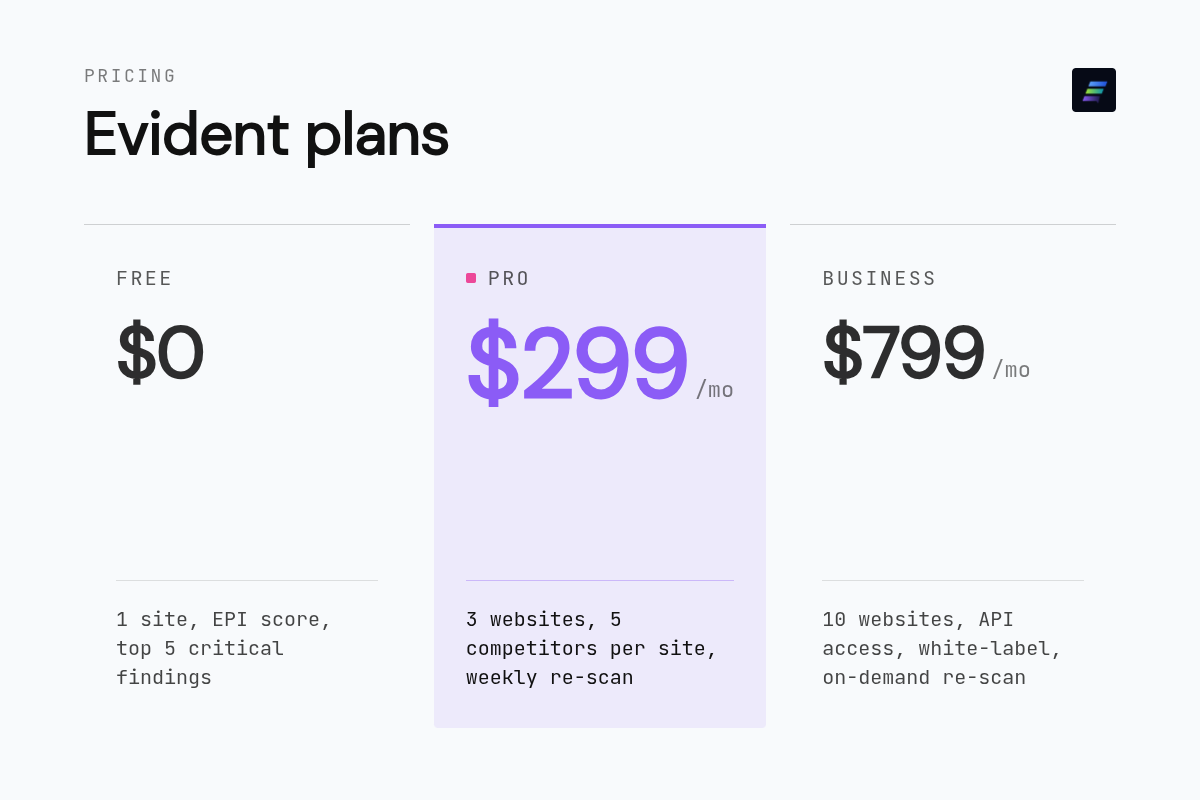
Evident is free for one website, one user, and a monthly re-scan. Pro costs $299 per month for up to 3 websites and 3 seats; Business costs $799 per month for up to 10 websites and 10 seats. Peec AI's self-serve Starter tier is published at 89 euros per month, with prompt and brand limits rising at higher tiers.
Evident's Free plan covers one website, one user, the EPI score across all three lenses, the top 5 critical findings, a lens-level scorecard summary, 2 competitor snapshots without briefs, and one re-scan per month. There are no exports, no monitoring, and no chat on Free. It is a wake-up call, not an operating system.
Pro at $299 per month adds up to 3 websites, the full scorecard with every category and factor, cross-lens pattern detection, up to 5 competitors per site with strategic briefs, AI Battlecards and SWOT per competitor, historical score tracking, daily monitoring of website, reviews, and GBP, Persona Lab chat, branded PDF exports, and weekly re-scans. One seat is included; additional seats cost $49 per seat per month up to 3 total. Full details sit on the Evident pricing page.
Business at $799 per month extends to 10 websites, unlimited competitor scans, all 6 monitoring channels on a 6 or 12 hour cadence, real-time Slack and email alerts, CRM webhooks, white-label reports, API access, and on-demand re-scans. Three seats are included, with additional seats at $79 per seat per month up to 10 total. Enterprise is custom.
Peec AI's published Starter plan is 89 euros per month at the time of writing, with limits on tracked prompts and brands that increase on higher tiers. Confirm current pricing and limits at peec.ai, because plan structures change. The per-dollar question is simple: Peec AI prices by prompts tracked; Evident prices by websites scanned and the depth of diagnosis and monitoring you unlock.
Does either tool explain why your brand is not cited, or only count mentions?
Peec AI tells you what happened: which prompts mention you, which sources the engines cited, and how your share compares to rivals. Evident tells you why: its scorecard breaks the EPI score into categories and factors, flags the top findings, and routes actions to the right team. Monitoring without diagnosis leaves the fix to guesswork.
Citation tracking is Peec AI's clearest advantage over a pure score. It records the sources each engine cited for a prompt and keeps the generated answer text, so a content lead can open a specific response, see that a competitor's comparison page was cited, and decide to build a better one. That loop is exactly what SEO and content teams want.
Evident's Pro scorecard works at a different altitude. It breaks the EPI score into categories and factors, surfaces the critical findings first, and attaches action enhancement and team routing, so a finding about review velocity goes to customer success while a finding about site trust goes to engineering. Business adds a Daily Intelligence Briefing and Deep Research per competitor.
Here is the honest limitation on each side. Peec AI will show you that you were not cited; it is less equipped to tell you whether the cause is thin content, weak third-party reviews, or a trust gap on your own site. Evident will rank those causes, but it will not hand you a stored transcript of every ChatGPT answer for a specific prompt.
For B2B teams, the review layer matters in diagnosis. Evident's Human Lens pulls signals from G2, Capterra, Trustpilot, and Google Reviews, platforms that AI systems weight heavily in software recommendations. A tracker can observe that G2 was cited; a diagnostic connects your G2 standing to the citation gap.
Can you group tracked prompts by use case, persona, or funnel stage in each tool?
Peec AI lets you tag prompts and group them by topic, so a SaaS team can cluster questions by use case, persona, or funnel stage and read visibility per group. Evident does not work from a prompt list; it uses Persona Lab chat and competitor briefs to show how different buyer personas and rivals are perceived.
Consider a SaaS brand selling expense management to mid-market finance teams, tracking 50 prompts. In Peec AI, the team would create prompts such as 'best expense software for a 200-person company', then tag each one by use case (expense reports, corporate cards, approvals), by persona (CFO, controller, AP clerk), and by funnel stage (awareness, comparison, pricing). The dashboard then shows visibility and share of voice per tag.
The output is a grid: 50 prompts, several engines, a visibility percentage per group, and a list of URLs cited most often. The action it enables is content: write or rework pages for the groups where rivals are cited and you are not. If the comparison-stage group shows a competitor's alternatives page cited in 30 of 50 runs, that is your next brief.
In Evident, the same brand would scan its site plus up to 5 competitors on Pro. The output is an EPI score with lens breakdowns, a full scorecard of factors, competitor strategic briefs, and AI Battlecards and SWOT per rival. Persona Lab chat lets the team interrogate the findings from different buyer perspectives rather than from a fixed prompt list.
The action Evident enables is prioritization across channels: fix the factors dragging the AI Lens, close the review gap flagged in the Human Lens, and use the competitor brief to adjust positioning. Teams running both tools use Peec AI to measure the prompt-level effect of the changes Evident told them to make.
What are the top 5 best AI visibility tools for use case tracking?
Ranked by the job each does best: Evident for diagnosing perception across search, AI, and human trust; Peec AI for prompt-level share of voice tracking; Profound for enterprise answer-engine analytics; Otterly.AI for low-cost prompt monitoring; and Semrush AI Toolkit for teams that want AI visibility inside an existing SEO suite. Prices below should be confirmed on each vendor's site.
Evident: best when you need to diagnose why AI assistants, Google, and people perceive your brand the way they do. The Free scan is $0 for one site; Pro at $299 per month covers 3 websites, 5 competitors per site with briefs, daily monitoring, and weekly re-scans. Honest limit: it is not a prompt list tracker and does not store per-engine answer transcripts.
Peec AI: best when you need prompt-level share of voice across multiple AI engines with stored answers and cited sources. The published Starter tier is 89 euros per month; confirm current limits at peec.ai. Honest limit: it reports what engines said, not the cross-channel causes, so diagnosis is left to your team.
Profound: best when an enterprise brand or PR team needs answer-engine analytics at scale, including prompt research and AI bot traffic analysis. Pricing is quote-based for enterprise plans, with a lower self-serve entry; confirm on tryprofound.com. Honest limit: cost and setup weight make it a poor fit for small teams or agencies with many small clients.
Otterly.AI: best when a small team or solo marketer wants low-cost prompt monitoring across ChatGPT, Perplexity, and Google AI Overviews. Self-serve plans are priced by the number of tracked prompts; confirm on otterly.ai. Honest limit: fewer diagnostic and competitor features than Peec AI or Evident, and tight prompt caps at the entry level.
Semrush AI Toolkit: best when you want AI visibility inside the SEO suite you already pay for. It is sold as a per-domain monthly add-on; confirm the current price on semrush.com. Honest limit: engine coverage and prompt customization are narrower than dedicated trackers, and it does not score human trust or review signals.
| Option | Best for | Pricing or format | Standout limit |
|---|---|---|---|
| Evident | Diagnosing perception across Search, AI, and Human lenses | Free at $0; Pro $299/mo; Business $799/mo | Not a prompt-by-prompt answer tracker |
| Peec AI | Prompt-level share of voice and cited sources | Starter published at 89 EUR/mo; higher tiers by prompts and brands | Monitors, does not diagnose root cause |
| Profound | Enterprise answer-engine analytics | Quote-based enterprise plans plus a self-serve entry | Heavy for small teams and agencies |
| Otterly.AI | Budget prompt monitoring | Self-serve plans priced by tracked prompts | Limited competitor and diagnostic depth |
| Semrush AI Toolkit | AI visibility inside an SEO suite | Per-domain monthly add-on | Narrower engines, no human trust scoring |
How often are prompts re-run, and how stable are the visibility scores?
Peec AI re-runs tracked prompts on a recurring schedule and stores each response, so you can see week-to-week movement, though AI answers vary by run and location. Evident re-scans once per month on Free, weekly on Pro, and on demand on Business, with monitoring cadences of daily on Pro and 6 or 12 hours on Business.
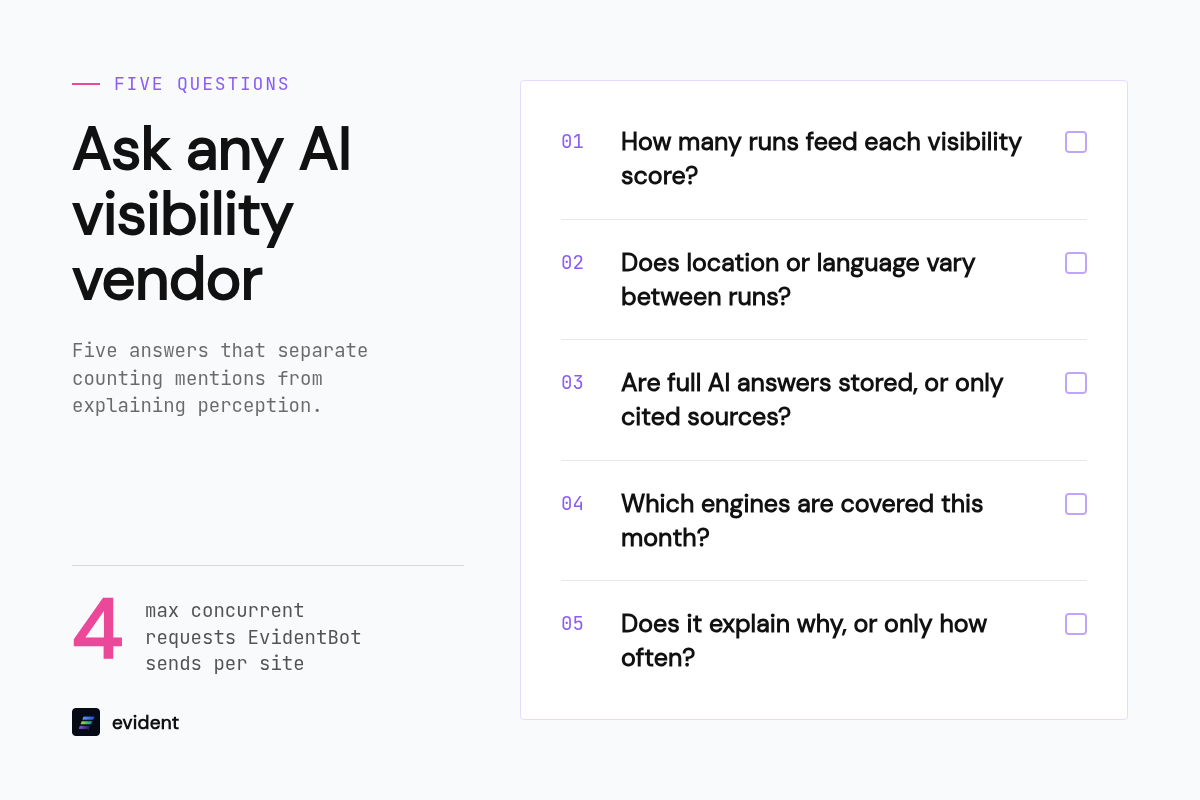
AI answers are not deterministic. The same prompt run twice can produce different brand lists, and location, language, and logged-in state shift results further. Any tracker's weekly score carries sampling noise, so look for tools that run prompts more than once per period and disclose the number of runs behind a percentage. Ask Peec AI how many runs sit behind each visibility figure at your tier.
Evident's methodology is more legible on the collection side. Its crawler, EvidentBot, identifies itself with the user agent EvidentBot/1.0, fetches at most 4 requests at a time per site, and follows robots.txt as defined in RFC 9309. The EvidentBot crawler documentation spells out how it handles 4xx and 5xx responses, which is rare transparency among visibility vendors.
Cadence is the other stability lever. Historical score tracking on Pro lets you separate a real shift from noise, and the weekly change digest email summarizes what moved. Our rule: never act on a single-week change in any AI visibility metric. Wait for two consecutive periods moving the same direction, then cross-check against Search Console impressions and review velocity before committing content or PR budget.
Which tool should an enterprise brand team, a small SEO team, or an agency choose?
Enterprise brand and PR teams usually need both engine-level answer tracking and a defensible diagnostic, so Peec AI or Profound plus Evident Business is a sensible pairing. Small SEO and content teams get the most from Peec AI's Starter tier or Evident Pro. Agencies lean toward Evident Business for white-label reports, 10 websites, and API access.
Enterprise teams need defensibility. Leadership asks why a competitor is recommended by ChatGPT, and 'our share of voice dropped four points' is not an answer. Pairing a stored-answer tracker with Evident Business, which adds Win/Loss talking points, outreach templates, Deep Research per competitor, and AI-powered competitor discovery, gives them both the evidence and the explanation.
Small SEO and content teams are usually budget constrained and content focused. Peec AI's Starter tier is the most direct fit if the goal is tracking a few dozen buyer prompts and building pages against the gaps. Evident Pro fits better if the same team also owns reviews, local presence, or site trust and needs one score to report upward.
Agencies have different math. Evident Business supports up to 10 websites, white-label reports, API access for programmatic scanning, and Field Intel from team members, which maps cleanly onto a client roster. A prompt tracker is still useful per client, but seat and prompt limits multiply quickly across ten accounts.
The audience shift is real for every team type. Pew Research reported that 34 percent of US adults had used ChatGPT by 2025, about double the 2023 share, so whichever tool you pick, the measurement needs to be in place now.
How do reporting, integrations, and competitor benchmarking turn findings into action?
Peec AI offers dashboards, prompt-level exports, and source lists that feed content teams directly. Evident offers branded PDF exports on Pro, white-label reports, Slack and email alerts, CRM webhooks for Salesforce and HubSpot, and API access on Business, plus integrations with Search Console, GA4, and review platforms. Evident also tracks up to 5 competitors per site on Pro.
Peec AI's reporting is built around the prompt table and source lists, with exports that content teams drop into briefs. Its competitor view runs rivals through the same prompt set, so you can read positioning and share of voice side by side. Sentiment per mention is part of the output; confirm the depth available at your tier.
Evident's competitor layer is more editorial. Pro delivers strategic briefs, AI Battlecards, and SWOT for up to 5 competitors per site; Business adds unlimited competitor scans, Win/Loss talking points, and outreach templates for email, LinkedIn, and cold calls. That turns a perception gap into sales enablement, not just a chart.
On integrations, Evident gets sharper as you connect first-party data. Search Console and GA4 enrich the Search Lens, Google Business Profile and review platforms enrich the Human Lens, and Semrush or Ahrefs can layer AI and Human analysis on top of SEO data you already have. The full list is on the Evident integrations page.
Alerts close the loop. Pro sends a weekly change digest email; Business adds real-time Slack and email alerts and routes work into Linear or Jira. If your team lives in Slack and your fixes live in Jira, that routing is the difference between a report and a resolved ticket.
How did we compare these options?
We compared published pricing pages, plan feature lists, and documented scope for Evident, Peec AI, Profound, Otterly.AI, and Semrush as of the writing date. Evident details come from its pricing, integrations, and crawler pages. Competitor details come from public vendor pages and may change, so confirm current limits before purchasing.
How do you get started with Evident?
Start with the free scan: one website, your EPI score across all three lenses, and your top 5 critical findings, with no credit card required. If the findings are worth acting on, upgrade to Pro at $299 per month for weekly re-scans, competitor briefs, and daily monitoring.
Run your free Evident scan and see how search engines, AI assistants, and people actually perceive your brand.
What do people also ask?
What is the actual difference between Evident and Peec AI, and which is better for tracking AI visibility by use case?
Peec AI tracks a list of buyer prompts across AI engines and reports share of voice, stored answers, and cited sources per prompt, so it is the better literal use case tracker. Evident scans your business and diagnoses why search engines, AI assistants, and people perceive it the way they do, scoring it across Search, AI, and Human lenses and ranking fixes. Pick Peec AI to measure prompts; pick Evident to explain and fix perception.
Which AI engines does each tool cover, and does either miss Claude, Gemini, or Google AI Overviews?
Peec AI publishes its engine list, which includes ChatGPT, Perplexity, Google AI Overviews and AI Mode, Gemini, and Claude, with coverage that can vary by plan. Evident's AI Lens measures how AI assistants describe your business but its pricing page does not enumerate engines, so email hello@evident.so to confirm the current sampling list before buying.
How much does each tool cost per month, and how do prompt, brand, and seat limits compare?
Evident is $0 for one website and one user, $299 per month for Pro with up to 3 websites and 3 seats (extra seats $49 each), and $799 per month for Business with up to 10 websites and 10 seats (extra seats $79 each). Peec AI's published Starter tier is 89 euros per month with prompt and brand limits that rise on higher tiers; confirm current pricing on peec.ai.
Does either tool show the specific pages AI models cite and store the full generated answers?
Peec AI does: it stores the generated answer for each tracked prompt and lists the sources the engine cited. Evident does not store per-prompt transcripts; instead it scores the factors behind your AI, search, and human perception, surfaces the top critical findings, and attaches team-routed actions, with historical score tracking on Pro.
How do Evident and Peec AI compare to alternatives like Profound, Otterly, or SEO-suite add-ons?
Profound is the enterprise answer-engine analytics option with quote-based pricing. Otterly.AI is the budget prompt monitor priced by tracked prompts. Semrush AI Toolkit adds AI visibility to an existing SEO suite as a per-domain add-on. Peec AI sits between Otterly and Profound on prompt tracking depth, while Evident is the only one of the five built primarily to diagnose perception across search, AI, and human trust rather than to count mentions.