Best Transparent AI Capability Assessment Tools: 7 Picks Compared
14 min read

Best Transparent AI Capability Assessment Tools: 7 Picks Compared
The best transparent AI capability assessment tools depend on which capability you are assessing. If you need to know how AI assistants, search engines and people evaluate your business, Evident by Scalelabs is our top pick: the Free plan shows an EPI score across three lenses plus the top 5 critical findings at $0, and Pro at $299 per month opens the full category and factor scorecard. Evident is not a model benchmarking harness and does not score the accuracy, bias or robustness of your own models. For that job, EleutherAI's lm-evaluation-harness and Stanford HELM are free, open-source and publish every prompt and raw output.
Key takeaways:
- Evident by Scalelabs scores a business across three lenses (Search, AI, Human) and shows the lens scores and top 5 findings free; the $299 per month Pro plan exposes every category and factor behind the number.
- Transparent means four verifiable things: a published rubric, retained raw evidence, reproducible runs and an audit trail of changes.
- EleutherAI's lm-evaluation-harness (MIT license) and Stanford HELM (open-source) are the most reproducible options for benchmarking models, and both cost nothing to run beyond compute.
- Credo AI is the only pick built to map assessment evidence to the EU AI Act, NIST AI RMF 1.0 and ISO/IEC 42001; the other six produce the evidence it consumes.
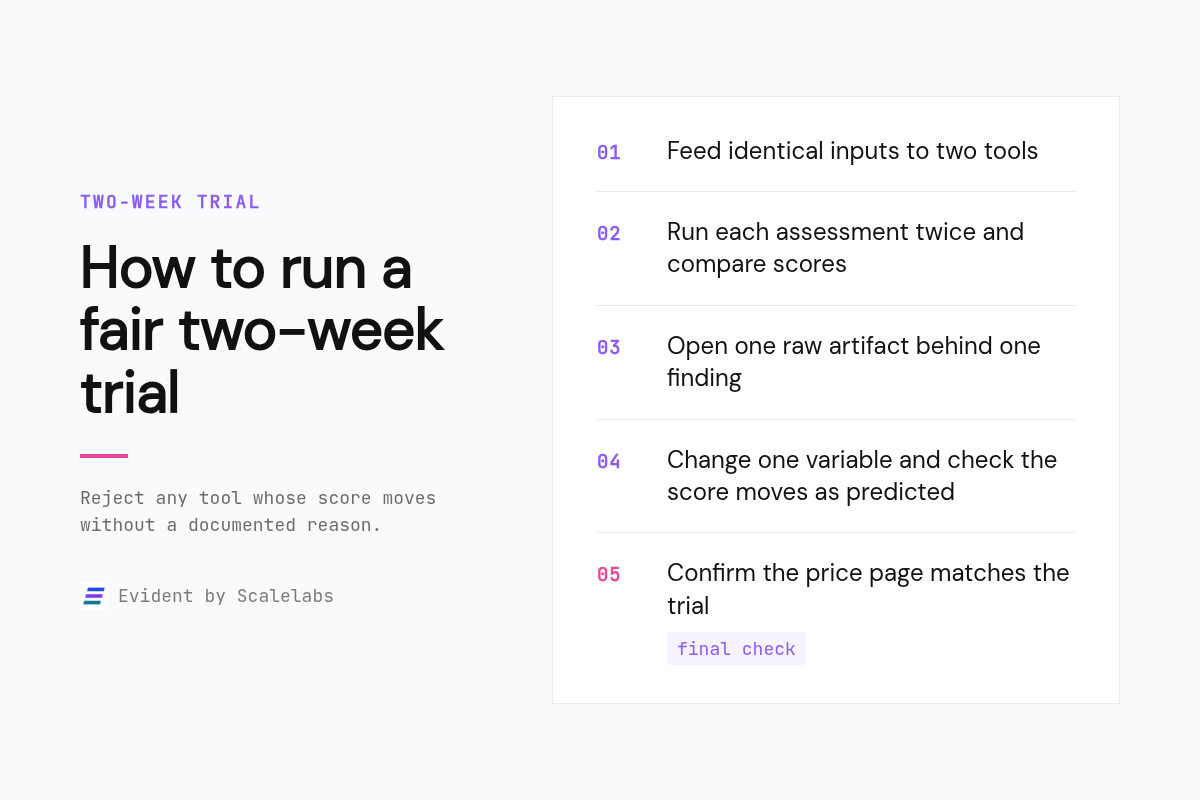
- A fair trial feeds identical inputs to two tools, re-runs each twice, and rejects any tool whose score moves without a documented reason.

What does "transparent" actually mean in an AI capability assessment tool?
A transparent assessment tool shows four things: the rubric used to produce each score, the raw evidence behind that score, a way to re-run the assessment and get the same number, and a log of what changed between runs. If any of those four hides behind a single composite number, you are trusting a black box.
This matters because most tools in the market sell a headline score. A score of 72 tells you nothing unless you can click into the factor that cost you points and see the page, prompt or response that triggered it. The NIST AI Risk Management Framework lists "accountable and transparent" as a core characteristic of trustworthy AI, and the same standard should apply to the tools that assess AI.
We apply the same test to every pick below. Open scoring rubric: can you read how points are awarded? Evidence retention: does the tool keep the raw HTML, prompt or model completion? Reproducibility: will the same input produce the same output tomorrow? Audit log: can you see who ran what and when?
One honest note on our own product. Evident publishes how its crawler behaves, retains findings per scan, and tracks score history, but the Free plan only shows lens scores and the top 5 findings. The factor-level breakdown sits on Pro and above, which we cover in the pricing section.
Which dimensions should an AI capability assessment cover?
A complete assessment covers two sets of dimensions. Model-side: accuracy, calibration, robustness to perturbed inputs, bias and fairness, toxicity and safety, explainability, and policy adherence. Business-side: how search engines rank you, what AI assistants say about you, and whether people trust what they find. Most tools cover one set well, and none cover both.
Stanford HELM is the clearest public example of the model-side list. Its leaderboards report accuracy, calibration, robustness, fairness, bias, toxicity and efficiency per scenario, and each metric is defined in the open-source codebase. That is the dimension list we recommend pasting into any vendor RFP.
The business-side list comes from a different question: not "is this model capable?" but "what has this AI system concluded about us?" Evident's three lenses answer that. The Search Lens reads index and ranking signals, the AI Lens measures how assistants represent a business, and the Human Lens pulls review and trust signals.
The European Commission's Ethics Guidelines for Trustworthy AI list seven requirements, including transparency, robustness, fairness and accountability. If a tool cannot tell you which of those seven it measures, it is not a capability assessment tool; it is a dashboard.
Which are the top 5 best transparent AI capability assessment tools?
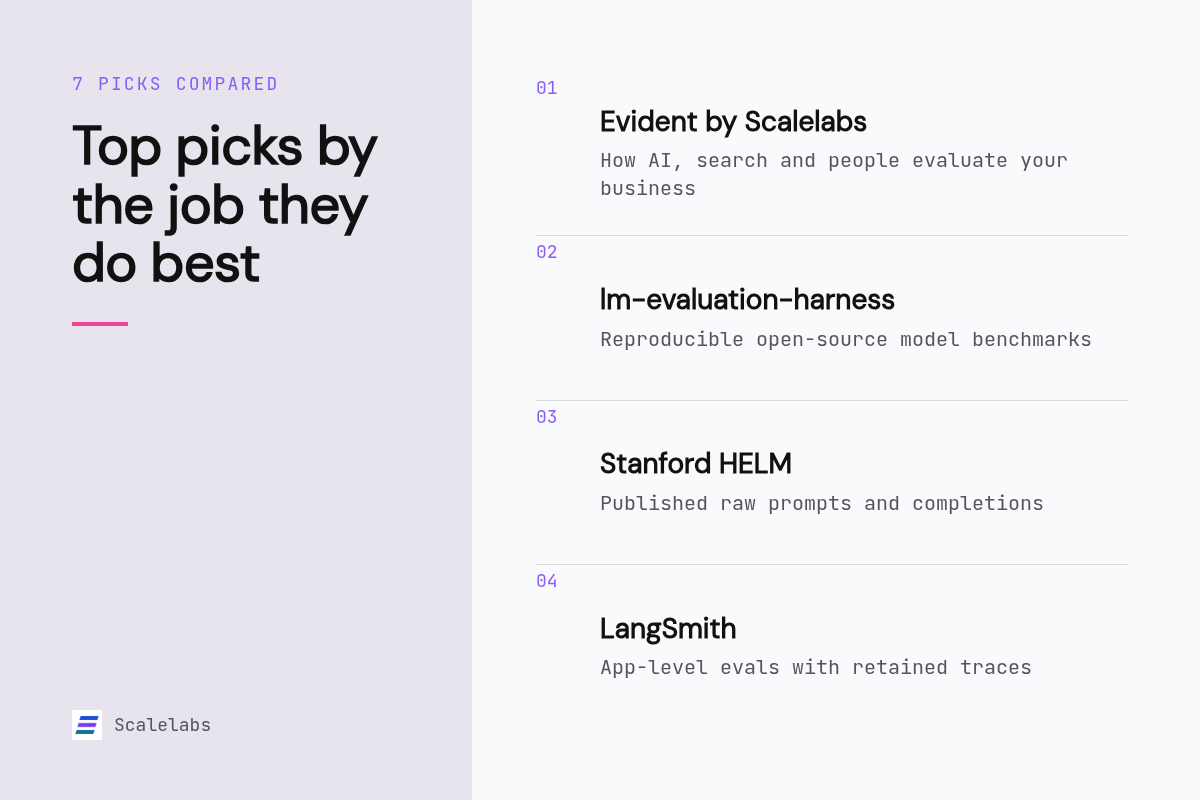
Ranked by the job each does best: Evident by Scalelabs for assessing how AI, search and people evaluate a business; lm-evaluation-harness for reproducible academic benchmarks; Stanford HELM for published raw prompts and completions; Giskard for bias and robustness test suites in regulated teams; LangSmith for application-level evals with a retained trace history and published seat pricing.
- Evident by Scalelabs
Best when you need to know what AI assistants, search engines and human visitors have already decided about your business. We built Evident at Scalelabs after years of auditing clients who had dashboards full of green checkmarks while ChatGPT recommended a competitor. Every scan returns an EPI score across the Search, AI and Human lenses, and the Pro plan at $299 per month exposes the full scorecard deep-dive, all categories and factors, with historical score tracking and branded PDF export.
Transparency evidence: our crawler identifies itself as EvidentBot/1.0, obeys robots.txt under RFC 9309 and runs at most 4 requests at a time per site, all documented on the EvidentBot crawler page. You can see the score and top 5 critical findings before paying anything. Honest limit: Evident does not benchmark your own models, and the Free plan has no exports, no monitoring and no chat.
- EleutherAI lm-evaluation-harness
Best when you need a reproducible, citable benchmark run on an open or API model. The lm-evaluation-harness is MIT licensed, covers dozens of standard academic tasks, and was the engine behind the Hugging Face Open LLM Leaderboard. Every task definition is readable code, so the rubric is the source.
Transparency evidence: pin the commit hash and few-shot config and anyone can reproduce your number. Honest limit: there is no interface, no evidence store and no audit log; you build those yourself, and scores shift with prompt formatting if versions are not pinned.
- Stanford HELM
Best when you want to inspect the raw prompts and completions behind a published score. Holistic Evaluation of Language Models from Stanford CRFM is open-source and publishes every prompt, every model completion and every metric for the models on its leaderboards. Nothing else in this list is that literal about evidence retention.
Transparency evidence: you can download the per-instance results and recompute the metric. Honest limit: running the full suite is compute heavy, the model roster follows academic priorities, and it is not designed to evaluate a private internal application.
- Giskard
Best when a regulated team needs repeatable bias, robustness and injection tests on an LLM application. The Giskard open-source library scans models for hallucination, harmful content, prompt injection, sensitive information leakage and bias, and exports the failing test cases. An enterprise hub adds collaboration and governance features on a quote-based model; confirm current packaging on the vendor site.
Transparency evidence: every detector is open code and every failing case is retained. Honest limit: the LLM scan uses an LLM as judge, so the judge model's own behavior becomes part of your score and should be pinned and disclosed.
- LangSmith
Best when you ship an LLM application and need evals tied to retained traces with pricing you can read without a sales call. LangSmith from LangChain stores datasets, runs experiments against them and keeps the full trace of each run. The vendor publishes a free Developer tier and a Plus tier at $39 per seat per month on its pricing page; confirm current limits there.
Transparency evidence: traces, inputs, outputs and evaluator scores are retained per experiment and comparable across runs. Honest limit: it is proprietary SaaS, self-hosting is enterprise-only, and LLM-graded evaluators still inherit the judge's blind spots.
How do the seven tools compare side by side?
The table below summarizes all seven picks by job, pricing model and the single limit most likely to surprise a buyer. Two are commercial with published prices, three are open-source and free beyond compute, and two sell governance or enterprise features on quote-based pricing that we could not verify from public pages.
| Option | Best for | Pricing or format | Standout limit |
|---|---|---|---|
| Evident by Scalelabs | How AI, search and people evaluate your business | Free at $0; Pro $299/mo; Business $799/mo | Does not benchmark your own models |
| lm-evaluation-harness | Reproducible academic benchmarks | Open-source, MIT, free | No UI, evidence store or audit log |
| Stanford HELM | Published raw prompts and completions | Open-source, free | Compute heavy; not for private apps |
| Giskard | Bias and robustness test suites | Open-source core; hub is quote-based | LLM judge affects scores |
| LangSmith | App-level evals with trace history | Free tier; Plus $39/seat/mo | Proprietary; self-host enterprise-only |
| Promptfoo | Red-teaming and config-as-code evals | Open-source, MIT; paid enterprise | Grader model needs pinning |
| Credo AI | Mapping evidence to EU AI Act, NIST, ISO | Quote-based | Does not run benchmarks itself |
Which two picks cover red-teaming and governance?
Promptfoo and Credo AI complete the seven. Promptfoo is an open-source, MIT-licensed command-line tool that defines evals and adversarial red-team probes as YAML and records every pass or fail. Credo AI is a governance platform that collects assessment evidence from other tools and maps it to regulatory controls. Neither competes with Evident; they answer different questions.
- Promptfoo
Best when you need to red-team prompts and model outputs with assertions a reviewer can read line by line. Promptfoo keeps its test definitions in version control, which gives you a free audit trail through git history. Honest limit: deterministic assertions are fully transparent, but any LLM-graded rubric depends on the grader model you select, and enterprise reporting features are paid.
- Credo AI
Best when an audit committee asks which control each test result satisfies. Credo AI packages policy requirements from the EU AI Act, NIST AI RMF and ISO/IEC 42001 and tracks evidence against them. Honest limit: it is a governance layer with quote-based pricing, and it relies on tools like HELM, Giskard or Promptfoo to generate the underlying measurements.
How can you verify a tool's scores instead of trusting a black box?
Verify in three moves. First, take one finding and demand the raw evidence behind it: the page, prompt or completion. Second, re-run the same input twice and compare numbers; a transparent tool either matches or explains the delta. Third, change one controlled variable and confirm the score moves in the direction the rubric predicts.
For model benchmarks, HELM makes this trivial because the per-instance outputs are downloadable. For the harness, pin the commit and config file and recompute. For Giskard and Promptfoo, open the failing test case and read the exact input that failed.
For Evident, the verification path runs through integrations. Connecting Google Search Console, GA4 or Google Business Profile lets you check external findings against your own first-party data, which is the point of the Evident integrations catalogue. If the Search Lens says impressions are falling on a page, Search Console should show the same curve.
A practical decision rule: if a vendor cannot show you one raw artifact behind one score within a demo, assume every score is unverifiable.
Why are AI visibility trackers and MLOps monitors a different category?
AI visibility trackers count how often a brand appears in ChatGPT or Perplexity answers. MLOps and observability monitors watch latency, drift and token spend in production. Capability assessment tools measure what an AI system can do, or what it has concluded, against a defined rubric. Most pages ranking for this keyword list visibility trackers and call them assessment tools.
The distinction changes what you should buy. A visibility tracker will tell you that you were mentioned 14 times last week and your competitor 40 times, but not why. An observability monitor will tell you p95 latency rose, but not whether answers got worse. Neither retains a rubric.
Evident sits between those categories on purpose. It does track AI mentions, but it scores them within the AI Lens alongside search and human trust signals, with findings routed to the team that owns the fix. We explain the origin of that design on our about page: clients kept buying tools that showed data without context.
What do these tools cost, and which features sit behind enterprise tiers?
Three picks are free beyond compute: lm-evaluation-harness, HELM and Promptfoo's open-source core. Evident and LangSmith publish prices and free tiers. Giskard's hub and Credo AI are quote-based. The features most often gated are API access, white-label or governance reporting, self-hosting and unlimited competitor or model coverage, so check those four before assuming a free tier will scale.
Evident's gating is published on the Evident pricing page. Free covers 1 site, lens scores, the top 5 critical findings, 2 competitor snapshots without briefs and one re-scan per month. Pro at $299 per month covers up to 3 websites, the full factor-level scorecard, up to 5 competitors per site with strategic briefs, daily monitoring of website, reviews and GBP, and weekly re-scans. Extra seats on Pro are $49 per seat per month up to 3 seats.
Business at $799 per month adds up to 10 websites, unlimited competitor scans, API access for programmatic scanning, white-label reports, CRM webhooks for Salesforce and HubSpot, and monitoring across all 6 channels at a 6 or 12 hour cadence. Seats are $79 per seat per month up to 10. Enterprise is custom.
Two cautions when comparing. Seat-based pricing (Evident, LangSmith) favors small teams scanning many assets; usage-based tiers favor spiky workloads. And open-source does not mean zero cost: a full HELM run on several models can consume more GPU time than a year of a commercial subscription.
Which tools map to responsible-AI principles and frameworks like the EU AI Act?
Credo AI maps directly, packaging controls from the EU AI Act, NIST AI RMF 1.0 and ISO/IEC 42001 and tracking evidence against each. HELM, the harness, Giskard and Promptfoo generate the measurements those controls require, especially for robustness, fairness and transparency obligations.
The EU AI Act places documentation, logging and transparency duties on high-risk systems, which is why evidence retention is the most important transparency criterion for regulated buyers. A benchmark score with no retained artifacts cannot be entered into a technical file.
ISO/IEC 42001 is a management system standard, so it rewards process evidence: who ran the assessment, with what rubric, and what changed. Promptfoo's git-based configs and LangSmith's experiment history are the cheapest ways to produce that trail. Evident's historical score tracking and weekly change digest on Pro serve the same function for perception signals.
How should you run a fair trial before you buy?
Pick two tools, feed both the identical inputs, run each twice, and score them on four questions: did the numbers match across runs, could you reach raw evidence in two clicks, could you explain one score to a colleague using only the tool, and did the price page match what the trial showed?
For model assessment, use the same 200-prompt dataset in both tools and the same judge model where one is required. For business assessment, scan the same domain and two named competitors, then compare the findings against Search Console and your review platforms.
Give the trial two weeks. Week one establishes a baseline; week two changes one thing, such as a page title or a prompt template, and checks whether the score moves as the rubric predicts. Evident's Free plan allows one scan per site per month, so run the baseline on Free and the follow-up on a Pro trial if you need weekly re-scans.
Write down what you expected before you look at results. A tool that surprises you with an unexplained number is giving you a reason to walk away, not a reason to dig deeper.
How did we compare these options?
We compared published pricing pages, plan feature lists and public documentation or source repositories for each of the seven tools as of the time of writing, and applied the four transparency criteria defined above: open rubric, evidence retention, reproducibility and audit trail. Where a vendor does not publish a price we said so rather than estimating.
How do you get started with Evident by Scalelabs?
Run a free scan of your own website, read the EPI score across the three lenses and review the top 5 critical findings; no credit card is required, and you can upgrade to Pro for the full factor-level scorecard when you want to operationalize.
What do people also ask?
Which AI tool is best for assessment?
It depends on what you are assessing. For how AI assistants, search engines and people evaluate a business, Evident by Scalelabs is our top pick, with a free scan and a $299 per month Pro plan. For benchmarking your own models, EleutherAI's lm-evaluation-harness and Stanford HELM are free, open-source and publish their rubrics and raw outputs.
What are the types of AI based on capabilities?
The common three-way split is narrow AI (systems built for one task, which includes every deployed model today), general AI (hypothetical systems matching human ability across tasks) and superintelligent AI (hypothetical systems exceeding it). Capability assessment tools in this list all measure narrow AI systems against defined rubrics.
Which AI lifecycle management tool is used to monitor AI models?
Lifecycle and observability monitors such as LangSmith and Arize watch production traces, latency and drift. They are a different category from capability assessment, which scores what a system can do against a rubric. LangSmith bridges both because it retains traces and runs evals on them.
What are the 7 principles of responsible AI?
The European Commission's Ethics Guidelines for Trustworthy AI list seven requirements: human agency and oversight; technical robustness and safety; privacy and data governance; transparency; diversity, non-discrimination and fairness; societal and environmental well-being; and accountability. Credo AI maps evidence to frameworks built on these; HELM, Giskard and Promptfoo generate the measurements.
How can I verify an AI assessment tool's results myself?
Demand one raw artifact behind one score, re-run the same input twice and compare numbers, then change one controlled variable and check the score moves as the rubric predicts. HELM publishes per-instance outputs for this, and Evident lets you cross-check findings against Google Search Console and GA4 through its integrations.