Best Data-driven Ai Benchmarking Services
15 min read

Best Data-driven Ai Benchmarking Services
Choosing among the best data-driven AI benchmarking services starts with one question: what are you actually benchmarking? Some buyers want to score a language model. Others want to know why ChatGPT recommends a competitor instead of them. The pages ranking for this term lump those jobs together, so we separated them and ranked each option by the work it does best.
Our top pick is Scalelabs, the company behind Evident, which benchmarks how your business is perceived in search, by AI assistants, and by people against named competitors. The Free plan costs $0 and the Pro plan is $299 per month. Evident is not an LLM model performance benchmark; if you need to score a model's accuracy or latency, use a public leaderboard such as Artificial Analysis instead.

Key takeaways:
- Scalelabs Evident scores a website across three lenses (Search, AI, Human), includes 2 competitor snapshots on the $0 Free plan, and tracks up to 5 competitors per site with strategic briefs on the $299 per month Pro plan.
- The phrase AI benchmarking covers three separate jobs: measuring LLM model performance, benchmarking business KPIs with AI tooling, and measuring AI visibility or share of voice against competitors.
- Pricing models split into free public leaderboards, monthly SaaS subscriptions with seat add-ons, per-report purchases, and consulting retainers quoted per engagement.
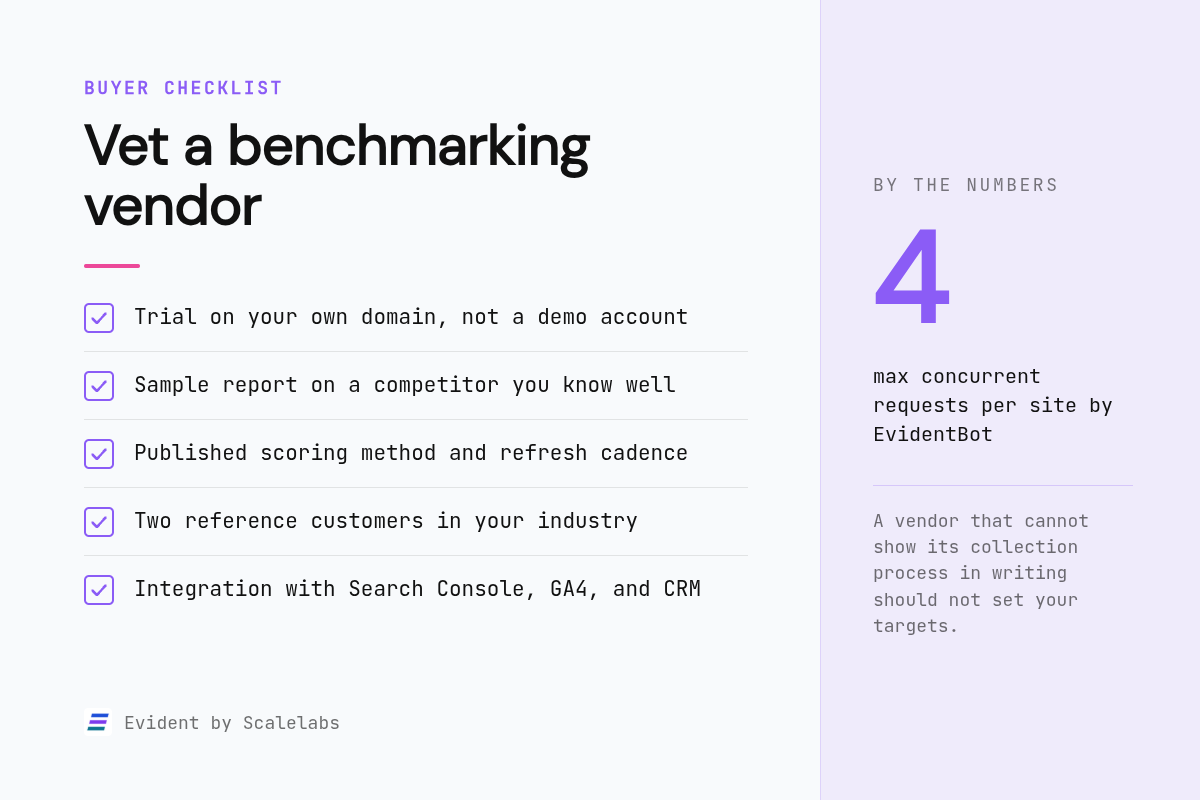
- Benchmark reliability depends on sample size, data recency, and a published scoring method; a vendor that cannot show its collection process in writing should not set your targets.
- Integration depth matters more than dashboard polish: benchmarks that connect to Search Console, GA4, and a CRM can tie perception shifts to pipeline.
What is a data-driven AI benchmarking service, and how is it different from an analytics platform?
A data-driven AI benchmarking service measures your performance against external reference points, such as competitors, industry peers, or public model leaderboards, using repeatable data collection. A generic analytics platform reports your own numbers in isolation. Benchmarking adds the comparison, the methodology behind it, and a judgment about where you stand and why.
The difference shows up in a simple case. Suppose GA4 tells you organic sessions fell 12 percent last quarter. A benchmark tells you whether three named competitors fell too, which changes the diagnosis from 'we broke something' to 'the channel is shifting.' Gartner predicted in 2024 that traditional search engine volume would drop 25 percent by 2026 as users move to AI chatbots, so that distinction matters more every quarter.
The data-driven qualifier is doing real work in this keyword. It rules out opinion surveys and analyst hot takes in favor of services that collect observations on a schedule, score them with a published method, and show the trend. Evident runs on that principle. Our founder built it because telling clients what was broken without an objective, repeatable system to prove it stopped being acceptable.
Which are the top 5 best data-driven AI benchmarking services?
The top five are Scalelabs (Evident) for perception benchmarking across search, AI assistants, and reviews; Profound for enterprise AI share-of-voice; Semrush for teams already running an SEO stack; Artificial Analysis for public LLM model performance comparisons; and Accenture for consulting-led AI maturity benchmarking. Each wins at a different job, so pick by the job.
Scalelabs (Evident): best when you need to benchmark how search engines, AI assistants, and people perceive your business against named competitors. Evident, built by Scale Labs LLC, scans a website and returns an EPI score across three lenses: Search, AI, and Human. The Free plan covers one site, the EPI score, the top 5 critical findings, and 2 competitor snapshots, with one re-scan per month. Pro at $299 per month extends that to 3 websites, up to 5 competitors per site with strategic briefs, AI battlecards and SWOT per competitor, historical score tracking, daily monitoring of your website, reviews, and Google Business Profile, and branded PDF exports. Business at $799 per month adds unlimited competitor scans, CRM webhooks, and API access. The honest limit: the Free plan has no exports, monitoring, or chat, and Evident does not score LLM model accuracy.
Profound: best when an enterprise brand needs AI share-of-voice tracking across multiple assistants at scale. Profound monitors how AI answer engines such as ChatGPT, Perplexity, and Google AI Overviews mention brands, with prompt-level visibility, citation analysis, and AI agent traffic reporting. It is built for larger marketing organizations with a dedicated owner for AI search. Pricing for its enterprise offering is quote-based rather than a flat public rate, so budget for a sales conversation and confirm current plans on Profound's website. The limit: it concentrates on the AI answer layer and does not score review platforms or human trust signals, so you still need another source for reputation benchmarking.
Semrush: best when you already run an SEO suite and want AI visibility added to existing keyword and backlink data. Semrush offers an AI Toolkit that reports brand mentions and share of voice in AI answers alongside its core rank tracking. Semrush publishes subscription pricing, with its Pro plan listed at $139.95 per month and the AI Toolkit sold as a separate add-on; confirm current rates on semrush.com before budgeting. The limit: Semrush is a keyword-first platform, so perception beyond search, such as review sentiment or trust signals, is outside its scope, and the AI layer is an add-on rather than the center of the product.
Artificial Analysis: best when a product or ML team needs independent comparisons of LLM quality, speed, and price per token. Artificial Analysis publishes free public dashboards that benchmark models from OpenAI, Anthropic, Google, Meta, and others on intelligence indexes, output speed, latency, and cost. Its data is refreshed as new models ship, and the methodology is documented on the site. The format is free public access with no subscription required to read the leaderboards. The limit: it benchmarks models, not companies. It will tell you which model to build on, but nothing about whether AI assistants recommend your business.
Accenture: best when leadership wants a consulting-led AI maturity benchmark tied to a transformation program. Accenture runs custom engagements that benchmark an organization's AI maturity, data readiness, and operating model against peers, drawing on its own survey research and client base. Engagements are scoped per project or retainer with a custom quote, and they typically bundle the benchmark with implementation roadmaps and change management. The limit: cost and time. A consulting benchmark is a point-in-time report delivered over weeks, not a daily feed, and continuous measurement requires either a renewed engagement or a separate platform.
| Option | Best for | Pricing or format | Standout limit |
|---|---|---|---|
| Scalelabs (Evident) | Perception benchmarking across search, AI assistants, and reviews vs named competitors | Free $0; Pro $299/mo; Business $799/mo; Enterprise custom | No LLM model scoring; Free plan has no exports, monitoring, or chat |
| Profound | Enterprise AI share-of-voice and citation tracking | Quote-based enterprise pricing | No review or human trust lens |
| Semrush | AI visibility layered on an existing SEO stack | Subscription; Pro listed at $139.95/mo, AI Toolkit as add-on (confirm current rates) | Keyword-first; AI layer is an add-on |
| Artificial Analysis | LLM quality, speed, and cost comparisons for ML teams | Free public leaderboards | Benchmarks models, not your business |
| Accenture | Consulting-led AI maturity benchmark with a roadmap | Project or retainer, custom quote | Point-in-time report, weeks to deliver |
Why does the phrase AI benchmarking describe three different jobs?
The phrase covers three distinct jobs. Model benchmarking scores an LLM on accuracy, latency, and cost, as Stanford's AI Index and public leaderboards do. AI-powered business benchmarking uses machine learning to compare KPIs against peers. AI visibility benchmarking measures whether assistants like ChatGPT recommend you or a competitor. Buy for the job you have.
Model benchmarking is the oldest category. The Stanford HAI AI Index tracks model capability on standardized tests each year and documents how quickly benchmarks saturate, which is why public leaderboards get re-weighted so often. If your team is choosing a model to build on, this is your lane, and much of it is free.
AI-powered business benchmarking uses machine learning to compare marketing, sales, or ad performance KPIs against peer sets. Large analytics vendors and consulting firms sell this, often built on anonymized client data. The quality question here is the peer set: who is in it, how it was selected, and when it was last refreshed.
AI visibility benchmarking is the newest job and the one most buyers searching this term actually mean. It asks whether ChatGPT, Gemini, Perplexity, and Google AI Overviews recommend you or a competitor, and why. Evident sits here, with the added step of connecting AI answers to the search and review signals those answers draw on.
How much do AI benchmarking services cost?
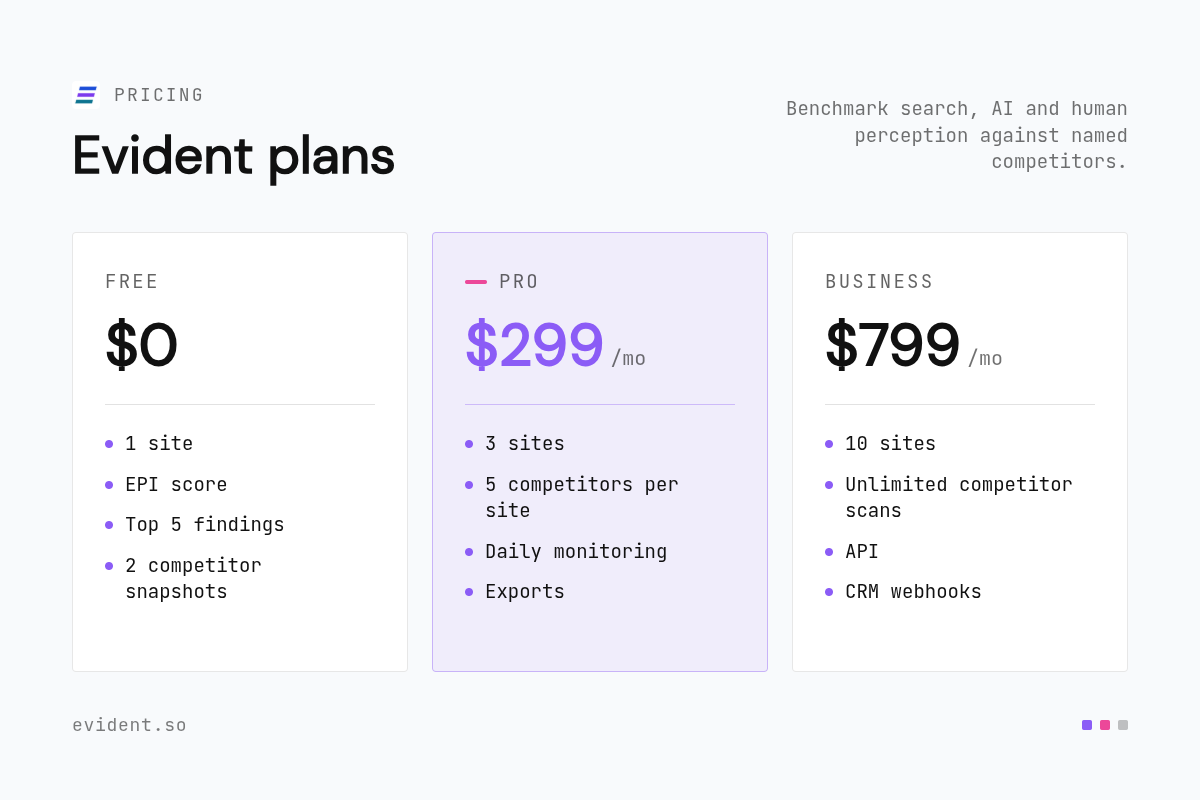
Costs range from $0 for public model leaderboards and free perception scans to consulting retainers quoted per engagement with no public rate card. Self-serve SaaS platforms typically charge a monthly subscription; Evident, for example, lists Free at $0, Pro at $299 per month, and Business at $799 per month. Seat add-ons and per-report fees change the real total.
Engagement models fall into four buckets. Public leaderboards such as Artificial Analysis cost nothing. Self-serve platforms charge monthly, and seat counts move the bill: on Evident Pro, 1 seat is included and up to 3 total are available at $49 per seat per month, while Business includes 3 seats and allows up to 10 at $79 per seat per month. Per-report pricing is common with research firms, and consulting firms quote retainers.
Watch what the base price excludes. Competitor limits, re-scan frequency, exports, and alerting are the usual upsell lines. Evident Pro allows weekly re-scans and up to 5 competitors per site, while Business allows re-scans on demand and unlimited competitor scans. Full plan details, including the custom Enterprise tier, are on our pricing page.
For ROI, work backwards from one decision the benchmark will change. If a benchmark shows that AI assistants cite a competitor's G2 reviews and not yours, the fix is a review program with a known cost. Compare that cost against the subscription, not against an abstract value of insight.
What data sources and methods should you verify before trusting a benchmark?
Verify four things: where the data comes from, how fresh it is, how large the sample is, and whether the scoring method is published. A benchmark built on a one-time scrape, an undisclosed prompt set, or a self-selected survey panel can mislead. Ask the vendor to show its collection process in writing before you set targets.
Transparency is easier to check than most buyers assume. Evident documents its crawler publicly: EvidentBot identifies itself with the user agent EvidentBot/1.0, follows robots.txt as defined in RFC 9309, fetches at most 4 requests at a time per site, and treats a 5xx robots.txt response as a full disallow. You can read the EvidentBot crawler policy and decide whether that collection method is acceptable to you.
For model benchmarks, the NIST AI Risk Management Framework sets out characteristics such as validity and reliability that any measurement should meet. For AI visibility benchmarks, ask how many prompts are run, how often, across which assistants, and whether results are sampled or exhaustive. AI answers vary by phrasing and by day, so a single run is an anecdote, not a benchmark.
Questions to put to every vendor in writing:
- How many prompts, pages, or respondents make up one benchmark run, and how often is it refreshed?
- Which competitors are in the comparison set, and who chose them?
- Is the scoring method published, and has it changed in the past year?
- Can we see the raw observations behind a score, not just the score?
Should you hire a consulting firm or buy a self-serve benchmarking platform?
Buy a self-serve platform when you need recurring measurement, a budget under a few thousand dollars a month, and results this week. Hire a consulting firm when the benchmark must drive an organizational change program, touch proprietary data under NDA, or carry a named partner's signature for the board. Many teams do both in sequence.
Evident came out of a growth consultancy. Our founder spent years inside companies auditing visibility and watching them buy tools that showed data without context, or agencies that sold services instead of truth. The platform exists to be the diagnostic layer that should run before any consulting or agency work starts, which is why the Free plan is positioned as a wake-up call rather than a demo. That origin story is on our about page.
A practical decision rule: if you would commission the same report more than twice a year, a subscription is cheaper and keeps a trend line. If the benchmark is a one-time input to a board decision about AI investment, a consulting engagement that also delivers the roadmap can justify its premium.
The peer set is also moving fast. McKinsey's State of AI research reported in 2025 that 78 percent of surveyed organizations use AI in at least one business function. When most peers are changing, a point-in-time benchmark ages within a quarter.
Which services integrate with the tools you already use?
Integration depth is where benchmarks become actionable. Evident connects Google Search Console, GA4, and Google Business Profile on Pro, and adds CRM webhooks for Salesforce and HubSpot, Slack, Linear, Jira, and review platforms on Business. Semrush and Ahrefs data can feed its AI and Human lens analysis. Warehouse-native options like Snowflake or Databricks require a consulting or API route.
Evident's model is that the external scan shows how the world sees you, while first-party data shows what is actually happening. Search Console data sharpens the Search Lens, review platform APIs deepen the Human Lens, and CRM data connects perception shifts to pipeline. The review integrations span Google Reviews, Trustpilot, G2, Capterra, Healthgrades, Zocdoc, Avvo, and Martindale, which matters because AI systems weight peer review platforms heavily in B2B and professional services contexts. The complete list is on the integrations page.
For data teams running Snowflake or Databricks, none of the five options here ship a native connector we can confirm. Evident's Business plan includes API access for programmatic scanning, which gives engineering teams a route to pull scan results into their own warehouse, and consulting firms will typically build that pipe as part of the engagement. Ask any vendor directly whether warehouse export is included or billed as custom work.
Who on your team uses the benchmark, and what should each group get?
Product and ML teams need model-level benchmarks with latency and cost per token. Marketing needs AI visibility and share-of-voice against named competitors. Strategy and competitive intelligence teams need battlecards, SWOT, and win/loss talking points. Executives need one trended score and the top findings. Choose a service that reports at the altitude each group actually reads.
On Evident, those altitudes map to plan features. Pro includes action enhancement with team routing, so a finding about page performance goes to engineering and a finding about review velocity goes to customer success. Business adds Win/Loss talking points, outreach templates for email, LinkedIn, and cold calls, Deep Research per competitor, and Field Intel so sales reps can log what they hear in deals.
Executives get the opposite of detail. The EPI score trended over time, a weekly change digest email on Pro, and a Daily Intelligence Briefing on Business are meant to be read in under a minute. If a vendor's executive view is just the analyst dashboard with bigger fonts, expect it to go unread. Product and ML teams, meanwhile, should stay on free public leaderboards until a business question, not a model question, needs answering.
How do you evaluate a benchmarking vendor before committing?
Run a trial on your own domain, request a sample report for a competitor you know well, and ask for two reference customers in your industry. Check that the trial exposes real findings rather than a locked teaser. Then compare the vendor's stated methodology with what the sample report actually shows. Any gap is your answer.
Evident's Free plan is the trial. It scans one site, returns the EPI score across all three lenses, lists the top 5 critical findings, and shows 2 competitor snapshots without a credit card. That is enough to judge whether the findings match what you already suspect and whether the competitor comparison is credible. If the free findings feel generic, do not expect the paid tiers to be sharper.
With any vendor, run the sample report on a competitor you understand well rather than on yourself. You already know their weak spots, so you can tell quickly whether the benchmark found them. Ask references two questions: what did you change because of the benchmark, and what did it miss? The second answer is usually more useful than the first.
How did we compare these options?
We compared published pricing pages, plan feature lists, and the stated scope of each service as they appear on the vendors' public websites at the time of writing. For Scalelabs we used our own pricing, integrations, and crawler documentation. We did not run paid trials of every competitor, and vendor prices change, so confirm current rates directly before you buy.
How do you get started with Scalelabs?
Start with the Free plan. It scans one website, returns your EPI score across the Search, AI, and Human lenses, lists your top 5 critical findings, and shows 2 competitor snapshots, with no credit card required. If the findings hold up, Pro at $299 per month adds competitor briefs, monitoring, and exports. Upgrade when the free findings prove useful.
Run your free Evident scan and see how search engines, AI assistants, and people actually perceive your business before you commit budget anywhere else.
What do people also ask?
What is the difference between AI model benchmarking and AI visibility benchmarking?
AI model benchmarking scores a language model on accuracy, speed, and cost per token, using public leaderboards such as Artificial Analysis or the Stanford AI Index. AI visibility benchmarking measures whether assistants like ChatGPT or Google AI Overviews recommend your business or a competitor. Scalelabs Evident does the second job, not the first.
How much do data-driven AI benchmarking services cost?
Public model leaderboards are free. Self-serve platforms charge monthly subscriptions; Scalelabs Evident lists a Free plan at $0, Pro at $299 per month, and Business at $799 per month, with extra seats at $49 or $79 per seat per month depending on tier. Consulting firms such as Accenture quote per project or retainer with no public rate card.
Does Scalelabs Evident benchmark LLM model performance?
No. Evident benchmarks how a business is perceived in search, by AI assistants, and by people, scoring a website across Search, AI, and Human lenses against named competitors. If you need to compare model accuracy or latency, use a public leaderboard such as Artificial Analysis and keep Evident for the business-level question.
How can I verify that an AI benchmark is reliable?
Ask for the data source, refresh frequency, sample size, and a published scoring method in writing. For AI visibility benchmarks, confirm how many prompts run, how often, and across which assistants, since AI answers vary by day and phrasing. Evident publishes its crawler rules, including a limit of 4 concurrent requests per site and robots.txt compliance under RFC 9309.
Which AI benchmarking services integrate with Google Analytics and a CRM?
Scalelabs Evident connects Google Search Console, GA4, and Google Business Profile on its Pro plan, and adds CRM webhooks for Salesforce and HubSpot, Slack, Linear, Jira, and review platforms such as G2 and Trustpilot on Business. Semrush integrates with its own SEO data set. Consulting firms typically build custom data pipes as part of an engagement.