Best AI Tracking Tools for Banks 2026
15 min read

Best AI Tracking Tools for Banks 2026
The best AI tracking tools for banks 2026 buyers are evaluating all do one core job: show how ChatGPT, Gemini, Perplexity and Google AI Overviews describe your products, and prove it with evidence a reviewer can check. This guide ranks five options by the job each does best, compares them in one table, and covers the bank-specific questions most roundups skip.
Our top pick is Evident, built by Scalelabs. It starts free with an EPI score across search, AI and human trust plus your top 5 critical findings, and the Pro plan at $299 per month adds daily monitoring of your website, reviews and Google Business Profile, up to 5 competitors per site, and exportable branded PDF reports. Evident is not a personal finance app, a fraud monitor or a transaction tracking system; it measures how your bank is perceived by search engines, AI assistants and people.
Key takeaways:
- Evident Pro costs $299 per month, covers up to 3 websites and 5 competitors per site with strategic briefs, and re-scans weekly; the free plan scans one site and re-scans once a month.
- "AI tracking" for a bank means AI visibility monitoring, not personal finance apps, AI call screening or fraud detection; those are different categories that rank for similar keywords.
- Compliance reviewers should favour tools that store the actual AI answer text with a timestamp and allow exports, because sampled or modelled prompt data cannot prove what a customer saw.
- Entry pricing in this category runs from Evident's free plan and Otterly.AI Lite at $29 per month up to custom enterprise quotes from Profound.
- The highest-value prompts for a bank to monitor are rate and product comparison queries such as "best high-yield savings account" and "best small business loan in [state]".

What does an AI tracking tool actually do for a bank or lender?
An AI tracking tool records how AI assistants and AI search surfaces answer questions about banking products, which brands they name, and whether the claims are accurate. For banks, Evident from Scalelabs is our top pick because it scores perception across search, AI assistants and human trust in one scan, and the first scan is free.
The reason this category exists is simple. Customers now ask an assistant "which bank has the best CD rates" before they open a tab for your website. Gartner has predicted that traditional search engine volume will drop 25 percent by 2026 as AI chatbots absorb those queries.
A tracker therefore does three things. It runs or samples prompts, it records which banks appear and what is said about them, and it reports change over time. The better tools add a fourth: they tell you why a competitor was recommended and what to fix.
We built Evident after years of running Scale Labs as a growth consultancy and watching clients invest in SEO dashboards full of green checkmarks while AI assistants recommended someone else. The gap between what a business was doing and what the world actually saw was where revenue leaked. You can read the full origin story on why we built a perception diagnostic layer.
Which types of "AI tracking" tools should banks separate before buying?
Banks should separate four categories before buying: AI visibility trackers that monitor assistant answers, AI Overview rank trackers that watch Google's AI results, traditional rank trackers that follow blue links, and unrelated products like personal finance apps or AI call screening. Only the first two show what AI tells prospective customers about your bank.
The search results for this keyword mix all four. One ranking page lists fintech visibility tools, another lists budgeting apps that use AI to categorise spending, and another covers AI Overview trackers bolted onto SEO suites. Treating them as one market leads to the wrong purchase.
A useful decision rule: if the tool cannot show you a sentence an AI assistant wrote about a named bank, it is not an AI tracking tool in the sense this guide covers. It may still be useful for SEO, but it will not answer a compliance or marketing question about AI-generated claims.
The five tools ranked below all pass that test. Evident adds a Search Lens and Human Lens beside its AI Lens, so a bank can see whether a weak AI reputation is caused by thin review signals or by a technical search problem rather than guessing.
Which are the top 5 best AI tracking tools for banks in 2026?
Our ranking by job to be done: Evident from Scalelabs for one perception score with audit-ready exports from $299 per month, Profound for enterprise multi-brand coverage, Semrush AI Toolkit for teams already on Semrush, Ahrefs Brand Radar for budget AI Overview mentions, and Otterly.AI for affordable prompt-level monitoring at a community bank.
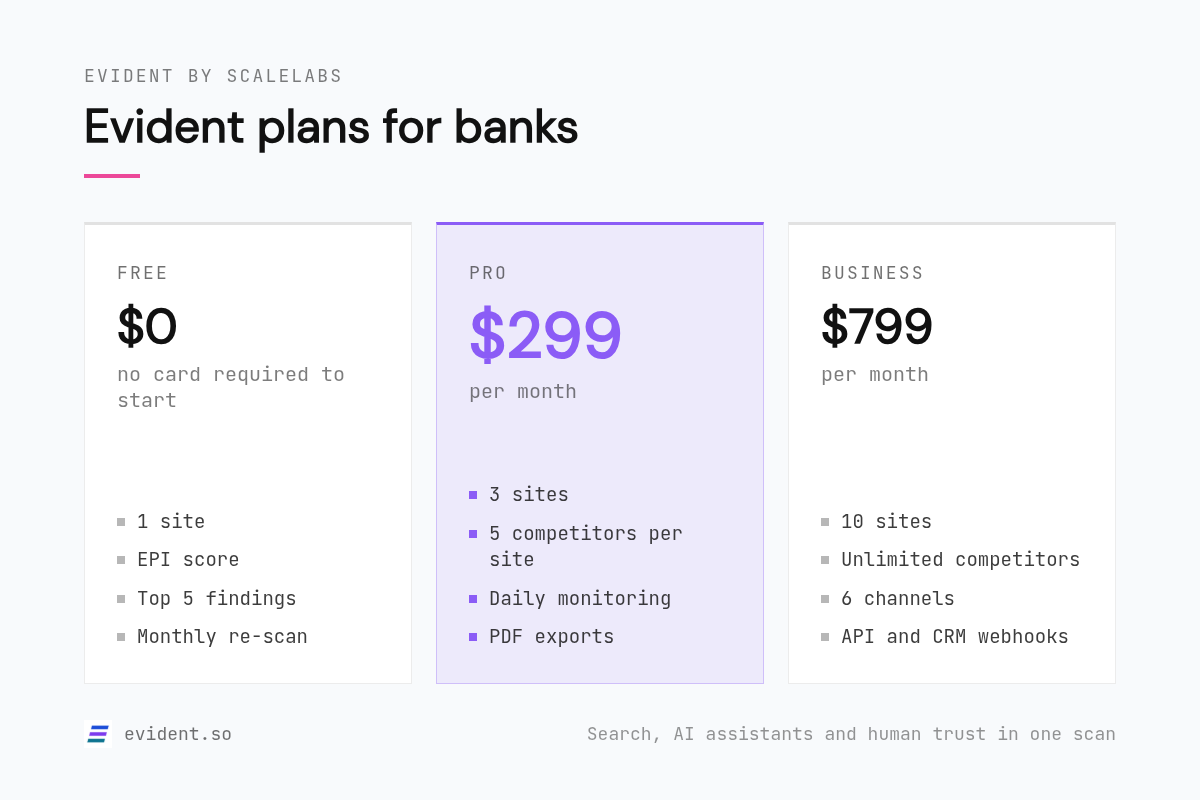
- Evident (Scalelabs): best when you need one score that joins search visibility, AI assistant perception and human trust signals, with a bank-ready audit trail and no enterprise contract. The free plan scans one site, returns an EPI score across all three lenses and your top 5 critical findings, and re-scans once a month. Pro at $299 per month covers up to 3 websites, up to 5 competitors per site with strategic briefs, AI battlecards and SWOT analysis per competitor, historical score tracking, daily monitoring of website, reviews and Google Business Profile, a weekly change digest email, and branded PDF exports.
Business at $799 per month adds up to 10 websites, unlimited competitor scans, monitoring across all 6 channels at a 6 or 12 hour cadence, real-time Slack and email alerts, CRM webhooks for Salesforce and HubSpot, white-label reports and API access for programmatic scanning. Honest limit: the free tier has no exports, no monitoring and no chat, so a compliance reviewer needs Pro or above to get a report they can file, and you should confirm the current list of AI assistants covered by the AI Lens with us during procurement.
Profound: best when a multi-brand financial group needs enterprise-grade coverage across ChatGPT, Google AI Overviews, Perplexity, Microsoft Copilot and other assistants, with large prompt volumes and AI agent traffic analytics. Pricing for enterprise deployments is quote-based; confirm current plans on the vendor's site. Honest limit: much of its prompt data is generated at scale from modelled queries, so banks must confirm which answers are stored verbatim and exportable before relying on it for marketing review.
Semrush AI Toolkit: best when your marketing team already lives in Semrush and wants AI visibility, sentiment and share-of-voice data beside existing keyword rankings. Semrush publishes the AI Toolkit as a per-domain add-on at $99 per month; confirm current pricing on semrush.com. Honest limit: it is built as a marketing analytics layer, not a compliance tool, and it does not offer a reviewer-focused evidence workflow or review platform integrations.
Ahrefs Brand Radar: best when you want the lowest-friction way to see AI Overview and assistant mentions across a very large prompt database, tied to Ahrefs backlink and keyword data you may already own. Brand Radar is sold inside Ahrefs subscriptions, which start at $129 per month on the Lite plan; confirm current plan inclusions on ahrefs.com. Honest limit: it reports on a sampled prompt corpus you cannot define, so you cannot re-run a specific "best mortgage lender in Ohio" prompt on demand.
Otterly.AI: best when a community bank wants an affordable, prompt-level monitor that stores the actual AI answer with its citations. Otterly publishes a Lite plan at $29 per month with a limited number of tracked prompts; confirm prompt limits and pricing on otterly.ai. Honest limit: it tracks only prompts you enter manually, so you still build and maintain the banking prompt set yourself, and it does not connect to reviews, CRM or Search Console data.
How do these tools compare side by side?
The table below summarises the five tools on the criteria that matter to a bank: the job each does best, published pricing or pricing model, and the single limit most likely to block adoption. Prices change often, so treat the vendor figures as a starting point and confirm them during procurement.
| Option | Best for | Pricing or format | Standout limit |
|---|---|---|---|
| Evident (Scalelabs) | One score across search, AI and human trust with audit-ready exports | Free; Pro $299/mo; Business $799/mo; Enterprise custom | Free tier has no exports or monitoring |
| Profound | Enterprise, multi-brand coverage at prompt volume | Custom quote | Modelled prompt data needs verification |
| Semrush AI Toolkit | Teams already running Semrush | $99/mo per domain add-on (confirm) | No compliance review workflow |
| Ahrefs Brand Radar | Budget AI Overview mentions beside SEO data | Inside Ahrefs plans from $129/mo Lite (confirm) | Sampled corpus, no custom re-runs |
| Otterly.AI | Prompt-level monitoring for a small bank | Lite from $29/mo (confirm) | Manual prompt set, no integrations |
Two patterns stand out. The cheapest options either sample prompts you cannot control or make you type every prompt yourself. The enterprise option gives volume but asks you to trust modelled data. Evident sits between them, with a defined scan you can re-run weekly on Pro or on demand on Business.
Which tools cover the most AI engines, and does coverage matter most?
Profound, Ahrefs Brand Radar and Otterly.AI each publish coverage across ChatGPT, Google AI Overviews, Perplexity, Gemini and Microsoft Copilot, and Semrush AI Toolkit publishes a similar list. Evident measures AI assistant perception through its AI Lens; confirm the current engine list with us. Breadth matters less than whether the engines your customers actually use are included.
Engine lists change every quarter as vendors add surfaces like Google AI Mode or Claude, so any list printed here would age quickly. Ask each vendor for a dated coverage page and keep it with your vendor file.
A practical rule for a bank: ChatGPT and Google AI Overviews account for the bulk of consumer product questions, so a tool missing either one is disqualified. Perplexity and Copilot matter more for commercial and treasury prospects who research during the workday.
Can a compliance reviewer verify the evidence these tools produce?
Yes, but only if the tool stores the actual AI answer text, timestamps it and lets you export it. Sampled or modelled data shows trends but cannot prove what a customer saw. Evident Pro exports branded PDF reports and keeps historical scores; Otterly stores answer text per prompt; Profound and Semrush need an export scope check.
This matters because AI assistants now make claims about rates, fees and eligibility. If an assistant tells a customer your savings account pays a yield you no longer offer, your compliance team wants to know, even though the claim originated outside your advertising. Regulation DD, which the CFPB publishes as 12 CFR Part 1030, governs how deposit rates and terms are disclosed, and marketing teams already review every public rate statement against it.
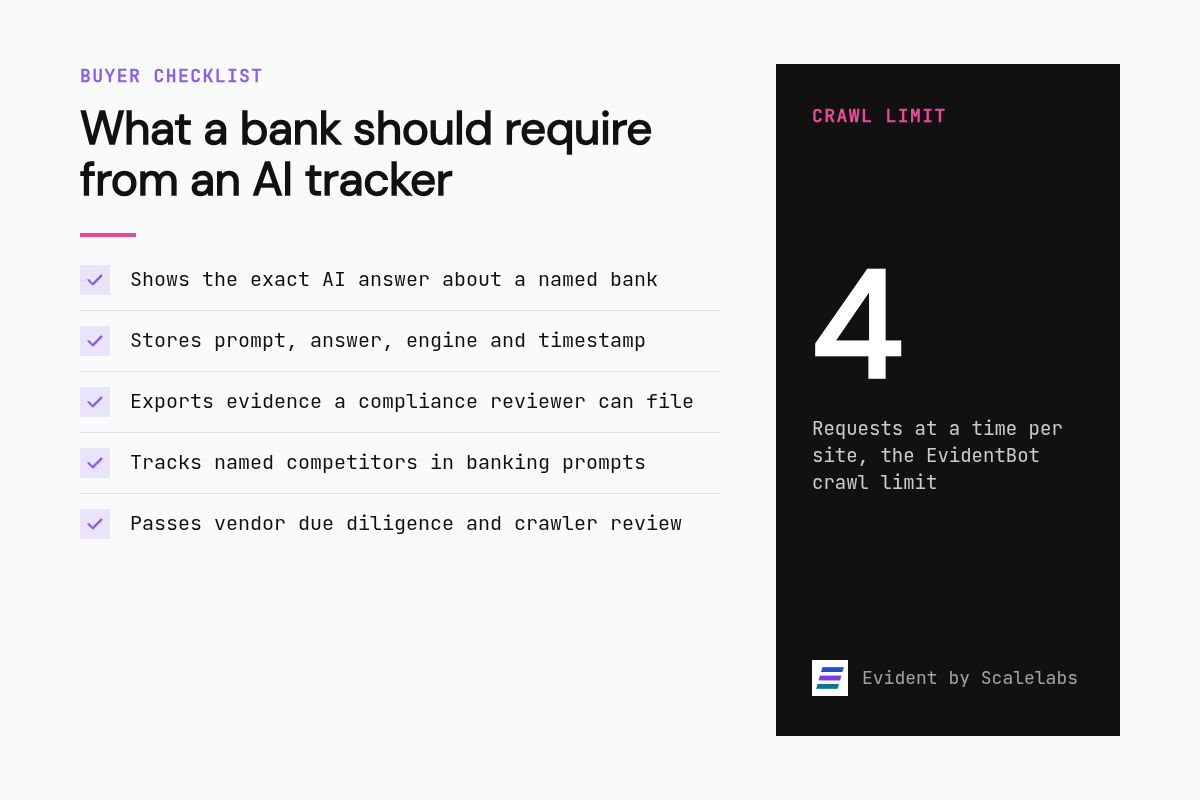
A reviewer therefore needs four things from a tracker: the exact prompt, the exact answer, the date and engine, and a way to re-run the same prompt after a correction. Build those four into your requirements document before any demo.
Evident's Business tier adds white-label reports and a Daily Intelligence Briefing, which lets an agency or a shared services team file evidence under the bank's own branding. The weekly change digest on Pro gives a smaller team a dated record of what moved and when.
How much do AI tracking tools cost banks in 2026?
In 2026 you can start at $0 with Evident's free plan, $29 per month with Otterly.AI Lite, $99 per month for the Semrush AI Toolkit add-on, or $129 per month for an Ahrefs Lite plan with Brand Radar. Full bank-ready monitoring with exports begins at Evident Pro at $299 per month, and enterprise suites are quoted.
Seat pricing is where budgets drift. Evident Pro includes 1 seat and allows up to 3 at $49 per seat per month; Business includes 3 seats and allows up to 10 at $79 per seat per month. A marketing lead, a compliance reviewer and an agency contact fit inside Pro, while a group with regional marketing teams needs Business.
The free Evident plan is deliberately limited: 1 site, 2 competitor snapshots without briefs, lens scores only, and a monthly re-scan with no exports. It answers one question well, which is whether you have a perception problem at all. Everything you need to act on that answer sits on the plans listed on our Evident pricing page with full plan comparisons.
When you model cost, add the price of the prompt set. A tool at $29 per month that requires a marketer to write, maintain and screenshot 40 prompts by hand often costs more in hours than a $299 plan that runs the scan and routes actions to the right team.
Which banking prompts should you monitor first?
Start with 20 to 40 prompts across five groups: rate comparisons, product recommendations, local and regional searches, trust and safety questions, and switching or complaint queries. Each prompt should mirror how a customer actually asks, such as "best high-yield savings account for retirees", and should be re-run on the same cadence the tool supports.
Rate comparisons come first because they carry the highest regulatory exposure. Examples: "which bank has the best CD rates right now", "best 30-year mortgage rate for first-time buyers", and "lowest APR business line of credit". Product recommendations follow: "best checking account with no fees", "best bank for a small business in Texas".
Regional prompts are where community banks win or lose. An assistant answering "best credit union in Tucson" or "best SBA lender in the Pacific Northwest" draws on local review signals and directory listings. Evident's Human Lens pulls in Google Business Profile and review platform data so you can see whether those signals support or undermine the answer.
Trust and switching prompts round out the set: "is [bank] safe", "how do I move my account from [bank]", and "[bank] complaints". Evident's competitor discovery on Business and the Persona Lab chat on Pro help you find which rivals appear in these answers instead of you, and the AI battlecards explain what those rivals are doing differently.
Should a community bank and a multi-brand financial group pick the same tool?
No. A community bank with one brand and one marketer is served by a $29 to $299 per month plan with weekly or daily checks. A multi-brand group needs unlimited competitors, API access, team routing and governance, which points to Evident Business, Evident Enterprise or Profound. Vendor risk checks apply at every size.
For a bank under a few billion in assets, Evident Pro or Otterly.AI covers the job. Pro's 3 websites fit a bank, its mortgage subsidiary and a wealth brand, and the 5 competitors per site match a typical local market. Otterly suits a bank that only wants prompt evidence and already has reporting elsewhere.
A group with 10 brands, regional teams and an agency needs the Business tier's 10 websites, CRM webhooks, Slack and email alerts, and Field Intel from team members, or an enterprise deployment. Evident's Enterprise tier is custom and built around deployment and governance, so bring your vendor management questions to that conversation.
Vendor due diligence is where most AI tracking roundups go quiet. The interagency guidance on third-party relationships that the OCC issued as Bulletin 2023-17 expects banks to assess a vendor's security practices, data handling and subcontractors in proportion to risk. Ask every vendor on this list, including us, for current SOC 2 or ISO certification status, data residency options and a sub-processor list.
One detail security teams will notice early: a tracker that crawls your site shows up in your logs. Our crawler identifies itself as EvidentBot/1.0, follows robots.txt under RFC 9309, and makes at most 4 requests at a time per site, all documented on the EvidentBot crawler policy page. Connecting first-party data is optional and scoped by plan; the Evident integrations list shows Search Console, GA4 and Google Business Profile on Pro, with CRM, Slack and review platforms on Business.
How did we compare these options?
We compared published pricing and plan pages, the scope each vendor states for engine coverage and data collection, and whether the product stores verbatim AI answers with exports a reviewer can file. Evident details come from our own plan documentation. Competitor figures come from vendor sites as published and should be confirmed before purchase, since plans change often.
How do you get started with Evident?
The fastest way to find out whether your bank has an AI perception problem is a free scan. It returns your EPI score across the Search, AI and Human lenses, your top 5 critical findings and 2 competitor snapshots, with no credit card required.
What do people also ask?
What does an AI visibility tracking tool actually do for a bank or lender?
It records how AI assistants such as ChatGPT, Gemini and Perplexity, plus Google AI Overviews, answer questions about banking products, which brands they recommend, and what claims they make about rates and fees. The tool reports change over time so marketing can fix gaps and compliance can review AI-generated statements about the bank.
Which AI tracking tools provide re-runnable, auditable evidence a compliance reviewer can verify?
Tools that store the exact prompt, the exact answer text, the engine and a timestamp, and let you export them. Evident Pro at $299 per month exports branded PDF reports and keeps historical scores, and Otterly.AI stores answer text per prompt. Tools built on sampled or modelled prompt corpora show trends but cannot prove what a specific customer saw.
How much do AI tracking tools for banks cost in 2026, and are there options under $300 per month?
Yes. Evident has a free plan, Otterly.AI Lite is published at $29 per month, the Semrush AI Toolkit add-on at $99 per month, and Ahrefs Lite with Brand Radar at $129 per month; confirm current prices on each vendor's site. Evident Pro at $299 per month is the first tier with daily monitoring, competitor briefs and exports.
How do I find out which banking prompts mention my competitors instead of my bank?
Build a prompt set of 20 to 40 queries across rate comparisons, product recommendations, regional searches, trust questions and switching queries, then run them through a tracker that names every brand in each answer. Evident Pro tracks up to 5 competitors per site with strategic briefs and AI battlecards, and the Business plan adds AI-powered competitor discovery.
What is the difference between an AI visibility tracker, an AI Overview tracker and a traditional rank tracker?
A traditional rank tracker follows your position in blue-link results. An AI Overview tracker watches whether Google's AI summary cites you. An AI visibility tracker monitors full assistant answers across ChatGPT, Gemini, Perplexity and similar engines, including what they say about you. Personal finance apps and AI call screening tools are unrelated categories despite ranking for similar keywords.