AEO AI
14 min read

AEO AI
When people search "aeo ai", they almost always mean answer engine optimization for AI assistants: the work of making your pages the source that ChatGPT, Perplexity, and Google AI Overviews quote when they answer a buyer's question. Our recommendation is to measure before you optimize, and the tool we use for that is Evident, built by Scale Labs, which scans any site for free and returns an EPI score across Search, AI, and Human lenses, with the full platform at $299 per month on Pro. Evident is a diagnostic and monitoring layer, not an agency that rewrites your content for you, and AEO in this sense has nothing to do with American Eagle Outfitters, the retailer that trades under the same ticker.

Key takeaways:
- AEO (answer engine optimization) means structuring pages so AI systems can lift a direct answer and cite the source, rather than ranking as a blue link.
- Pew Research found that Google users clicked a traditional result in 8% of visits when an AI summary appeared, compared with 15% of visits without one.
- AEO does not replace SEO: a page that is not crawlable, indexed, and tied to a recognizable entity is not eligible to be cited by any engine.
- Google Search Console does not separate AI Overview impressions and never reports ChatGPT or Perplexity citations, so AI visibility needs its own prompt-based measurement.
- Evident's Free plan scans one site, returns the top 5 critical findings and 2 competitor snapshots, and re-scans once a month; Pro at $299/mo adds weekly re-scans, daily monitoring, and 5 competitors with strategic briefs.
What is AEO in the context of AI search, and how does it work?
Answer engine optimization (AEO) is the practice of structuring content so that AI assistants and AI-powered search features can extract a direct answer and credit your page as the source. It works by matching the retrieval and summarization behavior of these systems: clear questions, concise answers, crawlable pages, and consistent brand signals across the web.
An answer engine is any system that replies with a synthesized answer instead of a list of links. The term predates large language models: featured snippets and voice assistants were the original answer engines. The AI half of the phrase is what changed. Today the answer is generated, the sources are chosen at retrieval time, and the citation is the only visible trace of your page.
The practice has gone global quickly. Chinese-language searches for "AEO 是什麼" (what is AEO) now sit alongside English queries on the same results page, and guides in both languages describe the same loop: a user asks, the engine retrieves a handful of pages, summarizes them, and names the ones it leaned on.
We came to this problem from inside client companies. Scale Labs is a growth consultancy, and Evident grew out of audits where a business had a dashboard full of green SEO checkmarks and still could not explain why AI assistants recommended a competitor. You can read that origin on the Evident about page. Tools measured performance, nobody measured perception, and LLMs made the gap bigger.
Which AI platforms does AEO actually target?
AEO targets six platforms in practice: ChatGPT, Perplexity, Google AI Overviews and AI Mode, Gemini, Claude, and Microsoft Copilot. Each one retrieves from a different index and cites in a different format, so a page can be quoted constantly in Perplexity and never appear in AI Overviews. Priority should follow where your buyers actually ask questions.
The platforms do not behave alike. ChatGPT searches through a Bing-backed browsing layer, so a page missing from Bing's index is invisible to it. Perplexity runs its own crawler and shows numbered citations on every answer. Google AI Overviews and AI Mode draw from Google's index, Gemini grounds answers in Google Search, Copilot sits on Bing, and Claude uses a web search tool when enabled.
A simple decision rule helps with priority. If you sell B2B software, start with ChatGPT and Perplexity, because buyers use them for vendor shortlists, and pay attention to G2 and Capterra signals that AI systems weight heavily in that context. If you run a local or regulated service, start with AI Overviews and Gemini, which lean on Google Business Profile data and directory listings.
Is AEO legit, or is it just SEO with a new name?
AEO is legitimate as a practice, but much of what is sold under the label is repackaged SEO. The behavior change is real: Pew Research measured lower click rates when Google shows an AI summary, and Gartner projected a 25 percent drop in traditional search volume by 2026. The tactics overlap heavily with good technical and content SEO.
The evidence for the behavior change is public. Pew Research Center's 2025 analysis of browsing data found that users who saw an AI summary clicked a traditional result in 8% of visits, versus 15% when no summary appeared. Gartner predicted in 2024 that traditional search engine volume would fall 25% by 2026 as chatbots absorb queries.
What is thin is ROI data. No vendor we reviewed publishes audited before-and-after citation rates across a client base, and we are not going to invent one. The honest position is that AEO is a real shift in where answers come from, delivered mostly through tactics that good SEO teams already know, plus a measurement layer that SEO tools do not have.
That leads to a buying rule. If an agency pitches AEO services, ask for the prompt set it will track, the engines it will sample, and the citation share it measured before the engagement. If it cannot produce those three things, you are buying rebranded SEO.
One more clarification, because the acronym causes confusion. AEO is also the stock ticker for American Eagle Outfitters, which is why "Does Eagle use AI?" appears under this search. That question is about a clothing retailer and has nothing to do with answer engines.
How is AEO different from SEO and GEO?
SEO earns a ranked position in a list of links. AEO earns a quoted passage and a citation inside a generated answer. GEO, generative engine optimization, covers the same goal with more emphasis on brand mentions that appear without a link. Most vendors treat AEO and GEO as one practice because the retrieval systems and tactics are nearly identical.
| Dimension | SEO | AEO | GEO |
|---|---|---|---|
| Goal | Ranked link on a results page | Quoted passage plus citation in an AI answer | Brand presence in generated answers, with or without a link |
| Primary unit | Keyword and URL | Question and answer passage | Entity and brand mention |
| Core signals | Links, relevance, technical health | Crawlability, direct answers, structured data, entity authority | Third-party mentions, reviews, consistency across sources |
| Measurement | Rankings and clicks in Search Console | Citation share across a prompt set | Mention share and sentiment across a prompt set |
What carries over from SEO is substantial. Crawlability, indexing, site speed, internal linking, and backlinks still decide whether a page can be retrieved at all, and Google's documentation states that its AI features rely on the same core systems as regular results. What changes is the unit of competition: a passage, not a page, and a citation, not a click.
Do you need both? Yes. AI Overviews cite pages that already rank, so dropping SEO removes you from the candidate pool. The practical split we use is SEO for eligibility and AEO for selection.
Why do ChatGPT, Perplexity, and Google AI Overviews cite different sources?
They differ because each engine retrieves from a different index and applies different selection rules. ChatGPT's browsing is Bing-backed, so Bing indexing matters. Perplexity crawls the web itself and favors recent, directly quotable pages. Google AI Overviews pull from Google's index and lean on pages already ranking well, which keeps traditional SEO relevant.
Tactically this means three checks rather than one. For ChatGPT and Copilot, confirm your key pages are indexed in Bing Webmaster Tools and that robots.txt allows OAI-SearchBot and Bingbot. For Perplexity, allow PerplexityBot and keep dates visible, since it rewards recency. For AI Overviews, keep doing the things that earn top-ten rankings, because Google's documentation on AI features says no special markup is required and standard indexing applies.
Gemini and Claude add fewer variables. Gemini inherits Google's grounding, so AI Overview work carries over. Claude's web search is newer and less predictable in citation format, so we treat it as a secondary engine to sample rather than a primary target.
Engines also disagree on how many sources they show. Perplexity routinely lists five or more, AI Overviews show a handful of link cards, and ChatGPT may name two or three. Being one of eight Perplexity citations is a different outcome from being one of two ChatGPT citations, and your measurement should record the count.
How do AI systems decide which pages to cite?
AI systems cite pages they can fetch, parse, and trust. Fetching depends on robots.txt and server response. Parsing depends on clean HTML, headings that match the question, and a direct answer near the top. Trust depends on entity signals: consistent brand name, third-party mentions, reviews, and structured data that confirms who you are.
Fetching is the step most teams skip. Every well-behaved crawler, including our own EvidentBot crawler, follows robots.txt as defined in RFC 9309. The detail that bites: if robots.txt returns a 5xx error or does not answer, EvidentBot treats the whole site as disallowed and fetches nothing, and other RFC-compliant crawlers behave the same way. A broken robots.txt can erase you from AI answers overnight.
Parsing rewards pages that read like answers. A heading phrased as the question, a direct answer in the first paragraph beneath it, and supporting detail after that is the pattern that survives summarization. Long introductions, answers split across tabs, and content loaded only by JavaScript all reduce the chance a passage gets extracted.
Trust is the entity layer. AI systems cross-reference what your site says against what Wikidata, review platforms, directories, and news sources say. Evident checks this through three lenses: Search Lens for how search engines see you, AI Lens for how AI assistants perceive you, and Human Lens for reviews and trust signals. Inconsistencies between lenses are usually where a citation is lost.
What on-page changes make a page quotable by AI?
The highest-leverage changes are question-phrased headings, a 40 to 60 word direct answer under each heading, an FAQ block with FAQPage schema, visible dates for freshness, and named sources for claims. Pages should state the entity clearly in the first paragraph and avoid burying the answer below a long introduction.
Here is a before-and-after we use when training teams. Before: "In today's fast-paced digital landscape, businesses of all sizes are discovering the importance of understanding how artificial intelligence is reshaping search, and in this comprehensive guide we will explore everything you need to know about staying ahead." After: "Answer engine optimization (AEO) is the practice of structuring pages so AI assistants can extract a direct answer and cite the source. It differs from SEO in three ways." The second version names the entity, answers the question, and signals what comes next in under 40 words.
The implementation checklist we run on a page:
- Rewrite the H1 and H2s as the questions buyers actually type into ChatGPT.
- Place a 40 to 60 word answer directly under each H2, with no links inside it.
- Add an FAQ block with 4 to 6 questions and FAQPage schema.
- Add Organization or Product schema using the same name that appears on review sites.
- Show a visible last-updated date and refresh anything older than 12 months.
- Cite at least two named external sources for factual claims.
- Confirm the page is indexed in both Google and Bing and allowed in robots.txt.
Each item is checkable in under five minutes, which is the point. AEO fails most often not from lack of theory but from pages that were never audited against a list.
Can Google Search Console measure AI search visibility, and what works instead?
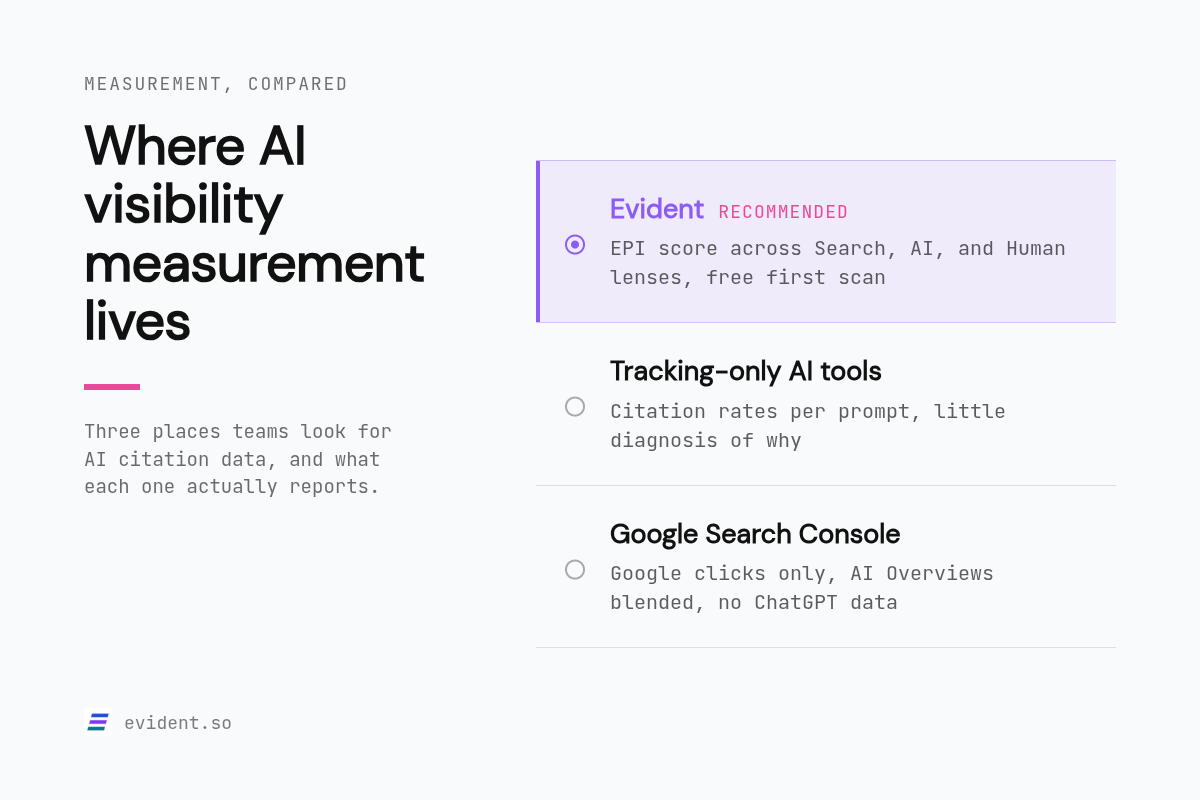
No. Google Search Console reports impressions and clicks from Google results, and AI Overview appearances are blended into those numbers with no separate filter, while ChatGPT and Perplexity never appear at all. Measurement requires a fixed prompt set, repeated runs per engine, and a citation share calculation you can track monthly.
GA4 is only slightly better. It can show referral sessions from chatgpt.com or perplexity.ai, but that counts clicks, and most AI citations are read without a click. A brand can be cited in half of relevant answers and show almost nothing in GA4.
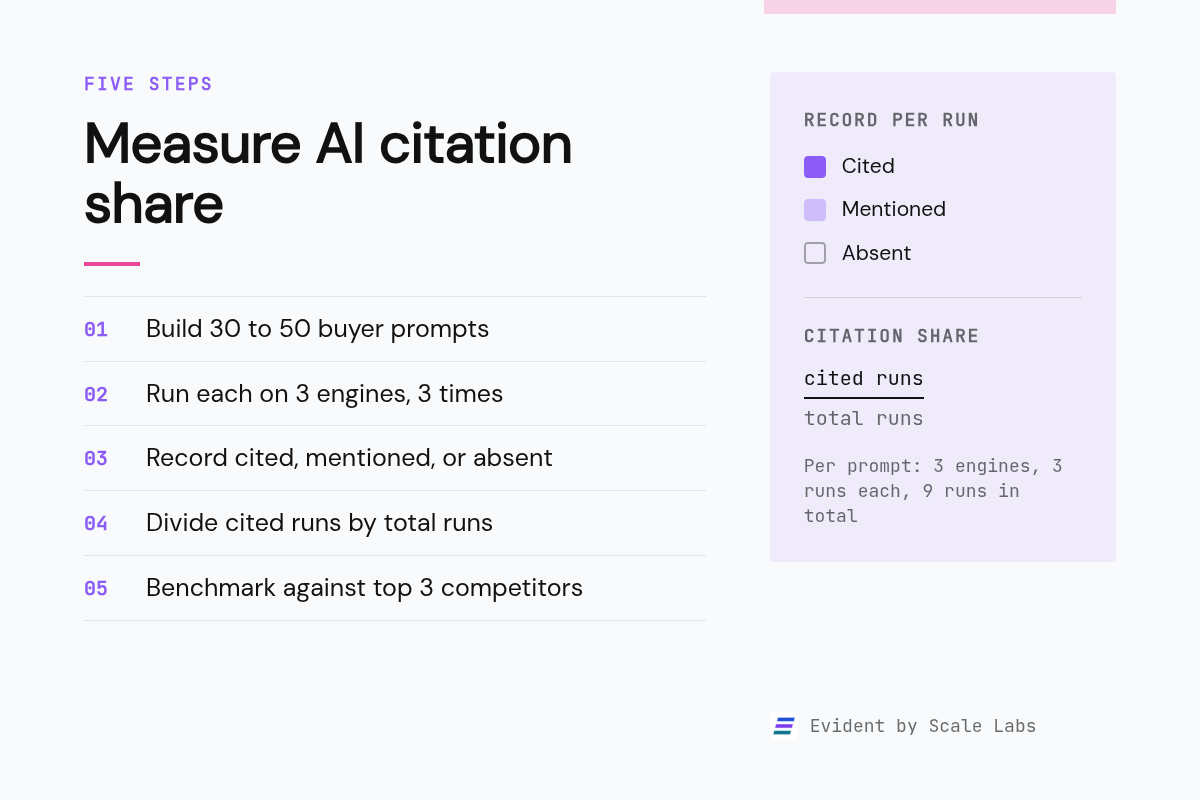
The method we recommend has four steps. First, build a prompt set of 30 to 50 questions your buyers ask, split across awareness, comparison, and purchase stages. Second, run each prompt on three engines, three times each, because generated answers vary between runs. Third, record for every run whether your brand was cited with a link, mentioned without a link, or absent, and how many total sources appeared. Fourth, calculate citation share as cited runs divided by total runs, and mention share the same way.
On benchmarks, we will not give you an industry average because none we have seen is sampled well enough to trust. Set targets relative to competitors instead: measure your top three named rivals on the same prompt set, and aim to close the gap with the leader within one quarter. Evident's Free plan gives you a first baseline with an EPI score and 2 competitor snapshots, and connecting Search Console, GA4, and Bing Webmaster Tools through Evident's integrations ties perception findings to real traffic so you can see whether citation gains convert.
Should you buy an AEO platform, and what must it track?
Buy one only if it tracks three things: whether your brand is cited or mentioned for a defined prompt set, how that compares with competitors, and which page-level and reputation signals explain the gap. Tracking-only tools report the number. Evident pairs its AI Lens measurement with findings and competitor briefs so a team knows what to change.
The market splits into two groups. Tracking platforms such as Profound, Peec AI, and Otterly.AI run prompt sets across engines and report citation and mention rates; Semrush and Ahrefs have added AI visibility reports on top of their SEO data. All of them price on subscription tiers that scale with prompts or seats, and we suggest confirming current pricing on each vendor's site because plans change frequently.
Evident sits in the diagnostic layer. The Free plan is $0: one site, an EPI score across all three lenses, the top 5 critical findings, 2 competitor snapshots, and one re-scan per month. Pro is $299 per month for up to 3 websites, the full scorecard, cross-lens pattern detection, 5 competitors per site with strategic briefs, AI battlecards, daily monitoring of website, reviews, and Google Business Profile, and weekly re-scans. Business is $799 per month with up to 10 websites, unlimited competitor scans, on-demand re-scans, and API access. The full breakdown is on the Evident pricing page.
When should you hire an agency instead? Hire one when you lack the writers to rewrite pages at volume or the capacity to earn third-party mentions. Keep measurement in a tool you control either way, so the agency reports against a baseline it did not set.
How did we put this guide together?
We compared Evident's published pricing and plan pages, the EvidentBot crawler documentation, Google's public documentation on AI features, RFC 9309 on robots.txt, and research from Pew Research Center and Gartner. For competing tools we reviewed public product descriptions only. We ran no proprietary citation study for this post, and every number about Evident comes from its published plan pages.
How do you get started with Evident?
The fastest path is to run the free scan. It takes minutes, needs no credit card, and shows your EPI score across Search, AI, and Human lenses plus the top 5 findings holding you back in AI answers. Start your free Evident scan and use the result as the baseline for every AEO change you make next.
What do people also ask?
Is AEO legit?
Yes as a practice, with caveats. Pew Research measured Google users clicking a traditional result in 8% of visits when an AI summary appeared versus 15% without one, so the shift in behavior is real. Much of what is sold as AEO is repackaged SEO, so ask any vendor for its prompt set, the engines it samples, and a baseline citation share before you sign.
Is AI used in SEO?
Yes, on both sides. Search engines use AI systems in ranking and in generating AI Overviews, and SEO teams use AI for keyword research, drafting, and audits. AEO is different: it is optimizing to be cited by AI answers, not using AI to do SEO work.
Does Eagle use AI?
That question refers to American Eagle Outfitters, the retailer whose stock ticker is AEO. It is unrelated to answer engine optimization. For the company's own statements on technology, check its investor relations materials rather than AEO marketing guides.
What is an AEO platform?
An AEO platform is software that runs a defined set of buyer prompts across engines such as ChatGPT, Perplexity, and Google AI Overviews, records whether your brand is cited or mentioned, compares you with competitors, and ideally explains which signals cause the gap. Evident offers a Free plan at $0 with an EPI score, top 5 findings, and 2 competitor snapshots, and Pro at $299 per month with 5 competitors per site and weekly re-scans.
Can I track AI search visibility in Google Search Console or GA4?
Not reliably. Search Console blends AI Overview impressions into overall Google performance with no separate filter and shows nothing from ChatGPT or Perplexity. GA4 can show referral clicks from chatgpt.com or perplexity.ai, but most citations are read without a click. You need a prompt-based measurement of citation share instead.